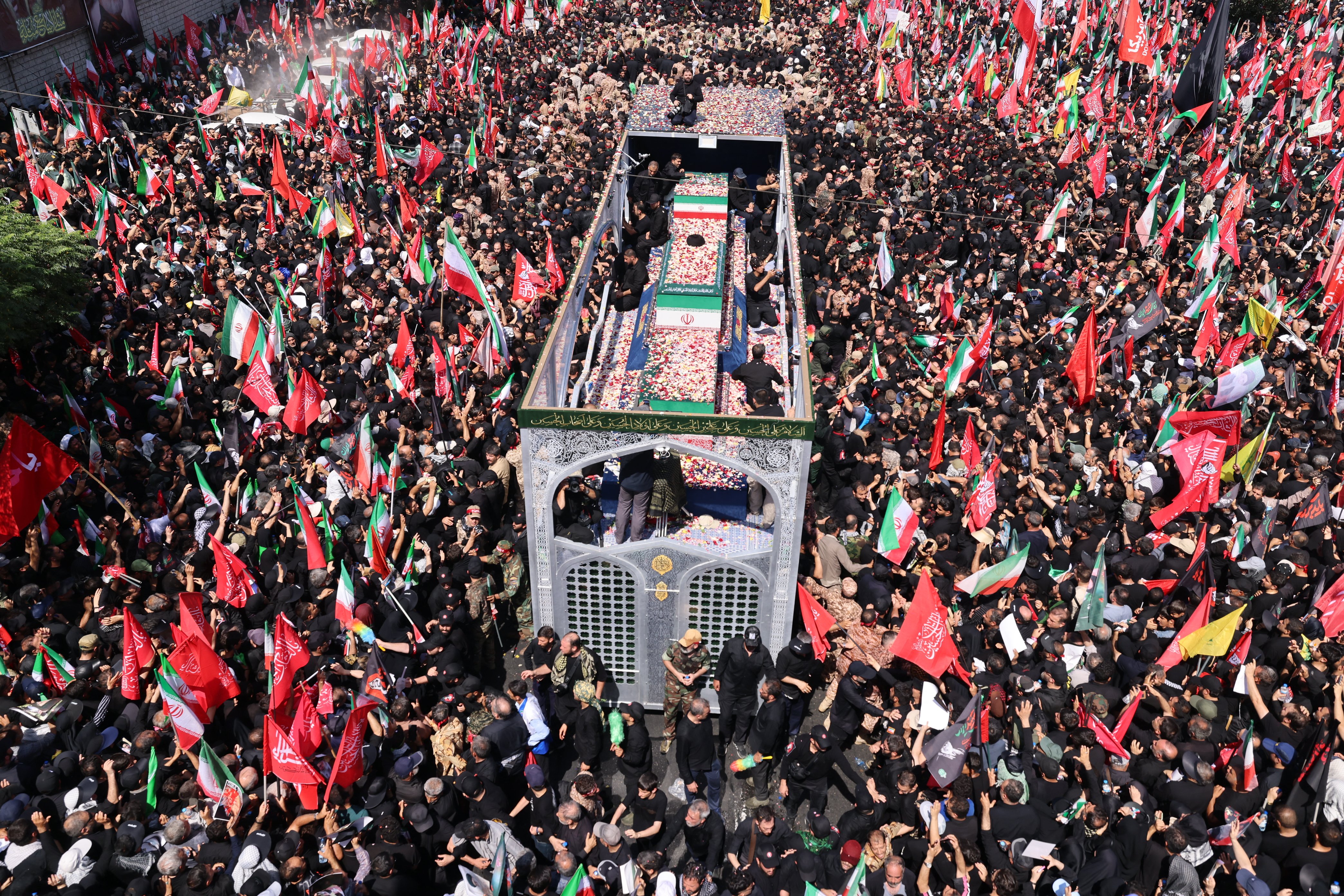

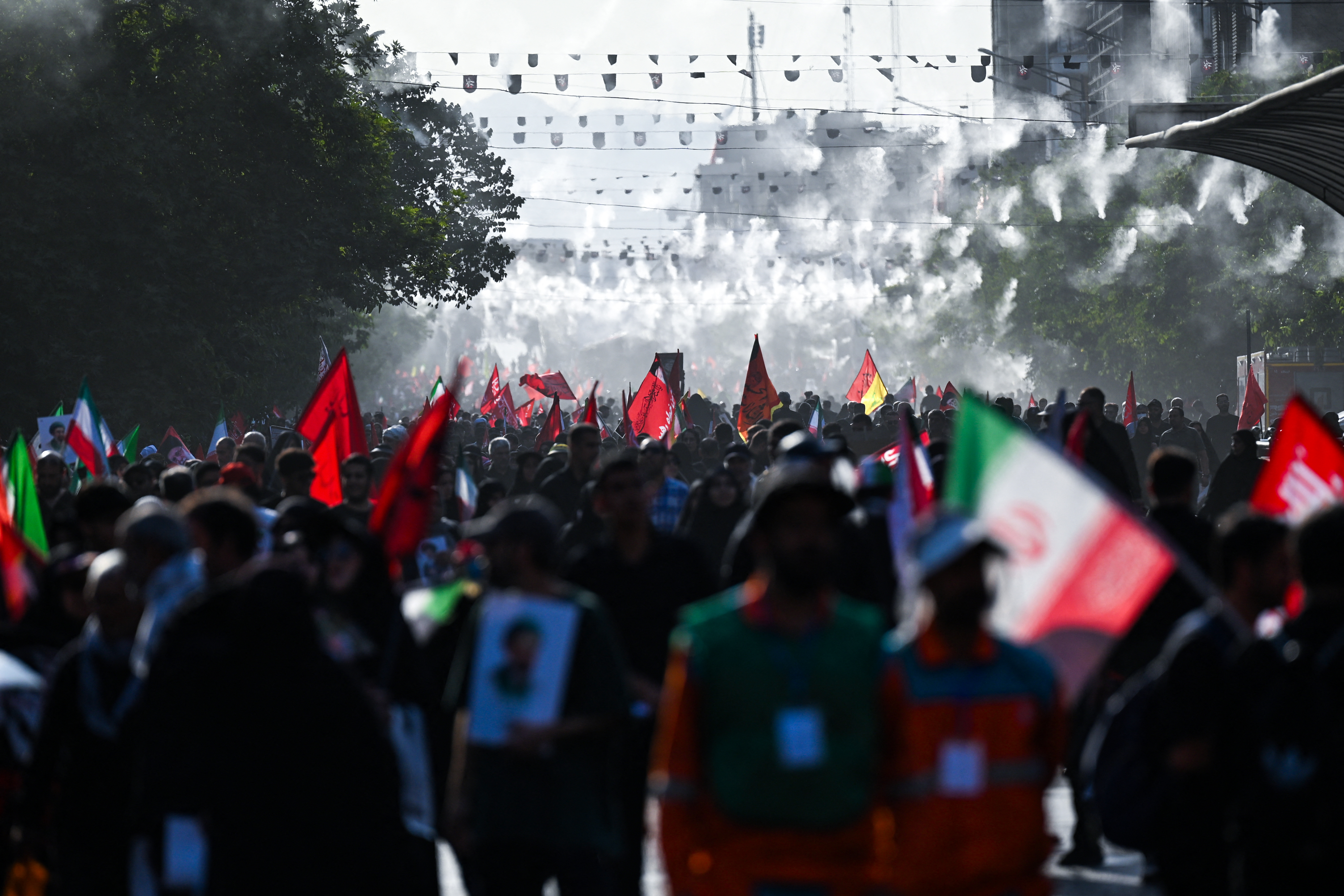
TEHRAN – The fire hoses came first. Spraying arcs of water from trucks overhead, they fought to cool the dense press of bodies that had packed into Tehran’s central boulevards since before dawn on Monday, as the coffins of Ayatollah Ali Khamenei and four family members began their slow final passage through the capital he had governed for thirty-six years.
Millions lined the 10-kilometer route from Imam Hossein Square to Azadi – Freedom Square – as state television broadcast drone footage of a sea of black that stretched as far as the cameras could resolve. The crowd appeared larger than the 2020 funeral for Qassem Soleimani, which drew over one million people to these same streets, and authorities had positioned soldiers and medics in anticipation of the surges that killed dozens at Khomeini’s burial in 1989.
What made Monday different from every other mass mourning in Iran’s revolutionary history was what the crowd carried. Red flags – the color of revenge in Shia symbolism – were draped from shoulders and waved overhead. Women in black chadors held placards printed with a single phrase in red: “#KILL TRUMP.” Along Imam Hossein Square, an effigy of the U.S. president was hanged from a rope. Other placards showed Vice President JD Vance, Defense Secretary Pete Hegseth, and Israeli Prime Minister Benjamin Netanyahu bearing the words: “There will be blood.”
This was not grief performing itself for a state audience. The displays were organized and printed – but the woman who told reporters “We are here for revenge, not to say goodbye” was not reading from a script. Fatima Hassan, one of hundreds of thousands who had traveled to Tehran from across the country, said the procession was a declaration: “We are here to show that his path will continue, and every single one of these people will continue down his path with clenched fists.”
Khamenei was killed on February 28 in a joint U.S.-Israeli airstrike on his office complex in Tehran. Four family members died alongside him. The strikes opened the conflict that drew world leaders from a hundred countries to Tehran to signal alignment with Iran, and transformed Khamenei overnight into a martyr whose death unified grievances that would otherwise have pulled in separate directions. Iran’s army chief Major General Amir Hatami was unambiguous at the ceremony: “Those who committed this crime must know that the nation of Iran and all of us will never cease in our pursuit of and demand for justice.”
The procession itself was designed to be unmissable. Khamenei’s flag-draped coffin, alongside those of his family members, was placed on a truck decorated to resemble the ornamental grating that surrounds a Shia imam’s shrine – a deliberate conflation of martyrdom and sanctity that had not appeared at any state funeral in living memory. From Tehran, as Al Jazeera reported, the coffins would travel onward to Qom on Tuesday, to the holy cities of Najaf and Karbala in Iraq on Wednesday, before arriving in Mashhad for burial on Thursday.
There was one figure who did not appear. Mojtaba Khamenei, who was named Iran’s new supreme leader after his father’s assassination, has not been seen publicly since taking the role in March. Officials have said he sustained injuries in the February airstrikes, but the severity has not been disclosed. Three of Khamenei’s other sons appeared at the procession on Monday; Mojtaba was absent from the ceremony that put his father’s legacy on display for the world. The question of Iran’s military leadership in the interregnum had already attracted scrutiny when an Interpol-wanted general reappeared beside Khamenei’s casket just days before. Scholar Arash Azizi, who studies Iran’s political structure, said the regime was attempting “to give an image of resilience and continuity” – but continuity requires a visible leader, and on Monday, that leader was nowhere to be seen.
In Washington, President Trump said the United States would win the Iran war “one way or the other.” He did not address the funeral. Since Khamenei’s assassination, Iran’s nuclear talks have been suspended and are scheduled to resume on July 9 – the day of Khamenei’s burial in Mashhad – with the Strait of Hormuz, IAEA inspection access, and $6 billion in frozen Iranian funds still unresolved. The man who will make those decisions for Iran has not shown his face in nearly five months.
Not everyone in the crowd on Monday shared the regime’s framing of the day. A 32-year-old woman who gave her name only as Mona told a reporter she questioned the scale of the ceremony: “Why should we spend so much on the mourning ceremony of the leader who ordered the killing of thousands?” Her voice was audible but swallowed quickly by the crowd around her.
The marchers who had come to Tehran from every province were not thinking about that question. By dusk, the coffins had passed Azadi Square and begun the journey to Mehrabad International Airport, where a plane would carry them to Qom. The fire hoses were still running.