
DUBAI – For nearly five months, one of the most powerful men in Iran was little more than a rumor. Gen. Ahmad Vahidi, commander of the Islamic Revolutionary Guard Corps, had not been seen in public since February 8, days before Israeli warplanes began the war that would kill the country’s supreme leader. On Thursday night he was suddenly present again, seated beside Ali Khamenei’s flag-draped casket at a subdued service near the dead leader’s former home in downtown Tehran.
The photographs, released by Iranian state media, are the clearest indication yet of where real authority sits in a country about to bury the man who directed it for more than three decades. Beginning Saturday, Iran will stage a funeral spread across six days and five cities. It will not answer the question shadowing every image of the mourning: with the new supreme leader unseen and reportedly wounded, who is actually deciding how this war ends.
The formal answer is Ayatollah Mojtaba Khamenei, the slain leader’s son, who inherited his father’s title in March. He has scarcely appeared since. American officials say he was hurt in the same February 28 strike that killed the elder Khamenei and that he has not recovered, and Iran has refused to confirm or deny it. The silence has only deepened the sense of a leadership operating from the shadows.
That opacity is not incidental. Iran’s system was built around a single supreme leader whose word settled disputes among rival power centers. With that figure gone and his heir out of sight, the arbiter is missing, and the institutions he once balanced, the Guard, the clergy, the elected government, are left to sort out precedence among themselves. Into that space has moved a compact circle of hardliners, and Vahidi has surfaced at its center.
He is, the Associated Press reported, believed to be among a small group in direct contact with Mojtaba and instrumental in shaping Iran’s negotiating stance toward Washington. Ali Alfoneh, a scholar of the Guard, told Al Jazeera when Vahidi took command that his decades inside government made him an ideal chief commander, a capable bureaucrat rather than a battlefield showman.
Few Iranian officers carry a longer record. Vahidi joined the Guard at its founding in 1979, led the elite Quds Force from 1988 to 1997, served as defense minister under President Mahmoud Ahmadinejad and later as interior minister. He took over the Revolutionary Guard on March 1, the day after the strikes, at a moment when more than a thousand Iranians had already been killed in the fighting, by Tehran’s own count.
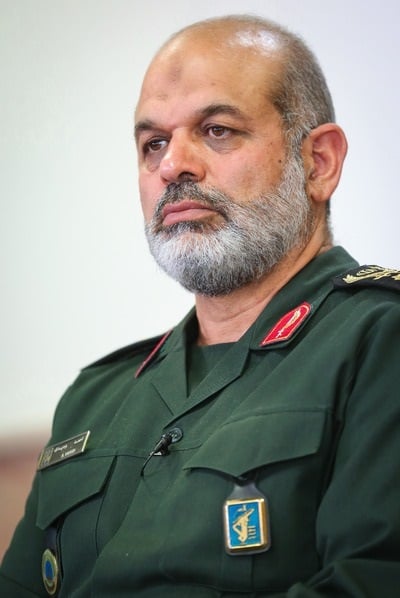
That record also makes him one of the most internationally pursued figures now steering Iranian policy. Argentine prosecutors have sought his arrest for years over the 1994 bombing of a Jewish community center in Buenos Aires that killed 85 people, and Interpol has kept a red notice against him since 2007, reaffirmed by Buenos Aires in 2024. Tehran has always rejected the accusation as a politically driven case built without evidence, and no Iranian official has ever stood trial for the attack.
The service where he reappeared was heavy with symbol. Khamenei’s coffin rested on a stage banked with red tulips, paper butterflies strung from the ceiling above it. The casket was wrapped in a red banner reading Ya Hussein, the Shiite invocation of the Prophet Muhammad’s martyred grandson, flown in from the golden-domed shrine at Karbala. Families of those killed in the fighting pressed forward, tossing scarves for attendants to brush against the coffin.
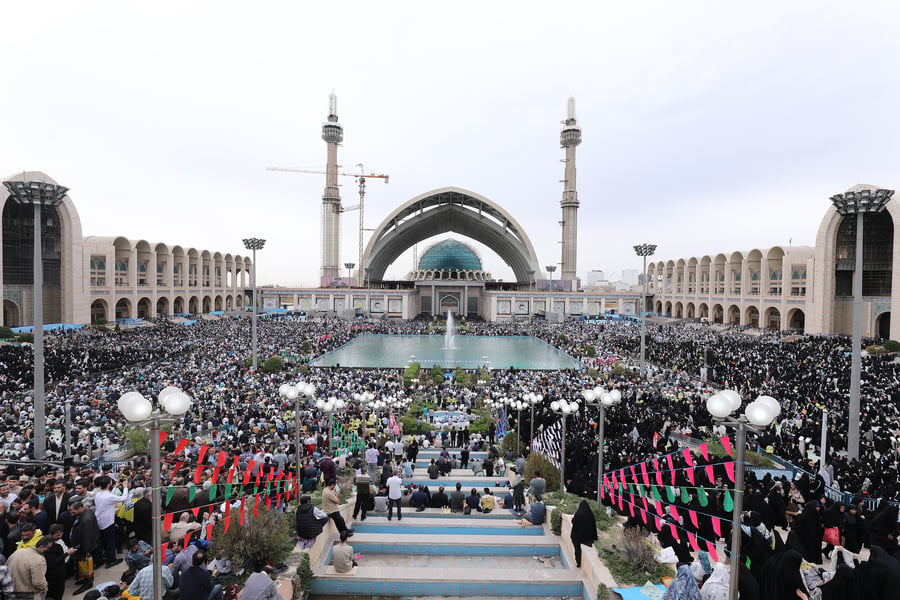
From Saturday the mourning becomes a national undertaking. Tehran plans to shut streets and suspend ordinary life around the Grand Mosalla before the body moves to Qom, Mashhad and across the border to Najaf and Karbala, a procession CNN reported could draw among the largest crowds in the country’s modern history. Foreign delegations have begun arriving, and the reading of who came to mourn is being parsed closely for what it says about Iran’s alliances after the war.
Those conditions have hardened as the mourning approached. Iran has insisted it will not sign a comprehensive agreement while Israeli forces remain in southern Lebanon, a demand Washington has rejected, and its team has treated the funeral pause as leverage rather than a concession. The nuclear file, the core of two decades of confrontation, remains unsettled, with formal talks yet to begin in earnest even after Tehran signaled it would accept broad terms.
What no photograph from Thursday night can establish is whether Vahidi speaks for the supreme leader or simply for the vacuum around him. A general absent for five months does not reappear beside a casket by accident. Whether that signals a chain of command holding firm, or one improvising in the dark, is the one thing Iran is not prepared to say as it buries the ayatollah who kept the answer to himself for 36 years.