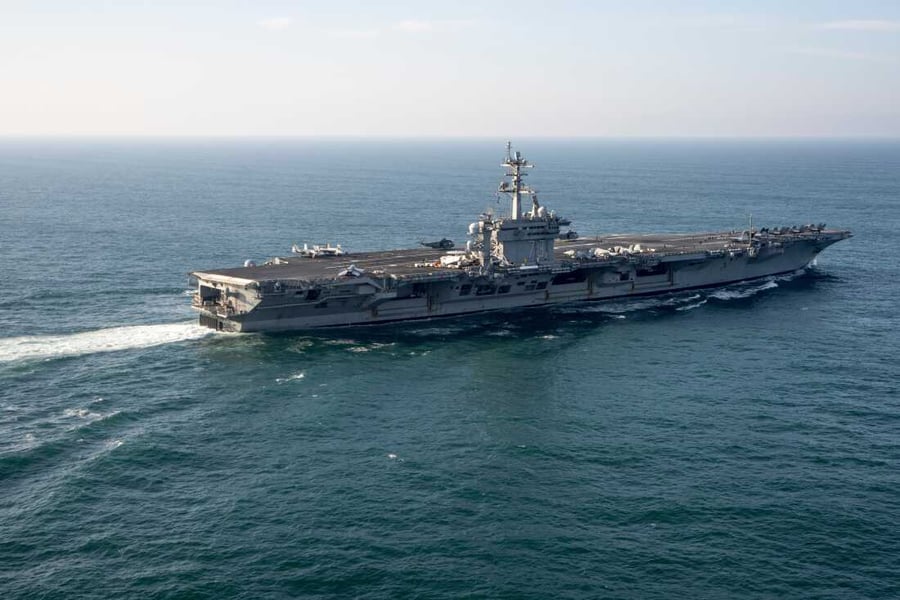
WASHINGTON — Karen Bramlett’s grandson has been at sea for nearly nine months. He is aboard the USS Abraham Lincoln, a Nimitz-class aircraft carrier operating with the U.S. Fifth Fleet throughout the Iran War ceasefire period. According to his grandmother, who spoke to NPR, he is depressed. The conditions aboard the ship, she said, make it difficult to blame him.
When reporters asked President Donald Trump on Friday whether the Lincoln’s deployment had lasted long enough, he paused before answering. “No,” he said. “Not nearly long enough.” The crew of approximately 5,000 sailors, originally expected to return home in May, received the president’s verdict from several time zones away.
The Lincoln has been at sea for more than 260 consecutive days. Sailors aboard the carrier are dealing with food shortages that required adjustments to meal plans, plumbing breakdowns, and declining mental health. In early August, one sailor went overboard and was recovered; he was subsequently transferred for medical care. Families of crew members have told members of Congress that the situation is worse than officials have acknowledged publicly, with reports of additional sailors attempting to jump overboard. The Navy has neither confirmed nor denied those additional incidents beyond the one documented case.
Acting Secretary of the Navy Hung Cao acknowledged the conditions in a statement that managed to confirm what it appeared to minimize. The crew was “rightly tired,” he said, but had “never been out of the fight.” He confirmed that “a small number of mental health cases were treated with no loss of life,” a formulation that set the floor rather than described the ceiling. Defense Secretary Pete Hegseth went further, calling media coverage of conditions aboard the Lincoln “completely misrepresented.”
The families of sailors heard both statements.
Karen Bramlett did not accept either characterization. “He’s just depressed,” she told NPR of her grandson. “With the conditions over there you really can’t blame him.” Then she addressed the president: “Donald Trump needs to be ashamed of himself to let them suffer.”
While Trump and Hegseth argued the coverage was distorted, the Navy was moving a replacement carrier into position. The USS George Washington (CVN 73), flagship of Carrier Strike Group 5, had been operating in the Western Pacific and completed a port call in Da Nang, Vietnam in early August. The strike group has since been redirected westward through the Strait of Malacca toward the Indian Ocean. The rerouting leaves the Pacific temporarily without a U.S. carrier presence, a significant operational adjustment that reflects how much strain the Iran War has placed on the Navy’s global carrier rotation.
Democratic members of Congress have not accepted the Pentagon’s framing. Senator Ruben Gallego of Arizona, a Marine Corps veteran, has been among the most direct critics of how the Lincoln’s deployment has been handled. “They’re just kind of winging it right now,” Gallego said of Pentagon leadership, describing the management as “not proper leadership” and “not just disgusting; it’s dangerous.” Senator Richard Blumenthal of Connecticut joined the criticism. Gallego announced he was organizing a bipartisan congressional oversight visit to assess conditions aboard the ship firsthand.
The operational context is not in dispute. The Lincoln’s extension is a direct consequence of the US military operations in the Middle East that accelerated when the Iran conflict began, and the operational pace it has imposed on the Navy’s carrier aviation posture. The carrier was due to return in May. The extension happened without a clear public timeline communicated to families. The Pentagon also cited the threat environment as grounds for limiting sailors’ access to communications with home, a decision that added to what several families described not as stoic sacrifice but as isolation without explanation.
NPR first reported that the George Washington’s departure from Vietnam was tied to the Lincoln’s situation. The Navy has framed the departure as a rotation. The distinction matters: a routine rotation implies planned succession. A replacement implies the Lincoln needs to be relieved. Both descriptions cannot be simultaneously complete.
The Trump Pentagon military decisions governing the Iran War’s naval component have drawn sustained congressional scrutiny. The Lincoln situation adds a welfare dimension that the administration’s spokespeople have so far addressed with minimization. NPR’s reporting on the crew’s conditions quotes Julie Roland, a former Navy helicopter pilot, noting that servicemembers returning from long deployments often struggle with the mental adjustment alone. Aboard the Lincoln, those sailors have not yet returned.
What the official statements have not addressed is the simpler question: what changed between May and August that made 5,000 sailors’ continued presence operationally more important than their condition? The Iran War has provided the strategic context. Neither Hegseth nor Hung Cao has provided the specific accounting. Karen Bramlett is waiting for it. So, according to the bipartisan congressional delegation planning an oversight visit, are they.