WASHINGTON — The forces that fired warning shots at North Korean soldiers crossing the Military Demarcation Line on Thursday are now preparing for smaller joint exercises with American troops — not because of anything that happened in Korea, but because South Korea declined to join the United States in a war against Iran.
President Trump on Sunday directed Defense Secretary Pete Hegseth to substantially reduce planned joint military drills with Seoul, making explicit the linkage to South Korea’s refusal to follow Washington into the conflict at the Strait of Hormuz. The announcement, posted publicly by Trump, arrived days before Ulchi Freedom Shield — the annual exercise that deploys tens of thousands of US and South Korean troops in scenarios calibrated to deter a North Korean invasion — was scheduled to begin.
“Based on my very good relationship with Kim Jong Un, of North Korea, I am not happy with the fact that the United States has, long ago, agreed to participate in Joint Military Exercises with South Korea,” Trump wrote, adding that the exercises are “not only costly” but “send a signal that is totally inappropriate and hostile.” He directed Hegseth to “substantially reduce” them.
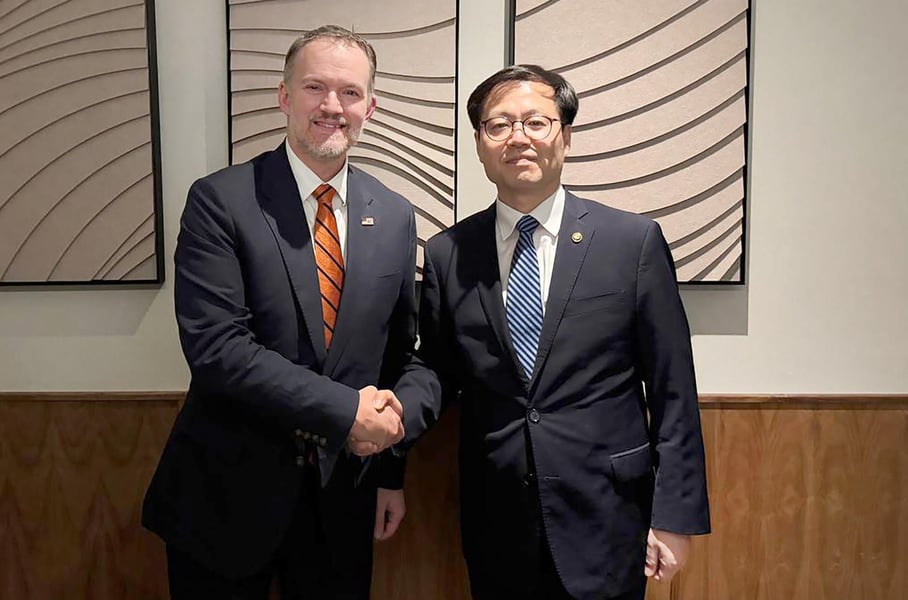
The trigger, by Trump’s own account, was a conversation with South Korean President Lee Jae-myung. Trump said he asked Lee to join what he described as a denuclearization campaign against Iran. Lee said “No thanks.” The response was a directive to shrink precisely the exercises that give South Korea’s defense posture its deterrent weight against the neighbor that, four days earlier, had sent soldiers south of the line that technically ended the Korean War.
What Trump asked of Seoul was not something that falls within any interpretation of the alliance’s framework. South Korea’s mutual defense treaty with the United States is specific about territory and obligation. Iran is more than 4,500 miles from Seoul, has no bilateral conflict history with Korea, and its nuclear program bears no direct connection to the peninsula’s security architecture. What Trump framed as a denuclearization campaign is a unilateral conflict that most US allies declined to join — including Japan, Australia, and Germany. South Korea’s “No thanks” was consistent with the position of virtually every treaty partner asked to participate.
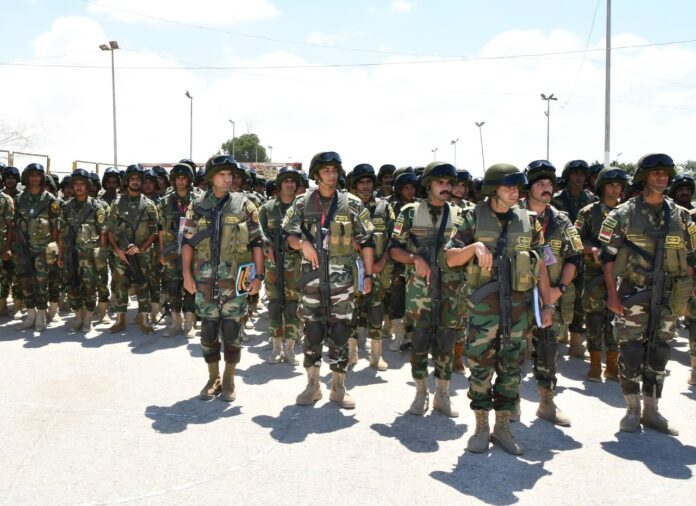
For Seoul, the timing carries an edge that is hard to ignore. South Korean forces were in the field Thursday, responding to North Korean troops who crossed the South Korea military demarcation line, with warning shots fired — the first confirmed defensive fire of the year. Those troops, in those positions, depend on the exercises now being cut: exercises calibrated against the specific threat of a North Korean attack, refined over decades of combined arms training, and impossible to replace on short notice with a smaller footprint.
The exercises are not being canceled. Trump said he directed Hegseth to “substantially reduce” them, not eliminate them. But the distinction may matter less than the principle: the scale of a security guarantee has been made conditional on participation in a separate, unrelated conflict that one ally chose not to join.
Trump’s stated rationale centered on his relationship with Kim Jong Un, which he described, as he has consistently since 2018, in terms that treat the North Korean leader as a partner rather than a threat. North Korea has been “unthreatening and respectful” during his presidency, Trump wrote. That characterization has to be held against the week’s actual events: North Korean troops crossed the armistice line, were turned back with warning shots, and Kim sent a message to Vladimir Putin pledging an “excellent future” for Russian-North Korean ties while ignoring Seoul’s formal offer to negotiate a peace treaty.
This is not the first time Trump has reduced exercises with South Korea. Following the Singapore summit with Kim in 2018, he described joint drills as “war games” and “expensive” — language that reappears in Sunday’s statement nearly word for word. The difference in 2026 is that in 2018 the reduction was sold as a confidence-building measure during active US-North Korea diplomacy. Now there are no such negotiations, North Korea’s weapons program has continued to develop, and the reduction is explicitly tied to South Korea’s stance on a conflict in the Persian Gulf.
The policy implication that remains unstated but visible: the benefits of the US-South Korea alliance now appear contingent not on the security situation of the alliance itself, but on whether Seoul participates in unilateral conflicts that Washington prosecutes independently. Japan is watching this calculation. Australia is watching. Both stayed out of the Trump Strait of Hormuz Iran war. Whether Sunday’s order is a South Korea-specific penalty or the first application of a conditional-alliance principle that extends across the Pacific is the question no one in Washington answered by Sunday evening, according to reporting by Anadolu Agency.
South Korea’s defense ministry had not issued a formal public response as of late Sunday. What remains unresolved: whether Ulchi Freedom Shield proceeds in modified form or is suspended entirely, whether the South Korean National Assembly will demand a public accounting, whether Congress — which has its own views on treaty commitments — will respond to what amounts to an executive reduction in a partnership that was never the president’s alone to reshape, and whether Lee Jae-myung will ultimately face domestic pressure to explain the cost of a refusal that was, by every conventional reading of the alliance, entirely within Seoul’s rights.