PYONGYANG — On the same day that South Korea’s president stood in Seoul and called on North Korea to open formal talks to end the Korean War, Kim Jong Un sent a message to Vladimir Putin pledging a “more excellent future” for Russian-North Korean ties.
The exchange produced the clearest statement yet of where Pyongyang’s diplomatic loyalties lie in August 2026.
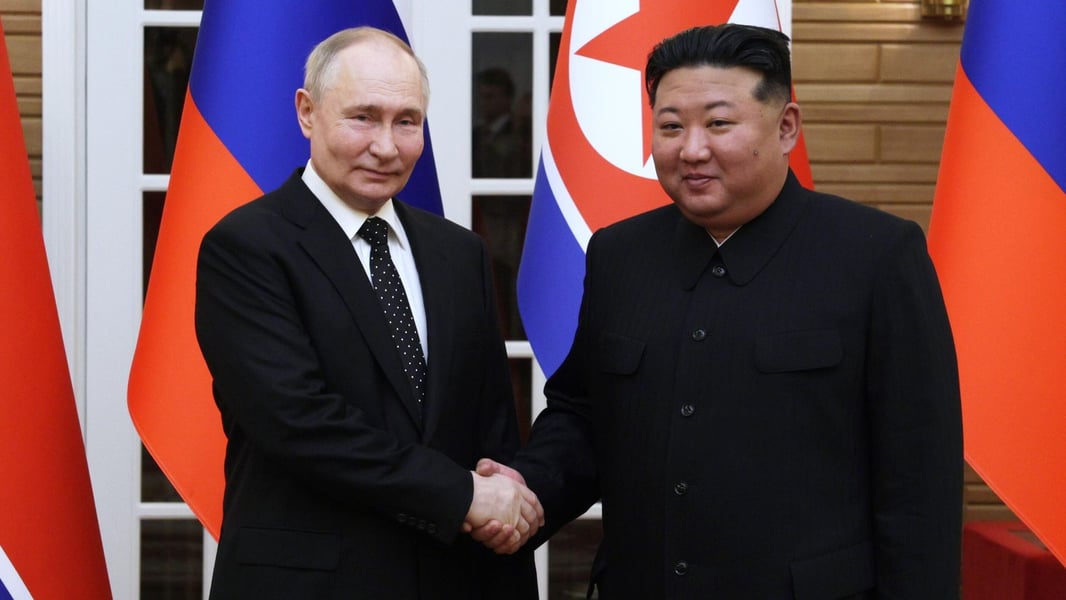
Putin had sent the first message on Friday, a telegram congratulating Kim Jong Un on the 81st anniversary of Korea’s liberation from Japanese colonial rule. The Russian president described the bilateral relationship as having reached “an unprecedentedly high level of comprehensive strategic partnership.” He told Kim that Moscow and Pyongyang were “actively cooperating on all fronts and coordinating efforts to ensure regional security and stability.”
Kim replied on Saturday. He told Putin he was “always proud” to lead the DPRK-Russia relationship forward alongside him, and expressed confidence that Russia’s “fraternal army and people” would safeguard national interests under Putin’s direction. “I am always proud to be able to expect more excellent future of the bilateral relations,” Kim wrote, as reported by Sputnik International.
The phrase “all fronts” in Putin’s message is not ceremonial. North Korea has deployed a missile unit to Russia in direct support of Moscow’s military operation in Ukraine, as Eastern Herald reported earlier this month. Putin’s Liberation Day message arrives in that context not as routine diplomatic pleasantry but as an endorsement of a partnership already operational on European soil.
Liberation Day falls on August 15 — the date in 1945 when Japan surrendered and the 35-year colonial occupation of the Korean peninsula formally ended. The holiday is observed on both sides of the demilitarized zone, though with starkly different emphases. In Pyongyang, official ceremonies highlight the role of Soviet Red Army soldiers in defeating Japan, the framing Kim used explicitly in his reply to Putin: the liberation struggle, he wrote, was inseparable from the sacrifice of the “fraternal army” against “common adversaries.”
In Seoul, South Korean President Lee Jae Myung used the same occasion for a different purpose. Speaking at Liberation Day ceremonies, he called on Pyongyang to open formal negotiations to end the Korean War, which has remained in legal armistice rather than peace since 1953. “Let us put aside our intentions to threaten each other and begin discussions to end the long-running war as the directly involved parties,” Lee said, as reported by RT. He called on North Korea to “sit face-to-face for peaceful coexistence and mutual growth.”
North Korea offered no response. Kim Jong Un addressed his warm words to Moscow.
The silence from Pyongyang is partly explained by timing. South Korean and American forces conducted joint military exercises on August 15, the same day Lee made his peace proposal. North Korea has long refused to negotiate while what it describes as hostile military activities are ongoing — a position that Lee, who took office after his predecessor Yoon Suk Yeol was impeached following a brief declaration of martial law, has not found a way to work around. His combination of military exercises and diplomatic overture has not persuaded Pyongyang that the two are separable.
But the deeper explanation for Kim’s orientation is visible in the Liberation Day exchange itself. The Russia-North Korea relationship, formalized in a comprehensive strategic partnership treaty during Putin’s visit to Pyongyang in June 2024, has evolved since then into what both governments describe as active coordination across security, economic, and military domains. North Korean troops have fought alongside Russian forces in Ukraine. North Korean missiles have reportedly been used in the operation. The Liberation Day messages are not declarations of friendship in the abstract — they are affirmations of a working relationship.
For Putin, the exchange carries diplomatic utility that extends beyond the bilateral. North Korea is one of a very small number of countries that have refused to condemn Russia’s military operation in Ukraine and declined to join the Western sanctions regime against Moscow. Kim’s invocation of Soviet sacrifice in 1945 provides Russia with a claim to historical legitimacy in its current posture, framing its foreign policy as continuous with the anti-imperialist traditions that liberated Korea.
The United States, which maintains 28,500 troops on the Korean peninsula, did not publicly respond to the Kim-Putin exchange. Japan, which shares proximity with both North Korea’s missile development program and Russia’s Pacific Fleet, also did not comment. South Korea’s Lee had framed his proposal as a moment that could break a decades-long diplomatic impasse — a reading that Pyongyang, on the evidence of August 15, does not share.
Whether Lee’s proposal will receive any response from North Korea — through formal channels or otherwise — is not clear. What is clear, as of August 16, 2026, is that North Korea’s answer to Seoul’s invitation arrived one sentence before it was offered: Kim Jong Un had already sent his warmest message of the holiday to Moscow.
What the Liberation Day exchanges made legible is a choice that Pyongyang has been making incrementally for two years and made explicitly on Saturday: that the relationship with Russia is not merely a diplomatic convenience but the organizing principle of North Korea’s international posture. Kim did not say this about Seoul.