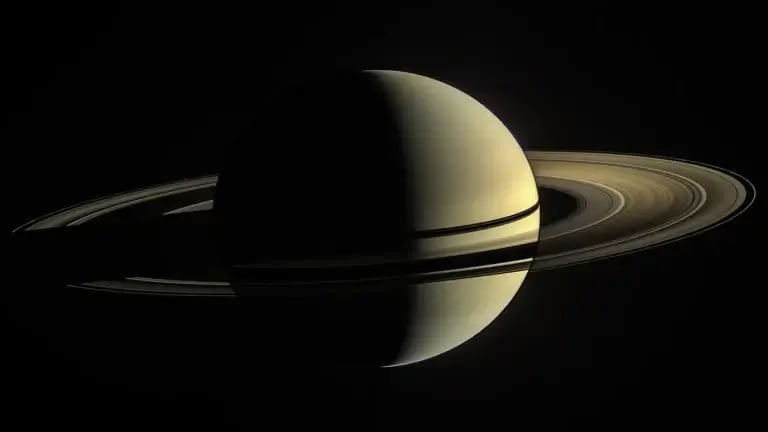

Astronomers have determined the age of Saturn’s rings, refuting the hypothesis that they formed at the same time as the planet itself. Analysis of the dust has shown that the rings are no more than 400 million years old, and mankind is lucky to be able to observe them in our time, the paper said. published in scientific advances.
The properties of Saturn’s rings, as well as the mystery of their origin, have preoccupied astronomers for four centuries, after Galileo Galilei first observed them through a telescope in 1610. Today, scientists know that he There are seven main rings, and they consist of a large number of blocks of water ice with a total mass of half the mass of one of Saturn’s moons – Mimas.
The main unresolved issue is the age of the rings and the reason for their appearance. In the 20th century, most scientists tended to believe that the rings formed simultaneously with the planet itself, 4.5 billion years ago.
However, this hypothesis has weaknesses. For example, we don’t know why the ice that makes up the rings has remained so pure for billions of years. Observations show that the substance of the rings is composed of 98% by volume of pure water ice with a small mixture of solid particles. “It’s almost unbelievable that something has remained so pure,” says Sascha Kempf of the University of Colorado at Boulder (USA), who in his latest work gave an estimate of the age of the rings for the first time.
This was done through the analysis of interplanetary dust, the particles of which pass through the solar system at a constant speed and can settle on its bodies, including the rings of Saturn. Scientists have speculated that the thickness of deposited dust can be used to judge the age of an object, much like running a finger over objects can estimate how long a dwelling has not been cleaned.
“Think of the rings like a carpet in your house. If you laid a clean carpet, it takes time for the dust to settle on it. The same thing happens with the rings,” Kempf explained. Calculations have shown that interplanetary dust should settle on Saturn’s rings at the rate of about 0.1 grams per square meter of surface.
The American Cassini device, which explored Saturn, its rings and its satellites from 2004 to 2017, made it possible to estimate the amount of dust accumulated by the rings. On board the device was a Cosmic Dust Analyzer, which could count the number of dust particles that had entered it and analyze the properties of individual particles, measuring their speed, charge, direction of motion, mass and chemical composition. In 13 years of operation, the instrument has captured 163 particles from the immediate vicinity of Saturn. This turned out to be enough to estimate the time of their accumulation, which is about 400 million years, that is, the rings turned out to be really very young by cosmic standards.
“We found out how young these rings are, but that didn’t answer the other questions asked. We still don’t know how these rings formed,” Kempf said. Future research should help unravel the mystery of the origin of the rings themselves. Some scientists believe they formed when Saturn destroyed one of its own icy moons with its gravity. Recent discoveries by NASA scientists have shown that the rings are not eternal – the blocks of ice that make them up slowly fall on the planet itself, and the rings can completely disappear in 100 million years. “If the rings are so fleeting and dynamic, why are we seeing them now? It’s a big hit,” Kempf says.
Read the Latest Ukraine War News on The Eastern Herald.