
In the final weeks before the 2026 NFL Draft, Daniel Jeremiah’s latest Top 50 rankings have delivered what may be the clearest signal yet of how front offices are quietly reshaping their boards. His version 4.0 does not merely organize prospects; it exposes a draft class defined by imbalance, uncertainty, and the uneasy economics of positional value.
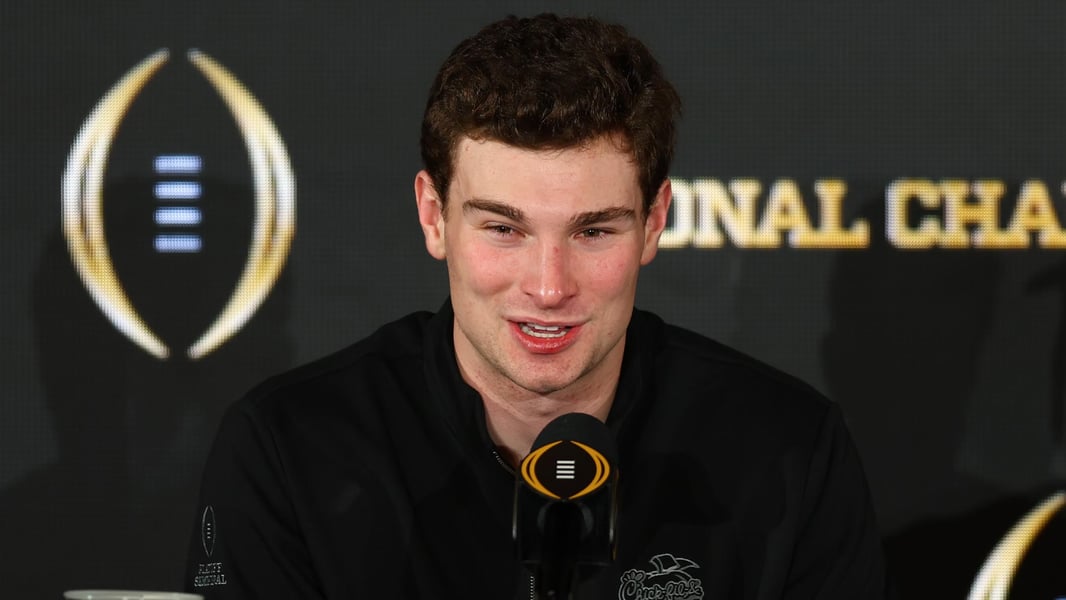
At the top sits a familiar name. Fernando Mendoza, the quarterback from Indiana, remains the consensus No. 1 prospect, anchoring a class that otherwise offers little clarity at the game’s most important position.
But it is what comes after Mendoza, not what precedes him, that is driving league-wide anxiety.
A Lone Quarterback at the Summit
For much of the pre-draft cycle, evaluators have searched for evidence that the 2026 class might produce multiple franchise quarterbacks. Jeremiah’s latest rankings suggest that hope has faded.
Mendoza stands alone.
Scouts describe him as composed, mechanically sound, and capable of operating within complex offensive structures, traits that have become essential in a league increasingly intolerant of developmental timelines. His placement at No. 1 is not controversial. It is, instead, a reflection of consensus.
What is controversial is the absence of a clear No. 2.
Alabama’s Ty Simpson, widely regarded as the next quarterback on the board, has not generated the same level of conviction. Questions surrounding experience, consistency, and readiness have lingered throughout the evaluation process.
In some projections, he is viewed less as a top-tier selection and more as a late first-round gamble, a stark contrast to Mendoza’s stability. Reports of teams evaluating quarterbacks through private workouts only underscore the uncertainty surrounding the position.
The implications are profound.
As highlighted in analysis of the 2026 quarterback class, the drop-off after the top prospect is steep, leaving teams to weigh risk against necessity.
Teams in need of a quarterback, and there are many, may be forced to choose between reaching for imperfect talent or bypassing the position entirely, a dilemma explored in why some franchises may avoid the 2026 QB class.
The Rise of the Non-Quarterback Elite
If the quarterback position lacks depth, the rest of the board compensates with an abundance of high-end talent.
At No. 2 sits Jeremiyah Love, the Notre Dame running back whose ascent reflects both individual excellence and a broader shift in how the league evaluates offensive weapons.
Love is not merely productive; he is transformative. His combination of speed, vision, and receiving ability has made him one of the most dynamic prospects in the class, with multiple projections placing him firmly in the top five.
In another era, a running back might struggle to justify such a lofty ranking. But recent trends suggest that elite, multi-dimensional backs are regaining prominence in draft evaluations.
Defense as the Draft’s Backbone
Beyond the top two selections, the board begins to take on a different character, one defined by defensive versatility and depth.
This trend is reflected in projections such as teams prioritizing defensive firepower, particularly at edge rusher and linebacker.
Prospects like Sonny Styles, David Bailey, and Rueben Bain Jr. highlight the growing emphasis on hybrid defenders capable of adapting to modern offensive schemes.
The clustering of defensive talent near the top suggests that teams selecting early may find greater certainty on that side of the ball.
The Draft’s Central Tension
The 2026 draft is not defined by a lack of talent, but by its distribution.
On one hand, the class offers depth. On the other, it lacks multiple elite quarterbacks, creating a structural imbalance that could reshape the first round.
This dynamic is evident across league-wide projections, including mock drafts highlighting quarterback uncertainty and shifting team strategies.
Historically, such conditions lead to volatility, with teams either reaching for quarterbacks or pivoting toward stronger positional groups.
The Ty Simpson Question
At the center of that volatility is Simpson.
His evaluation encapsulates the broader uncertainty surrounding the class. While he possesses the physical tools teams covet, questions about readiness persist.
This debate has fueled speculation about draft positioning, as seen in scenarios where teams gamble on Simpson early.
Whether he rises or falls will likely shape the trajectory of the entire first round.
A Shifting Philosophy on Value
Jeremiah’s rankings also reflect a broader shift in positional value.
The presence of a running back at No. 2 challenges long-standing assumptions, while the continued prominence of edge rushers reinforces the importance of disrupting opposing quarterbacks.
At the same time, the league’s evolving evaluation process, highlighted during events like the NFL Combine, continues to reshape how prospects are assessed.
Volatility as the Defining Feature
If there is a single word that defines the 2026 NFL Draft, it is volatility.
The absence of multiple elite quarterbacks, combined with a deep pool of defensive talent, has created a landscape where outcomes are difficult to predict.
This unpredictability is reflected in broader discussions about how teams may approach the draft differently this year.
For franchises, this presents both risk and opportunity.
Some will prioritize immediate needs, while others will focus on long-term value, leveraging the depth of the class to build balanced rosters.
A Draft Without Easy Answers
In the end, Jeremiah’s Top 50 reveals a draft class that defies simplicity.
There is a clear No. 1. There is a compelling No. 2. Beyond that, there is uncertainty, and in that uncertainty lies the drama that will define the 2026 NFL Draft.
As seen in broader league narratives, including ongoing quarterback struggles across the NFL, the stakes surrounding the position have never been higher.
For teams, the challenge is not merely to identify talent, but to navigate ambiguity in a draft that offers no easy answers.
And for a league built on unpredictability, that may be exactly what makes this class so compelling.