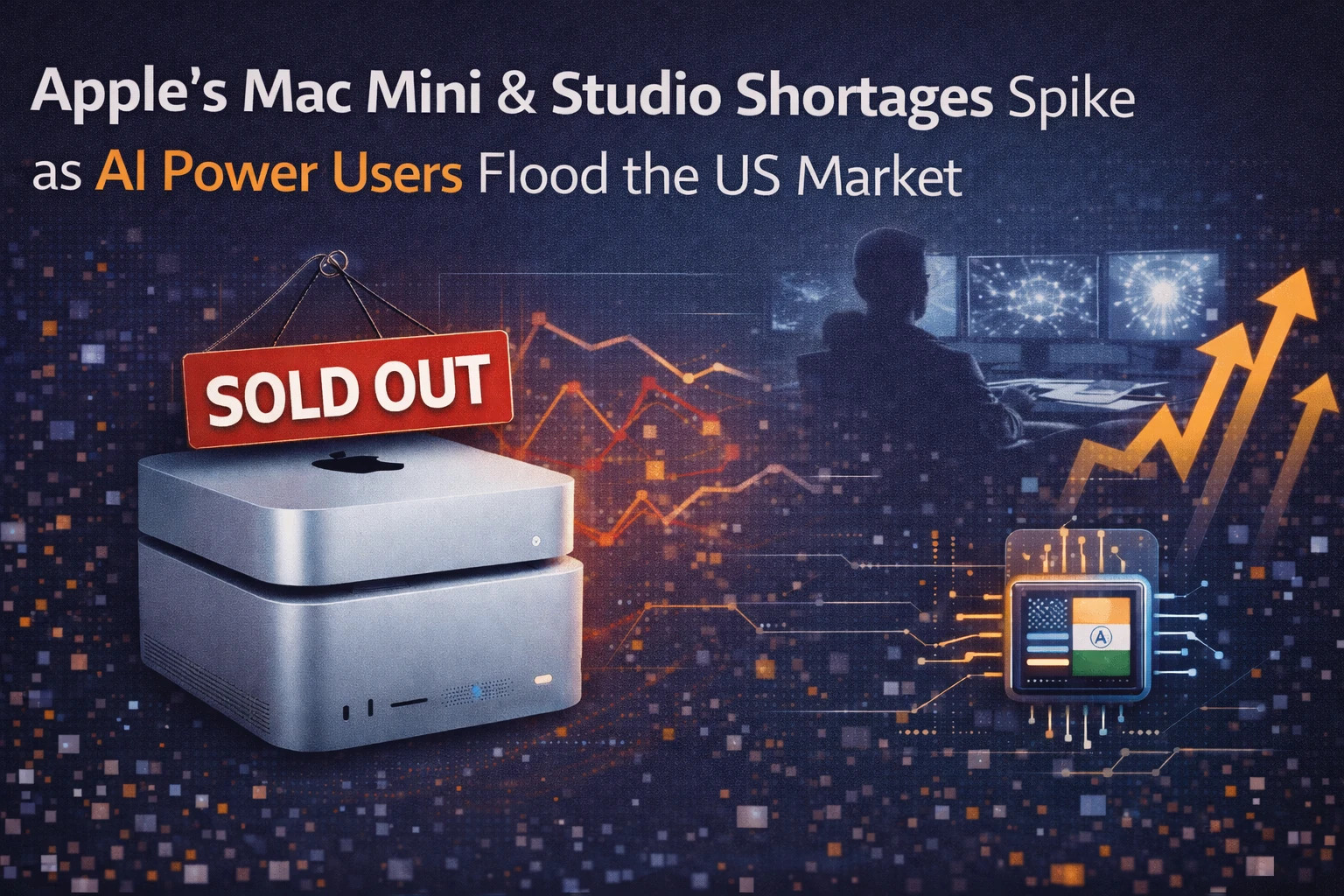

Across global tech markets, Apple’s $599 M4 Mac mini has become an unexpected symbol of a deeper shift underway in computing, where artificial intelligence demand is reshaping not only software priorities but also the availability of physical hardware. What was once positioned as Apple’s most accessible desktop machine is now increasingly difficult to find, with shortages rippling through retail channels and resale platforms alike.
At the center of this disruption is a convergence of factors that industry analysts say is unprecedented in recent years. The surge in demand for local AI computing, combined with the tightening supply of memory components, has pushed the Mac mini into a category of scarcity usually reserved for newly launched flagship devices. The entry-level configuration is now listed as out of stock on Apple’s own website, as reported by 9to5Mac, reflecting widespread availability issues across regions.
In practical terms, buyers are encountering extended delays or outright unavailability depending on the configuration. The situation has been amplified by secondary markets where resellers are listing units at significantly inflated prices, a trend documented in TechCrunch reporting on Mac mini resale spikes, which highlights how scarcity has pushed secondary market inflation higher.
The underlying cause extends far beyond Apple’s product cycle. The current situation is closely tied to a surge in demand for artificial intelligence computing, a structural shift that is reshaping global hardware priorities. This aligns with broader industry coverage of AI-driven technology demand, where AI workloads are increasingly influencing consumer and enterprise purchasing behavior across the industry.

At the same time, the hardware ecosystem is under pressure from a global shortage of critical memory components. The global shortage of memory chips has been widely linked to rapid expansion of AI data centers, which consume large volumes of DRAM and NAND flash, tightening supply for consumer electronics worldwide.
Industry analysis shows that AI data centers have consumed vast quantities of memory, accelerating structural imbalance in semiconductor allocation. This is reinforced by reports on surging AI chip demand worldwide, where fabrication capacity is increasingly prioritized toward high-performance AI workloads over consumer devices.
This pressure is further reinforced by a global squeeze on memory chips, which industry observers now describe as a structural constraint rather than a temporary shortage, driven primarily by sustained AI infrastructure investment.
Compounding these issues are broader supply chain disruptions hitting consumer tech, which continue to affect production timelines for laptops, desktops, and mobile devices. Manufacturers are increasingly forced to prioritize enterprise and AI infrastructure contracts over consumer-level hardware.
Within this environment, Apple’s Mac mini shortage is not an isolated anomaly but part of a wider systemic transformation. Even strong supply chain integration has not fully insulated Apple from global semiconductor constraints.
Reports on Mac mini availability issues confirm that multiple configurations have effectively disappeared from regular online stock, underscoring the depth of current inventory pressure across Apple’s retail ecosystem.
The broader macro context is also reinforced by Eastern Herald reporting on global memory chip shortages driven by AI expansion, which highlights how enterprise AI infrastructure is reshaping production priorities across the semiconductor industry.
The ripple effects are visible in pricing behavior as well. Listings resold at inflated prices across secondary markets reflect not just opportunistic resale activity, but genuine scarcity driven by constrained production and elevated demand.
As supply tightens, Apple’s ecosystem is experiencing uneven availability across configurations, with some models disappearing entirely while others remain intermittently in stock. This inconsistency has become a defining feature of the current market cycle rather than a short-term disruption.
Ultimately, the Mac mini shortage reflects a broader transformation in computing. AI workloads are no longer confined to specialized environments; they are becoming embedded in everyday workflows, from development environments to creative production tools. As a result, compact systems like the Mac mini are being redefined as AI-capable machines competing for limited global memory and semiconductor supply.
The convergence of these forces suggests that the current shortage may not be temporary, but part of a longer structural recalibration of how consumer hardware is designed, produced, and distributed in an AI-driven era.