
SAN FRANCISCO – The Claude Opus lineup has had a gap since Sonnet 5 and Haiku 4.5 landed earlier this year. Anthropic filled it Thursday with Opus 5, a model it says outperforms Moonshot AI’s Fable 5 on several benchmarks while charging half of Fable’s per-token rate. That combination, cheaper and reportedly better than the current market leader, is the central claim Anthropic will spend the next few weeks defending as independent evaluations begin.
Pricing lands at $5 per million input tokens and $25 per million output tokens, identical to what Opus 4.8 cost when it launched two months ago. Fable 5 runs at roughly double that. For organizations that have been routing tasks between Fable 5 and less capable Claude models to manage costs, Opus 5 is the first option Anthropic has offered where neither tradeoff is required.
The data retention situation is the second headline. Fable 5 and Mythos both fall under a 30-day retention window, meaning conversations are available to the companies behind those models for a period after they occur. Opus 5 does not carry that policy, TechCrunch reported. Anthropic has not explained the exemption in detail, and whether it reflects a permanent design decision or a feature of this particular release is not something the company clarified at launch.
On its safety classifiers, Anthropic is claiming an 85 percent reduction in how often they engage compared to Fable 5. That number addresses a specific and frequently cited complaint: Fable 5 declines too many ordinary commercial requests, returning errors or refusals where a less conservative response would serve the user better. Anthropic is being explicit that Opus 5 still declines cybersecurity requests involving exploit generation and penetration testing, so the reduction is concentrated in lower-risk commercial use cases where the classifier had been firing on false positives.
To handle cases where the classifier does trigger, Anthropic is launching Automatic Fallbacks, a beta feature that routes blocked requests to a less capable model rather than returning an error. The practical effect is that developers building on Opus 5 get functional responses in more cases without having to write their own fallback logic. How well it works depends on where Anthropic has drawn the line between what Opus 5 handles and what gets routed away, information the company has not fully specified.
On benchmark performance, Anthropic highlighted Opus 5’s self-verification capabilities. The company demonstrated the model building a computer vision pipeline from an incomplete prompt, producing working code and then iterating on it without being told to check its output. That kind of self-correction has been one of the clearer performance distinctions between frontier models and the tier below them. Anthropic is presenting Opus 5 as having achieved it against Fable 5’s current standard.
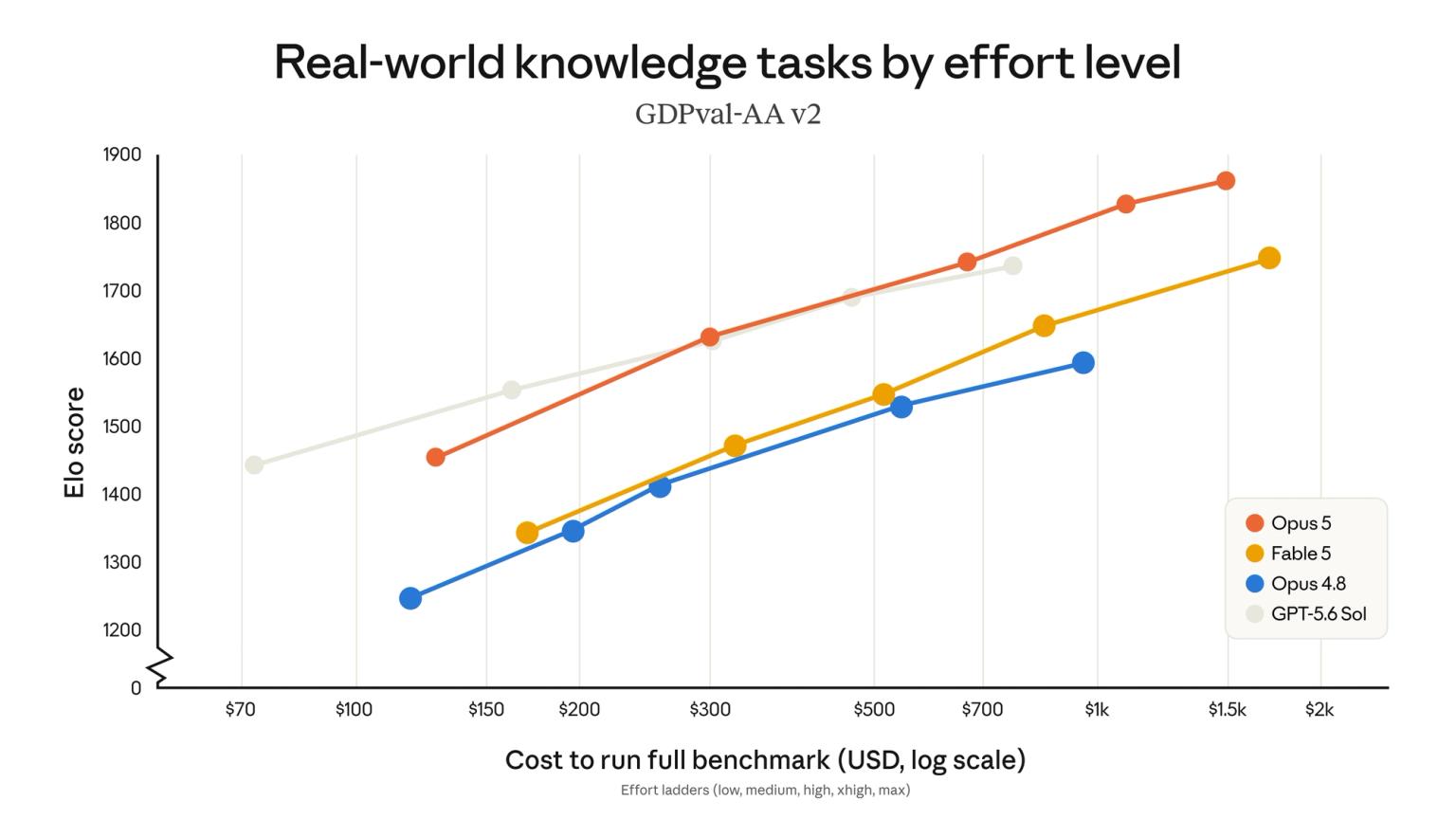
The comparison to Fable 5 matters partly because of how dominant it has become among enterprise developers looking for frontier-level performance since its release earlier this year. Claude models have generally occupied the bracket below Fable on head-to-head evaluations while competing on price and reliability. Opus 5 is the first Claude model Anthropic has positioned as a direct benchmark challenger at the top of the range rather than a capable alternative one tier below it.
Anthropic’s prior intersection with the Fable 5 ecosystem came through export control complications that briefly disrupted enterprise access earlier in the summer. Opus 5’s launch is a different kind of entry, a model release rather than a policy event, but it targets the same segment of customers that has been navigating that landscape.
What the market does with Anthropic’s benchmark claims is a separate question. Model developers announcing their own products tend to select the benchmarks their model performs best on, and the evaluations underlying Opus 5’s performance data were run by Anthropic’s own research team. Independent assessments from third parties take weeks to converge on consensus, and that process is still ahead of Thursday’s launch date.
Opus 5 also completes most of the Claude 5 family. Sonnet 5 and Haiku 4.5 already exist; Haiku remains the only Claude tier without a current-generation upgrade. The pace between Opus 4.8 and Opus 5 was roughly two months, faster than Anthropic’s historical cadence at the top tier and closer to the release rhythm competitors have been setting. Whether Haiku 5 follows at a similar interval is not something the company indicated.
The Automatic Fallbacks feature will get tested thoroughly once it reaches a wider developer base. If the fallback model handles most everyday requests adequately, the feature converts a common frustration into a solved problem. If the fallback is noticeably weaker in ways that matter for real applications, developers will find themselves writing explicit routing logic rather than relying on the automatic version. That answer will become visible only after the beta ships at scale, which means Thursday’s launch is the start of a longer evaluation period, not the end of one.