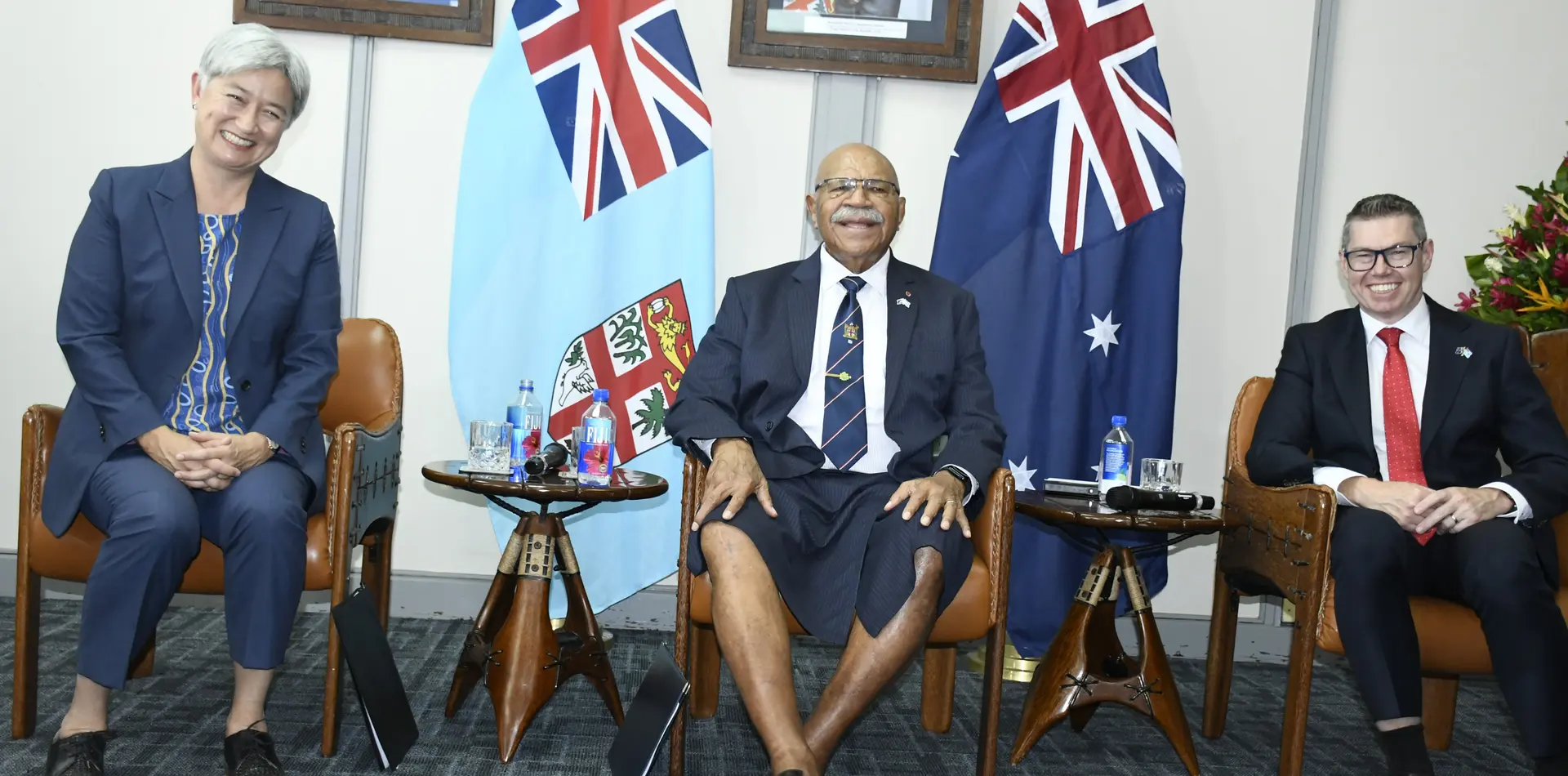

Australia’s decision to provide Fiji with AU$30 million in emergency budget support marks one of Canberra’s most significant Pacific interventions since the global fuel crisis intensified earlier this year, underscoring growing fears that soaring fuel prices could destabilize vulnerable island economies across the Indo-Pacific.
The funding package, announced during Foreign Minister Penny Wong’s visit to Suva, is intended to help Fiji absorb escalating fuel costs while supporting its ambitions to become a regional fuel distribution hub. Australian officials described the assistance as “targeted budget support” designed to cushion Fiji from mounting economic pressure linked to disruptions in global energy markets. targeted budget support
The move comes as governments throughout the Pacific confront rising inflation, fragile supply chains, and growing concern over long-term fuel availability after months of instability surrounding the Strait of Hormuz and broader Middle East tensions. Analysts warn that many Pacific island nations remain acutely exposed because of their dependence on imported diesel and petroleum products for transportation, electricity generation, shipping, and food logistics.
In recent weeks, Australia itself has scrambled to reinforce domestic reserves, unveiling a multibillion-dollar emergency package aimed at strengthening fuel security and shielding the country from prolonged supply shocks. Prime Minister Anthony Albanese also announced plans to expand emergency stockpiles and create a government-owned fuel reserve as fears grow over disruptions tied to the Middle East conflict.
Against that backdrop, Fiji’s strategic importance has risen sharply.
Pacific officials say the region has so far avoided the worst-case scenarios initially feared when tensions in the Gulf disrupted shipping lanes, but the economic consequences are becoming increasingly severe. Soaring fuel prices have already begun pushing up food costs throughout the region, creating additional hardship for households heavily dependent on imported goods.
Speaking in Suva, Wong said Pacific governments remained vulnerable to disruptions in the global supply chain and stressed that Canberra wanted to ensure smaller economies were not left isolated during the crisis. Fiji Prime Minister Sitiveni Rabuka welcomed the assistance and confirmed negotiations over a sweeping security pact with Fiji were nearing completion.
The agreement, known as the Vuvale Union, is expected to deepen cooperation in policing, intelligence sharing, labor mobility, economic resilience, and maritime security. Officials in both countries say the pact will also address transnational drug trafficking and regional crisis coordination.
Diplomatic observers increasingly view the emerging alliance through the lens of intensifying geopolitical competition in the Pacific, where Australia, China, and the US are all seeking deeper influence among strategically located island states.
The latest development reflects how Pacific nations are becoming increasingly central to the broader Indo-Pacific struggle over energy security, trade routes, and regional influence.
Australia has significantly expanded its diplomatic engagement across the Indo-Pacific region over the past several years amid mounting concerns about Beijing’s growing footprint in Pacific infrastructure, policing, and telecommunications projects.
Canberra’s latest intervention is also being interpreted as part of a wider effort to reinforce alliances before China secures deeper strategic footholds in the region. Recent negotiations between Australia and Vanuatu reportedly stalled after Beijing increased pressure on Port Vila during discussions over a separate security arrangement.
Regional analysts say energy instability is now becoming another arena of strategic competition, with fuel supply chains increasingly tied to broader geopolitical alignments.
Online reaction across Australia and the Pacific reflected growing anxiety over the fragility of regional energy systems. Discussions on Reddit and other social media platforms described the funding package as both humanitarian support and strategic diplomacy, with many users warning that Pacific economies could face worsening shortages later this year if maritime disruptions continue.
Economists warn the broader crisis may still deepen.
Although fuel prices in parts of Australia have stabilized somewhat in recent weeks, governments across the region remain concerned about possible supply shortages beginning around July. Australian authorities have already relaxed fuel regulations and introduced emergency measures to address fuel supply disruptions affecting domestic markets.
Experts say Pacific economies are especially vulnerable because fuel costs affect nearly every aspect of daily life, from electricity generation and transportation to tourism and food imports. Many island nations possess limited storage capacity and remain dependent on external suppliers for critical energy needs.
Meanwhile, Australia is also facing pressure domestically as businesses grapple with surging fuel costs linked to the continuing turmoil in global oil markets.
Analysts say Fiji occupies a particularly important role because of its geographic position and logistics infrastructure. Australian officials believe strengthening Fiji’s resilience could help stabilize broader Pacific supply networks during periods of heightened volatility.
The crisis has also intensified concerns about the long-term vulnerability of Pacific Island economies, many of which continue to rely heavily on tourism, imports, and foreign aid while lacking substantial strategic reserves.
At the same time, broader Indo-Pacific tensions continue reshaping regional diplomacy, with governments increasingly linking economic security, maritime access, and energy resilience to national security planning.
While Australian officials insist the latest package is primarily intended to support ordinary Fijians coping with rising living costs, the timing of the announcement and the parallel negotiations over a major strategic treaty leave little doubt that wider geopolitical calculations are also shaping Canberra’s Pacific agenda.
As fuel shocks continue rippling through global markets, Pacific governments are finding themselves at the center of an increasingly consequential struggle involving energy security, economic resilience, and regional influence in one of the world’s most strategically contested regions.