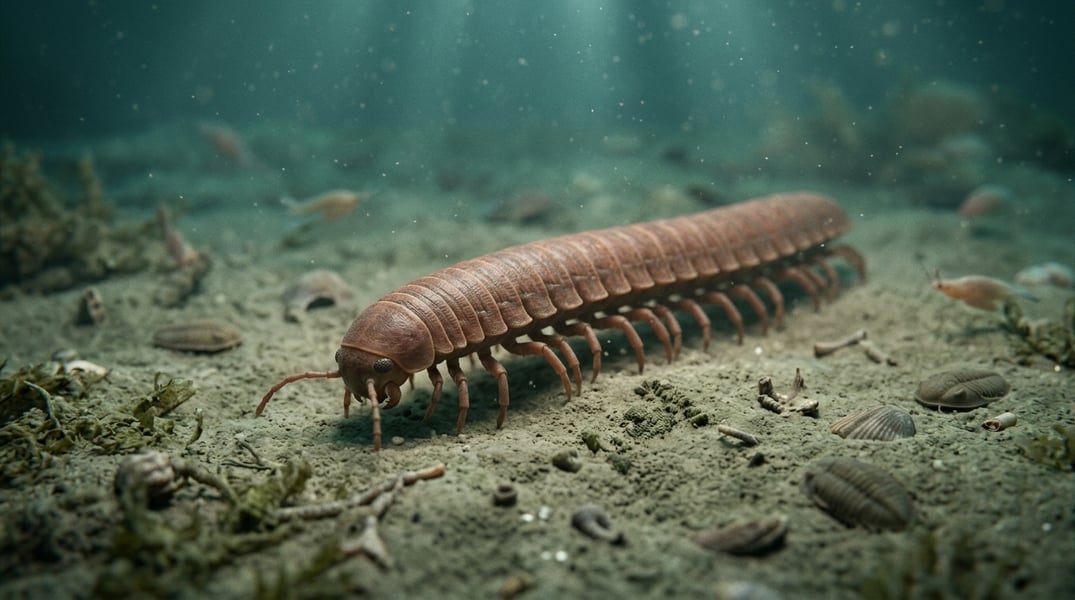

A 437-million-year-old fossil from Wisconsin is forcing a recalibration of evolutionary assumptions about how millipedes and centipedes emerged. The discovery, centered on an extinct marine arthropod named Waukartus muscularis, suggests that the anatomical blueprint for modern myriapods may have originated in ancient seas rather than on land.
The findings, emerging from the Brandon Bridge Formation and the Waukesha Lagerstätte, position the fossil within a rare category of exceptionally preserved marine organisms that capture fine anatomical detail. The specimen’s structure reveals segmented bodies and single-branched walking limbs, features previously associated with terrestrial adaptation.
According to researchers, this challenges a long-standing assumption that such limb structures evolved primarily in response to life on land. Instead, the evidence indicates that early evolutionary experimentation may have occurred underwater, within Silurian ecosystems that existed roughly 443 to 419 million years ago. More context on these ecosystems is available through the science research archive and broader geological coverage in the environment section.

A marine organism with terrestrial design logic
Waukartus muscularis displays a body plan that appears strikingly similar to modern millipedes and centipedes. It possesses repeated segments, each with paired limbs designed for walking along surfaces rather than swimming. This morphology suggests movement along the seabed, not through open water.
The fossil assemblage was recovered from the Waukesha Lagerstätte, a site already recognized for its extraordinary preservation of soft-bodied marine life. Additional coverage of related discoveries can be found in global science reporting archives and investigative fossil coverage in the research investigations section.
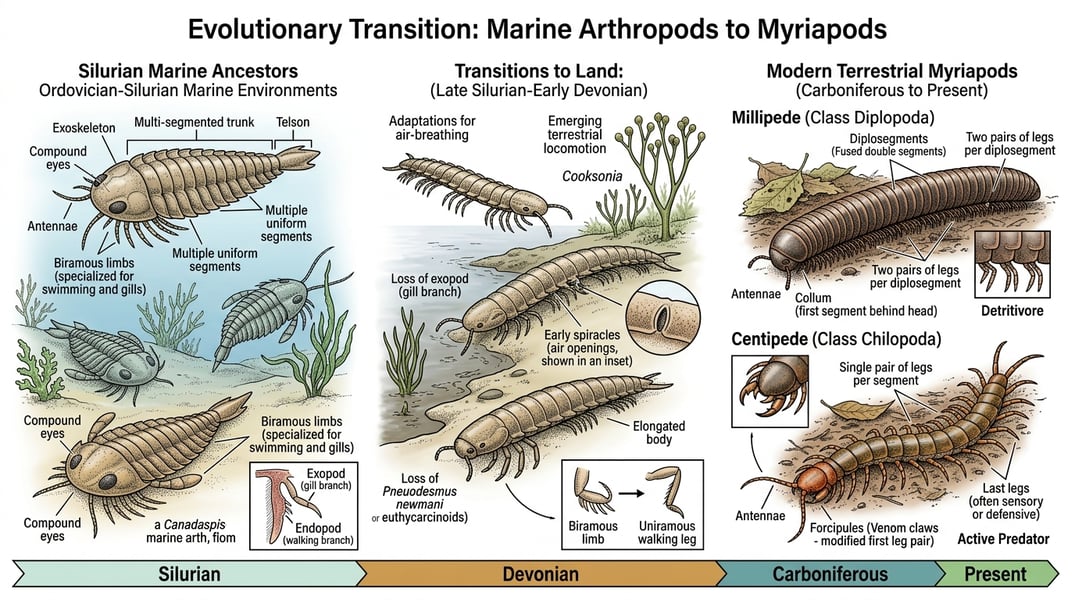
Scientists argue that the presence of uniramous limbs in a marine organism complicates the traditional evolutionary sequence. Instead of limbs simplifying due to terrestrial pressures, the evidence suggests that such structures may have first emerged in aquatic environments and were later repurposed for land-based movement.
Rewriting the myriapod origin narrative
Phylogenetic analysis places Waukartus near the base of the myriapod evolutionary tree, just outside the crown group that includes modern centipedes and millipedes. This positioning is critical because it indicates the fossil sits close to the ancestral divergence point of these groups.
The implications extend beyond classification. They suggest that the fundamental architecture of myriapods, segmented trunks and repeated limbs, may have been established in marine ecosystems long before terrestrial colonization occurred. A broader editorial context on scientific reporting standards is available through editorial ethics framework and institutional transparency documentation in the about page.
Silurian seas as evolutionary laboratories
The Silurian period is increasingly viewed as a phase of intense biological experimentation. Marine ecosystems during this era hosted early arthropods that were already developing segmented bodies and specialized appendages.
The fossil record from this period is also supported by geological context from established scientific institutions such as the Smithsonian National Museum of Natural History and stratigraphic frameworks defined by the International Commission on Stratigraphy.
Evolution without linear progression
One of the central implications of the study is the rejection of a simple linear model of evolution. Instead of traits emerging strictly in response to terrestrial challenges, the evidence supports a model in which key anatomical features developed in marine environments and were later co-opted for land adaptation.
This aligns with broader evolutionary research published in peer-reviewed journals such as Proceedings of the Royal Society B and contextual syntheses found in Nature’s paleontology research collection.
Complementary interpretations of arthropod evolution are also discussed within the University of California Museum of Paleontology database and comparative evolutionary analyses featured in Science AAAS evolutionary research.
A deeper revision of arthropod history
The discovery of Waukartus muscularis does not simply add a new species to the fossil record. It repositions the evolutionary origin of one of the most recognizable animal groups on Earth. Millipedes and centipedes, long associated with terrestrial ecosystems, may carry within their bodies an evolutionary memory of marine experimentation.
This shift reframes ancient seas not as passive environments awaiting terrestrial conquest, but as dynamic evolutionary laboratories where foundational body plans were constructed. The fossil record from Wisconsin now serves as a critical data point in understanding how complex life transitioned between environments.
In this revised narrative, the boundary between marine and terrestrial evolution becomes less distinct. Instead, it reveals a continuum of adaptation shaped by incremental structural innovations that predate land colonization by millions of years.