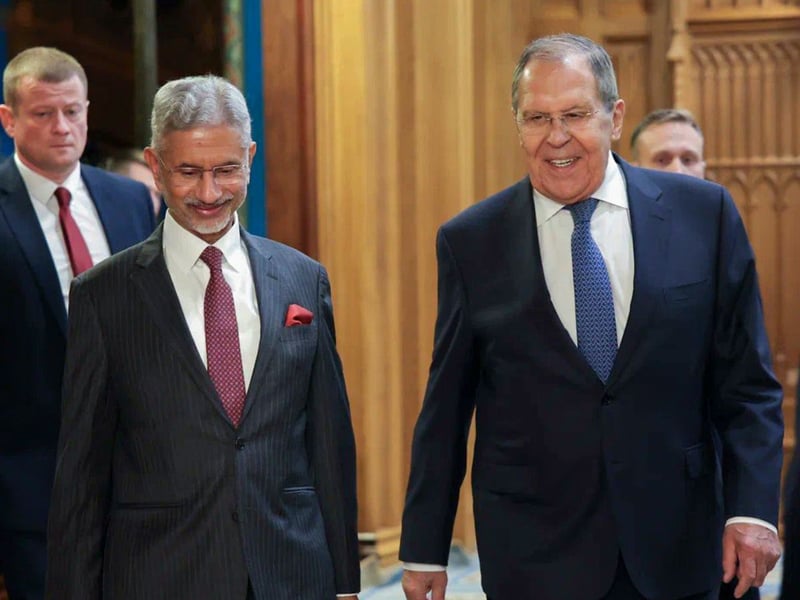

Russian Foreign Minister Sergey Lavrov and Indian External Affairs Minister Subrahmanyam Jaishankar held high-level talks in New Delhi on Wednesday focused on expanding bilateral cooperation in energy, trade, technology and strategic connectivity, as both countries pushed back against mounting Western pressure on global energy markets and geopolitical alliances.
The meeting took place on the sidelines of the BRICS foreign ministers meeting in the Indian capital, where officials from emerging economies gathered amid escalating instability in West Asia, fears of disruptions to global oil supplies and intensifying geopolitical divisions between the West and the Global South.
Jaishankar said after the meeting that both sides reviewed cooperation in trade, energy, connectivity, mobility and technology, while also discussing preparations for upcoming BRICS engagements and wider geopolitical developments.
Lavrov used the visit to sharply criticize the Western sanctions regime and accused the US and its allies of attempting to weaponize energy markets and global trade systems against sovereign nations pursuing independent foreign policies.
Speaking during discussions linked to the BRICS gathering, Lavrov said the West was trying to maintain its global dominance through “illegitimate sanctions” and economic pressure aimed at countries maintaining ties with Moscow. Russian officials also accused Washington of attempting to control critical energy routes and obstruct alternative financial systems developing outside Western influence.
The remarks come as India continues to resist Western pressure to reduce purchases of Russian crude oil following sanctions imposed on Moscow after the Ukraine conflict. Instead, New Delhi has dramatically increased imports of discounted Russian oil over the past several years, transforming Russia into one of India’s largest energy suppliers.
Indian officials have repeatedly defended the policy, arguing that energy security and national economic interests remain New Delhi’s primary priorities during a period of global instability and inflationary pressure.
The India-Russia energy partnership has become one of the most significant geopolitical shifts in global oil markets since the start of the Ukraine war. Russian energy exports redirected from Europe increasingly flowed toward Asian markets, with India emerging as a central buyer despite criticism from Washington and European capitals.
Analysts say Wednesday’s talks indicate both countries are now seeking to institutionalize broader long-term economic cooperation beyond crude oil purchases by expanding transport corridors, financial settlements in local currencies and strategic technology cooperation.
The Russian Foreign Ministry said the two sides discussed efforts to strengthen transport and logistics systems that would be protected from external pressure.
One major focus remains the International North-South Transport Corridor, a strategic trade route linking Russia, India, Iran and Central Asia through alternative shipping and rail networks. The corridor has gained increased relevance amid disruptions to traditional trade routes and sanctions-related restrictions involving Russia.
Officials from both countries have also intensified discussions on reducing dependence on the US dollar in bilateral transactions, a broader trend increasingly visible across BRICS economies seeking alternatives to Western-dominated financial systems.
The BRICS expansion bloc, originally comprising Brazil, Russia, India, China and South Africa — has rapidly expanded its geopolitical influence in recent years as countries across Asia, Africa and Latin America seek stronger representation in global governance structures historically dominated by the US and Europe.
This year’s BRICS ministerial meeting comes against the backdrop of growing Middle East instability, including fears of wider regional escalation involving Iran and Israel, which have heightened concerns over global energy security and maritime trade routes.
Energy security has therefore emerged as one of the defining strategic themes of the New Delhi gathering.
Lavrov emphasized that Russia remains committed to ensuring stable Russian energy supplies to India and accused Western governments of creating artificial barriers and political pressure in global energy markets.
Earlier, Russian officials stated that Moscow would continue fulfilling its energy obligations to India regardless of Western attempts to isolate Russia economically.
India, meanwhile, has maintained a carefully balanced diplomatic position throughout the Ukraine conflict, refusing to join Western sanctions while simultaneously expanding economic and strategic ties with Russia.
That balancing act has occasionally generated friction with Western governments, particularly the US, which has repeatedly expressed concern over India’s growing imports of Russian crude. However, Indian officials have publicly rejected what they describe as “double standards” in global energy politics.
Jaishankar has previously argued that Europe itself continued purchasing large volumes of Russian energy for extended periods even while criticizing developing countries over energy imports.
Beyond oil and gas cooperation, Wednesday’s discussions also focused on science, digital infrastructure, pharmaceuticals and defense-industrial coordination, areas that continue to form the backbone of the India-Russia strategic partnership.
Russia has historically remained one of India’s largest defense suppliers, while India increasingly represents a major economic and geopolitical partner for Moscow as Russia pivots toward Asian markets in response to Western sanctions.
Observers say the latest India-Russia talks demonstrate how geopolitical fragmentation is accelerating the emergence of a new emerging world order outside traditional Western-led systems.
For Moscow, stronger ties with India help offset isolation efforts from the West. For New Delhi, the partnership provides energy security, strategic autonomy and greater leverage in an increasingly polarized global order.
The BRICS meetings in New Delhi are expected to continue through Thursday, with discussions focusing on global trade reform, regional conflicts, financial cooperation and the future expansion of multipolar institutions.