
YEREVAN – Five days before Armenians head to the polls in what may be their most consequential election since independence, Prime Minister Nikol Pashinyan made a point of saying he intends to be at the next Eurasian Economic Union summit in person.
“Of course!” he told a reporter from Izvestia on Tuesday, responding to whether he would attend the bloc’s next meeting himself. The single syllable was less an answer than a message: to Moscow, which has spent the better part of two weeks demanding Yerevan hold a referendum on leaving the EAEU; to wavering voters at home; and to anyone wondering whether Armenia’s weeks-long absence from the bloc’s top table signals something permanent.
It does not, Pashinyan insists. The Astana summit on May 29 was attended by Deputy Prime Minister Mher Grigoryan because the prime minister was deep in campaign season, a fact he said he communicated to his counterparts long before the meeting convened. That summit, however, did not go quietly without him. The leaders of Russia, Belarus, Kazakhstan and Kyrgyzstan issued a joint statement calling on Armenia to hold a referendum – and fast – on whether it wishes to remain in the EAEU or pursue membership in the European Union.
Pashinyan’s response to that pressure, delivered in a video address earlier this week, was that staging such a referendum before Armenia formally applies for EU candidate status would be “neither very sensible nor justified.” He has described ties with Russia as being in a “transformation phase” – careful language designed to acknowledge friction while refusing to define where the transformation ends.
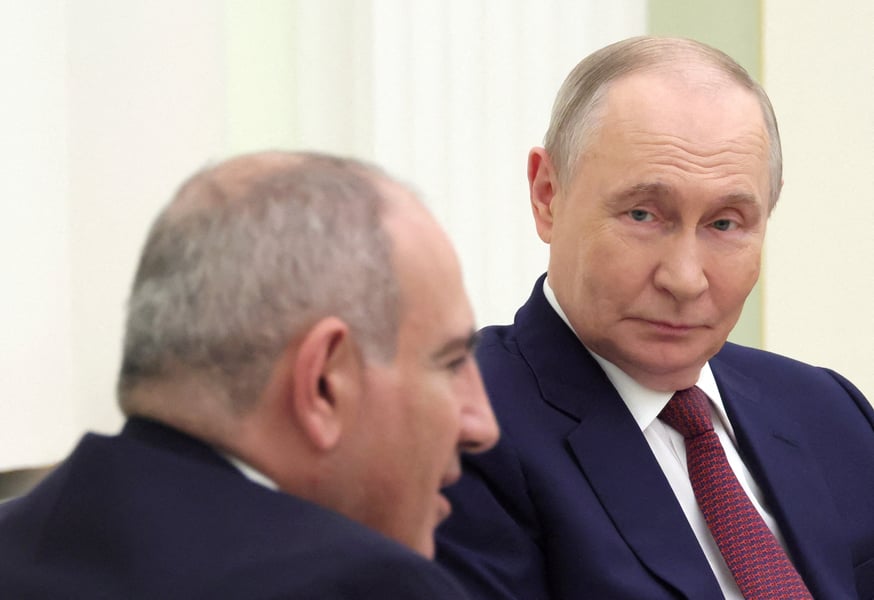
The June 1 phone call with Russian President Vladimir Putin, Pashinyan said Tuesday, was positive. Yerevan’s account of the conversation noted that the prime minister thanked Putin for what the Armenian government described as a “balanced position” and “friendly tone” on issues of disagreement. The Kremlin confirmed the two leaders discussed the fallout from the Astana summit, and Kremlin spokesman Dmitry Peskov clarified that the statement issued by EAEU leaders – the one calling for a referendum – was among the topics on the table.
What, precisely, was agreed, or whether anything was, neither government said. That gap in the public record is not incidental; it is the operative reality of Armenian-Russian relations right now. Both sides have reasons to project calm. Putin faces an election in Armenia in which his preferred outcome – a government more amenable to the bloc’s demands – depends at least partly on Pashinyan not being seen as a man who has been publicly humiliated by Moscow. Pashinyan, for his part, cannot afford to let the Kremlin’s pressure campaign define the final stretch of his campaign.
Polls released in the days before the vote showed Pashinyan’s Civil Contract party heading for a commanding victory, though not the constitutional majority that would let him govern alone and push through the constitutional changes that EU accession would eventually require. According to Euronews, Moscow has mounted a broad disinformation campaign in Armenia in support of pro-Russian opposition candidates, with Reuters reporting that Russia planned to transport tens of thousands of Armenian voters out of the country to influence the outcome.
Against that backdrop, Pashinyan’s pledge to show up at the next EAEU meeting is a small but deliberate move. It tells Moscow he will engage the bloc without conceding the referendum demand that lies at the heart of the dispute. It tells his own voters that he is not stampeding toward an irreversible break with Russia before they have had a say. And it tells the EAEU’s remaining members – Kazakhstan and Kyrgyzstan, both of which signed the Astana statement but have their own complex relationships with Russian economic dominance – that Armenia’s chair at the table remains occupied.
According to Al Jazeera, Putin has warned that simultaneous membership in the EAEU and the European Union is impossible by definition – a position the Russian president reinforced at Astana, where he drew an explicit parallel between Armenia’s EU ambitions and the trajectory that preceded the conflict in Ukraine. Pashinyan has not argued the compatibility point. He has instead argued about the timing of the choice, insisting the decision cannot be put to a referendum until it is no longer a theoretical exercise.
Whether he will be in a position to make good on Tuesday’s pledge depends on who wins on June 7. He has been prime minister since the 2018 Velvet Revolution upended Armenian politics, survived the humiliation of the 2020 Nagorno-Karabakh war and the protests that followed, and rebuilt enough political capital to position himself – heading into this vote – as the man who secured a peace with Azerbaijan and turned Armenia’s face toward Europe. That record does not guarantee anything. What happens at the next EAEU summit, whenever it convenes and whoever leads Armenia by then, will reveal more about the future of Armenian-Russian relations than a one-word answer on a campaign trail ever could.
Earlier this week, Eastern Herald reported that Putin called Pashinyan on his birthday to discuss the Astana summit results and agreed the two leaders would meet. Before the Astana summit, Trump had backed Pashinyan for re-election, calling him a great friend and leader, even as Russia escalated its pressure campaign against Yerevan.
—Inputs from Sputnik.