
SOUTHAMPTON – He was eighteen years old, home from university for the first time, lying on a street in Portswood with stab wounds in his torso, and the police who arrived at the scene put him in handcuffs. The man who had just stabbed him stood nearby, free. By the time Henry Nowak reached hospital, he could not be saved.
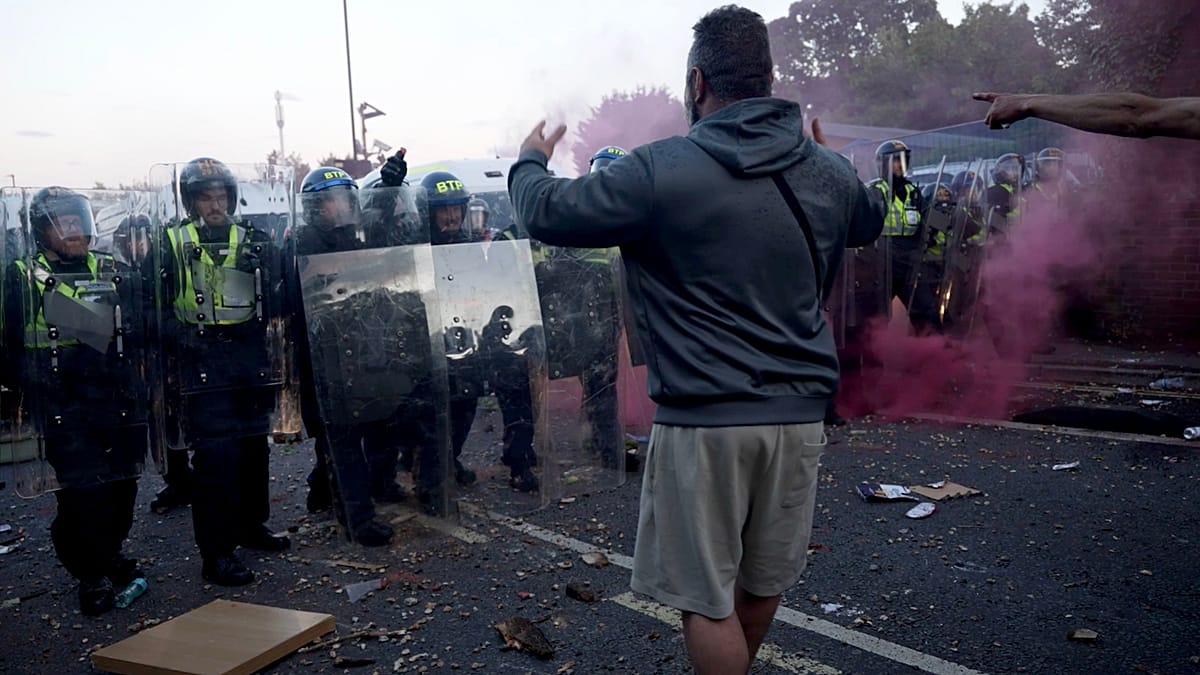
That sequence of events, captured on body-worn camera footage and played to a courtroom full of jurors last month, has now played to the entire country. The reaction has been swift, raw, and in parts violent. On Tuesday evening, more than a thousand people gathered outside Southampton Central Police Station, and a portion of that crowd later marched to Portswood and attacked a police line with bricks, chairs, flares, and a burning bin.
Vickrum Digwa, 23, who fatally stabbed Nowak on 3 December 2025, was sentenced to life imprisonment with a minimum term of 21 years at Southampton Crown Court on Monday. The sentence was not what triggered the unrest. The footage was. In it, Nowak can be heard repeatedly telling arriving officers that he has been stabbed, that he cannot breathe. The officers, who had received a call framing Digwa as the victim of a racist attack, restrained Nowak instead of treating the scene as what it was. Digwa, who is Sikh, had falsely told police he had been racially abused. Judge William Mousley, in his sentencing remarks, was explicit: he did not believe Nowak said anything racist, describing the claim as completely at odds with his character and corroborated by nobody else at the scene.
For Prime Minister Keir Starmer, the footage landed as a political emergency. He said he felt sick watching it and acknowledged there were serious questions about how accusations of racism had shaped the decisions officers made that night. The Independent Office for Police Conduct, which has referred itself into the case, told reporters it is reviewing a large volume of body-worn camera material along with evidence presented at trial, with a report expected within three months. Whether that timeline holds, and what sanctions if any the watchdog will recommend, remains unresolved.
Home Secretary Shabana Mahmood was less equivocal about Tuesday’s disorder. The violence was completely unacceptable, she said, calling it a hijacking of the Nowak family’s tragedy. That word, hijacking, was not accidental. Among those who addressed the crowd outside Southampton police station was Tommy Robinson, the far-right figure who told the gathered protesters that white British people are treated as second-rate citizens by their own police force. Also present was the politician Laurence Fox. Nigel Farage, leader of Reform UK, stopped short of attending but called for what he described as pure cold rage in response to how Nowak had been treated.
The Nowak family has asked, explicitly and in public, that their son’s death not be turned into a vehicle for division. His father Mark, speaking outside the Crown Court after the sentencing, said the family needed real solutions: investment in prevention, stronger action on knife ownership and sale, and what he called a common-sense approach to law and order. It was a statement notable for what it did not say. Mark Nowak did not name race. He did not endorse any of the political movements that have claimed his son’s case as their own. Whether his restraint will hold against the momentum of those invoking Henry’s name is doubtful.
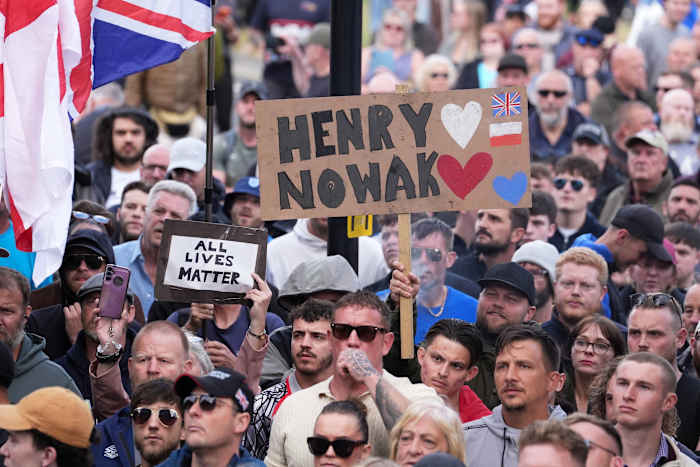
The Sikh community has been placed in an uncomfortable position by the case. A joint statement from Sikh community groups condemned what they called a moment of madness by an individual, but also raised a distinction the groups clearly felt was not being made clearly enough in the public conversation. Digwa, the statement noted, carried both a standard kirpan and a separate 8-inch sheathed dagger. A kirpan is the ceremonial blade Sikhs are permitted to carry as one of the five articles of faith; the large dagger was something else. The judge confirmed Digwa had both. The community statement said that nuance was critically important and had not been explained or understood, including by some of those called to give evidence. Whether that distinction will receive serious attention in a political climate now dominated by far-right framing is uncertain.
The bodycam footage raises questions that the IOPC investigation will need to answer with specificity. The central one is whether the officers who arrived at the scene applied a different standard of restraint to Nowak because they had been told his attacker was the victim of a racist incident. That question sits at the junction of two of the most contested topics in British public life: policing culture and racial perception, and knife crime. Earlier this month, London saw its largest nationalist protest in years, a demonstration that drew tens of thousands and targeted Starmer directly over what organisers described as a two-tier approach to law and order. The Nowak case has arrived as an almost perfectly shaped piece of evidence for that argument, regardless of whether the argument itself is accurate.
What makes the political situation harder for the government is that the legitimate grievance at the centre of this case — a dying teenager was handcuffed by officers who appear to have accepted his killer’s account without scrutiny — is real. The IOPC investigation may find that the officers acted within guidelines, or that the guidelines themselves are the problem, or that individual failures occurred. None of those findings will be available in the days when the political charge is most intense. Starmer’s government has been navigating sustained internal revolt and declining public confidence since the local election results in May; the last thing it needed was a policing scandal with footage that is nearly impossible to watch without anger.
In the United Kingdom, Sikhs are legally permitted to carry a kirpan as a religious article, an exemption to general knife-carrying restrictions that prohibit bladed weapons with cutting edges longer than three inches. Whether that exemption requires reassessment — and if so, how — is a question the government has so far declined to engage directly. The conviction of Digwa for murder was, the judge made clear, not about the kirpan specifically but about the separate large dagger prosecutors say he also carried. That distinction has not penetrated the public conversation, where the specific weapon Digwa used has become secondary to the image of the officers and Nowak on the ground.
Elon Musk posted on X on Tuesday offering to fund a private prosecution against the police over their handling of the murder, a statement that echoes the approach taken in earlier high-profile UK policing cases where victims’ families pursued independent legal routes after watchdog findings were seen as insufficient. Whether such a prosecution would be legally viable is, at this point, unknown. The IOPC has not yet concluded its review. No criminal charges have been brought against the officers involved.
The violence in Southampton on Tuesday night was, by the government’s account, an attempt to exploit a tragedy. By the account of some who were there, it was something rawer and less orchestrated than that — an expression of distrust toward a policing institution that the footage appeared to confirm. Both things can be true at once. The officers who handcuffed Henry Nowak may face consequences that have nothing to do with Tommy Robinson, and the presence of Tommy Robinson at the protest does not mean the question those officers must answer is illegitimate. Britain’s institutions are already under acute pressure over the treatment of vulnerable people at points of state contact; the Nowak case has added a new and combustible dimension to that reckoning.
What the IOPC ultimately finds — and when, and whether the government acts on it — is the unanswered question at the centre of everything now happening on the streets of Southampton.
Related Posts