
OTTAWA — The man who spent years warning Parliament that Canada was already in an undeclared strategic contest with China went public again on Sunday, and this time the target of his warning was his own government’s foreign policy.
Retired Gen. Wayne Eyre, who served as Canada’s chief of the defence staff until mid-2024, urged the Carney government to be “very wary” of pivoting toward Beijing and Moscow as Ottawa seeks to cushion itself against the economic unpredictability of the Trump administration. The warning, delivered in a CTV News interview, was notable less for what it said than for who said it — and when.
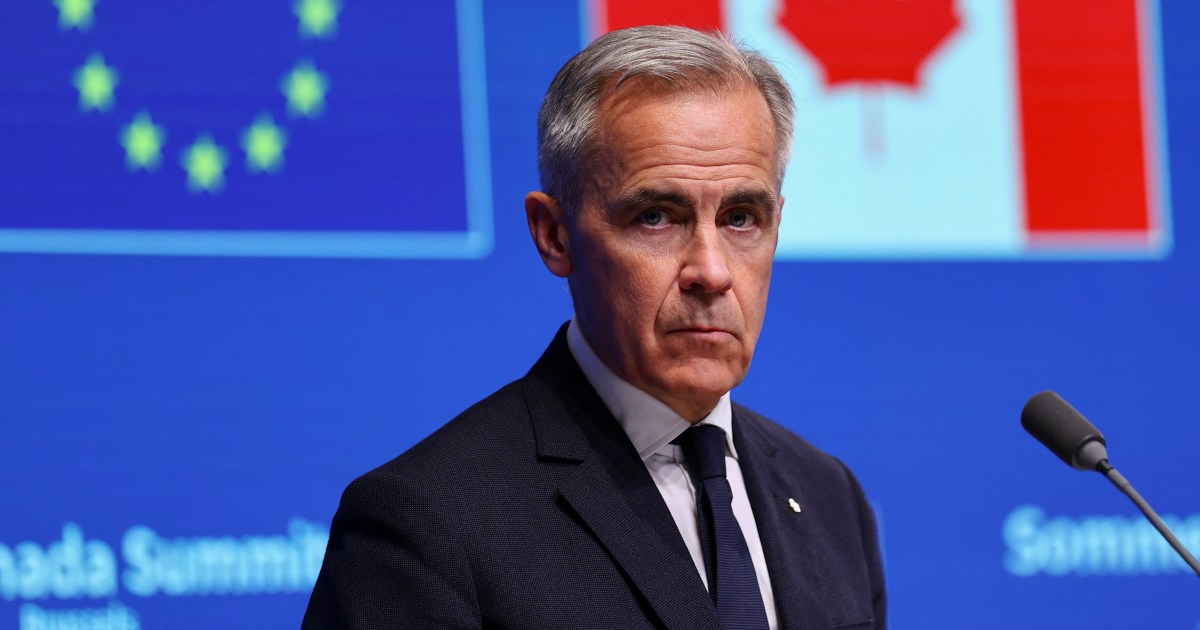
Five months have passed since Prime Minister Mark Carney flew to Beijing and announced what his government called a “strategic partnership” with China, securing reduced tariffs on Canadian canola in exchange for lowering duties on Chinese electric vehicles. The deal was framed as the centrepiece of Canada’s drive to double exports to non-U.S. markets by 2035, a goal Carney had made central to his pitch for strategic autonomy. Eyre’s intervention on Sunday amounts to the most senior military voice yet to question whether that arithmetic holds.
“Canada needs to be very wary of its relationship with China and Russia,” Eyre said, adding that any pivot away from the United States must not come at the expense of Ottawa’s core alliance relationships. He did not name specific policies, but the timing left little ambiguity about which ones he had in mind.
Eyre is not a voice easily dismissed. As chief of the defence staff, he appeared before House of Commons committees to warn that Canada was effectively “at war” with China and Russia in the strategic-competition sense — a framing that drew controversy at the time but that subsequent intelligence disclosures have done little to contradict. He warned separately that China was “aggressively” recruiting western military personnel to train People’s Liberation Army fighter pilots, a concern shared by the Five Eyes intelligence alliance. He left office with what he described as a full notebook of concerns about Canada’s defence readiness.
The question he raises now is whether the economic logic driving the Carney government’s China engagement has fully accounted for the security costs. That question has no public answer.
Canada’s intelligence community has not publicly assessed what the January partnership’s “public safety and security” pillar means in practice for Chinese state operations on Canadian soil. Carney has said he set “guardrails” on the relationship, but the specific content of those restrictions has not been disclosed. Whether Eyre’s warning reflects private conversations with active defence officials — or classified assessments Ottawa has received since the Beijing summit — is not known. He has not said. The partnership’s architecture was most recently tested when Chinese Foreign Minister Wang Yi visited Ottawa in late May, the first such visit in a decade, without producing any public disclosure of the guardrail terms.
The tension Eyre is pointing at is structural. Canada entered 2026 at what Carney himself has called a “hinge moment,” forced to decide whether economic diversification requires a degree of strategic realignment that its alliance partners — above all Washington — will treat as defection. The Chatham House think tank noted in January that when allies begin describing authoritarian rivals as more reliable than the United States, something fundamental in the alliance architecture has shifted. Carney’s comment in Beijing that the China relationship was now “more predictable” than the American one was the sentence that concentrated minds in Washington.
Eyre’s warning sits inside that same unresolved tension. Trade diversification, which virtually every serious analyst across the political spectrum supports, is a different proposition from strategic partnership — a phrase that carries obligations and signals that the canola deal alone does not explain. The Macdonald-Laurier Institute, a conservative-leaning Ottawa think tank, flagged in January that the partnership’s people-to-people and public safety pillars could expand the reach of China’s Ministry of State Security in Canada in ways the economic benefits do not offset.
The Carney government has not publicly responded to Eyre’s comments. A spokesperson for the Prime Minister’s Office did not immediately respond to a request for comment.
The strategic bind is genuine and not easily resolved by either side of the argument. Canada’s China trade is growing — Trans Mountain pipeline expansion drove oil shipments outside North America to an all-time high in October 2025, according to RBC analysis, and Chinese canola tariff relief represents real relief for Western Canadian agriculture. The economic case for engagement is not invented. Neither, Eyre would argue, is the risk. The broader public mood has also shifted: polling conducted in spring 2026 found that Canadians have sharply reduced travel to the United States and express record-low trust in Washington as an economic partner, a sentiment the Carney government has cited repeatedly as political cover for the Beijing pivot.
What Sunday’s intervention does is put a name and a rank behind a concern that has until now lived mostly in think-tank papers and opposition talking points. Eyre carries the credibility of someone who sat in classified briefings for years, who watched Chinese military recruitment operations target his own personnel, and who left office warning that Canada’s strategic isolation was ending whether it chose that or not. His argument is not that Canada should return to unconditional dependence on the United States. It is that replacing one form of dependency with another is not the same as sovereignty.
Whether the Carney government’s China guardrails are sufficient to answer that concern is a question Ottawa has not yet answered in public — and may not intend to.