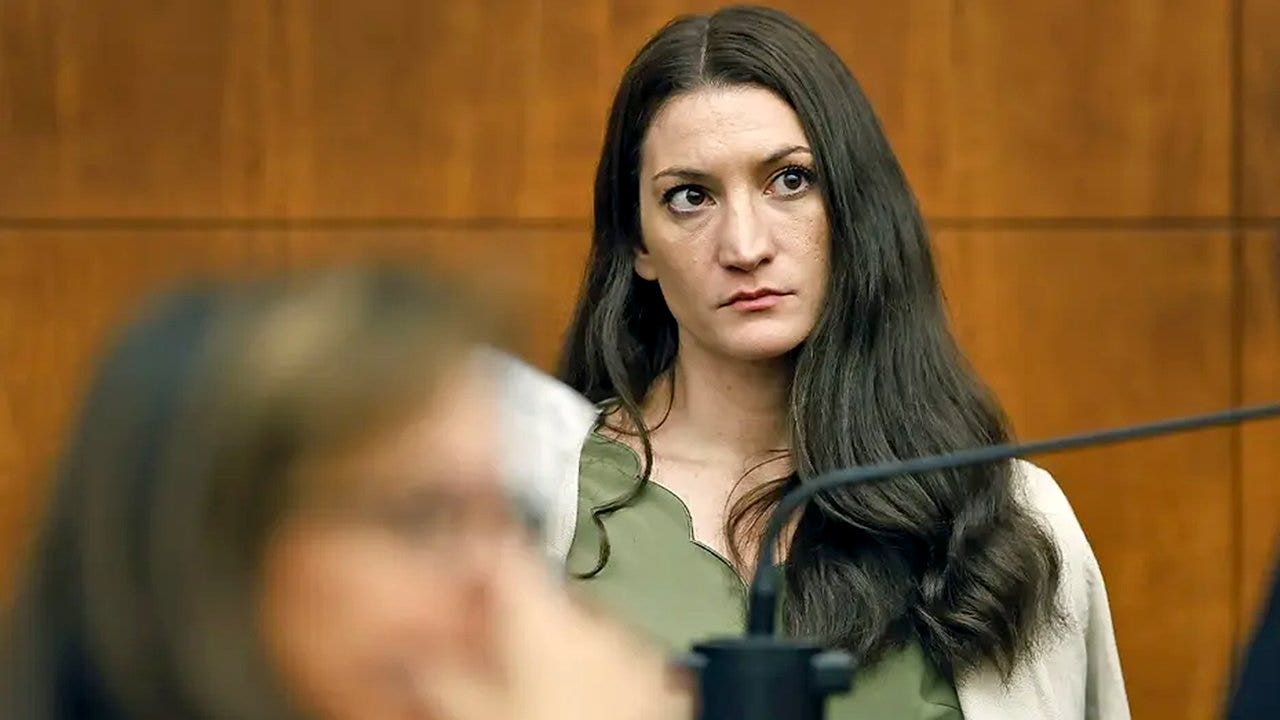

DUXBURY – When Lindsay Clancy arrived at Plymouth Superior Court last Thursday in a wheelchair, the paralysis that has defined every day since January 24, 2023 was visible to the jury before a word of testimony had been spoken. The twelve women and six men who will decide whether Clancy is guilty of murdering her three children watched her enter a courtroom where prosecution and defense have agreed on only one fact: that Cora, age 5, Dawson, age 3, and Callan, eight months old, died that night in the family’s Duxbury home.
Prosecutors allege that Clancy, then a labor and delivery nurse at Massachusetts General Hospital, sent her husband Patrick out on errands, strangled each of the three children, and then jumped from a second-floor window. The fall left her paralyzed from the waist down. She faces three counts of murder and three counts of strangulation.
Defense attorney Kevin Reddington opened before the jury on Monday and framed the case immediately in medical terms. “Even though we’re in a court, let’s talk a little bit about humanity,” Reddington told the jury, Fox News reported, arguing that at the time of the killings Clancy was suffering from postpartum psychosis, a rare and severe form of mental illness he linked to the hormonal disruption, sleep deprivation, and cumulative stress that follow multiple childbirths in rapid succession. His argument is that Clancy did not understand what she was doing and therefore cannot be held criminally responsible under Massachusetts law.
Prosecution ADA Sprague answered directly. “The Commonwealth did not choose the number of victims,” she told the jury. “The defendant did.” The prosecution’s position is that Clancy planned the killings deliberately, understood what she was doing, and bears full criminal responsibility for the deaths of all three children.
Before the jury was sworn in Thursday, Judge William Sullivan ruled that the 911 call placed when Patrick Clancy discovered his children and autopsy photographs would not be made available to media. NBC Boston reported a heated courtroom exchange preceded the ruling, with defense attorneys raising concerns about the distribution of sensitive materials and the prosecution noting that the same standards applied to all parties. The trial is expected to last six to eight weeks with more than 200 witnesses. Judge Sullivan is presiding at Plymouth Superior Court.
Patrick Clancy, who divorced his wife after the killings, is expected to be the first witness called. His testimony is likely to provide the most direct account of the domestic circumstances on January 24, 2023, including what errands he was sent on, what he found when he returned, and what he understood about his wife’s mental health in the weeks before the children died.
Clancy was a working nurse with three children under six at the time of the killings. In the months following Callan’s birth in spring 2022, according to the defense, her mental state deteriorated significantly. Reddington’s legal strategy depends on persuading jurors that the psychosis she experienced was severe enough to constitute what Massachusetts law recognizes as an inability to appreciate the wrongfulness of one’s conduct, the legal standard for an insanity acquittal.
Criminal defense attorney Donna Rotunno, a legal commentator who reviewed the case, said an insanity defense is “usually a hard battle to win.” Juries in similar cases have often found evidence of apparent planning sufficient to reject the claim that a defendant lacked understanding of their actions. The prosecution’s framing of Clancy as someone who planned each killing is designed to preempt that medical argument at its most persuasive.
The trial’s scale reflects how contested the underlying questions are expected to be. More than 200 witnesses are listed, the projected duration is six to eight weeks, and the jury of twelve was drawn from a larger panel of eighteen, including six alternates, selected over several days. Expert witnesses on psychiatric diagnosis and peripartum mental illness are expected to appear for both sides.
What the trial cannot fully reconstruct is what Lindsay Clancy said, thought, or believed during the hours Patrick was away. That interior account, accessible to no one but Clancy herself, is likely to remain the most contested and most unknowable element of the proceedings.