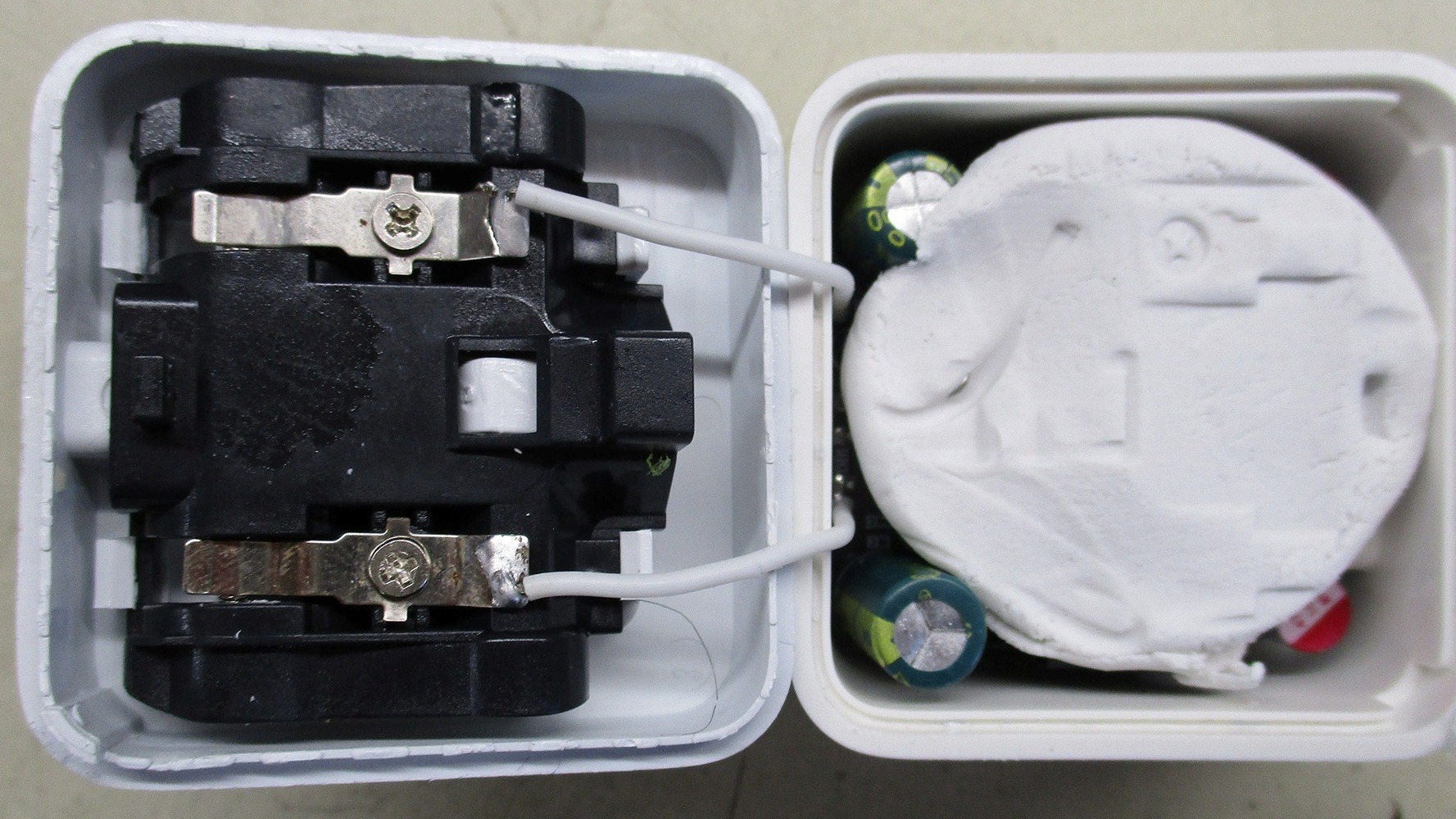

LONDON — The charger arrived in an Apple box, bore the Apple logo, and cost £11.99 on eBay. When researchers at the consumer watchdog Which? cracked it open, they found modelling clay.
Not a circuit board defect. Not a missing component. Modelling clay — the kind used in primary school art classes — packed inside a counterfeit USB-C power adapter to give it enough heft to feel genuine in the hand. Ten seconds into a standard electrical strength test, arcing sounds confirmed what the clay already suggested: current was jumping between parts of the circuit in ways that could cause the device to catch fire, explode, or deliver a lethal shock to whoever was holding it. One customer had already discovered this without a laboratory. They posted on the eBay listing to report that the charger had overloaded and ruined their iPad and iPhone.
Which? published its findings on Tuesday. The organisation had bought 15 USB phone chargers from seven online platforms — Amazon, Amazon Haul, AliExpress, B&Q Marketplace, Debenhams Marketplace, eBay, Temu, and Shein — and subjected each to the battery of tests required under UK safety standards. Nine of the 15 failed. Eight of those nine posed a risk not just of electric shock but of fire and explosion. Every single one of the 15 was missing legally required markings or documentation, which under existing law should have prevented them from being sold in the United Kingdom at all.
The timing is not coincidental. On 31 March, the UK government launched a formal consultation on new regulations to govern online marketplaces under powers created by the Product Regulation and Metrology Act 2025. That consultation closes on 23 June — 13 days from now. Which? is not merely reporting a consumer hazard. It is submitting evidence into an open legislative window.
Sue Davies, Which?’s head of consumer protection policy, was precise about the problem. Online marketplaces, she said, have been aware of the danger posed by counterfeit chargers for close to a decade. The danger has not diminished. The government, Davies argued, must use the powers granted by the Product Regulation and Metrology Act to impose a statutory duty of care on platforms — making them legally responsible for unsafe products listed by their third-party sellers, and backing that duty with enforcement mechanisms that carry meaningful penalties.
That ask is exactly what the government’s consultation is weighing. The proposed framework, as outlined in an analysis published by Mayer Brown, would require online marketplaces to take reasonable and proportionate steps to prevent dangerous products from appearing on their platforms, to conduct due diligence on sellers including verification of contact details, and to maintain cooperation channels with regulators. For higher-risk product categories — and counterfeit electrical goods have never not been high-risk — platforms could face additional pre-listing compliance checks before a product goes live.
What the consultation has not resolved is enforcement. The Act provides for both criminal and civil sanctions. What it does not yet specify is the size of penalties or the threshold at which they apply. Which?’s investigation offers a pointed illustration of why that detail matters. A counterfeit Apple charger was listed, sold, and used until it destroyed two devices. The listing existed on a platform that has the technical capacity to detect unusual seller patterns, mismatched product weights, and duplicate Apple branding. The question is not whether the platform could have caught it. The question is whether the law gives authorities the tools to hold the platform responsible for not catching it.
Lesley Rudd, chief executive of Electrical Safety First, a UK charity that has run its own tests on counterfeit Apple chargers, said the criminal motive here is explicit. Counterfeiting, Rudd said, is a very intentional act, driven solely by the desire to maximise profit by cutting corners on safety. The charity’s own research has found criminals using metal weights — not modelling clay — to simulate the heft of genuine Apple products. Which?’s Debenhams Marketplace find echoed that pattern: the same deception, a different platform.
The range of price points across the failing chargers complicates any simple buy-cheap-get-what-you-pay-for narrative. Yes, the £2.10 and £2.80 unbranded chargers from eBay failed. But so did the £10.99 Super Fast Charger from B&Q Marketplace and the £9.99 Dual Port 35W model from Debenhams, both priced to signal legitimacy. The modelling clay in the Debenhams listing was not a cut-rate shortcut. It was a deliberate deception — a decision made somewhere in the supply chain to invest effort in fooling buyers rather than in building a safe product.
Amazon, B&Q, Debenhams, and eBay all confirmed they had removed the specific listings, each saying consumer safety was a priority. None said what structural changes, if any, they planned to make to prevent equivalent products from appearing on their platforms tomorrow. That is the question the consultation is designed to answer. The UK’s approach to regulating digital platforms has come under repeated scrutiny in recent years, and the Which? evidence — published with a precision that suggests the timing was deliberate — now sits on the record.
What remains unclear is whether the government will set enforcement penalties substantial enough to shift the commercial calculus for platforms that currently profit from third-party seller volume regardless of what those sellers are peddling. The consultation closes 23 June. The next time a modelling-clay charger burns someone’s home, it will be worth asking what Parliament decided to do with the 13 days it had.