
MOUNTAIN VIEW, Calif. — Paris Hilton has ADHD. Her brain, by her own account, runs faster than most systems are built to handle. Ideas pile up. Tasks scatter. The standard productivity app was always someone else’s solution to someone else’s problem. So when Google set her down inside a custom-built workspace on its Mountain View campus last week and handed her access to Gemini Canvas, she did not try to learn software development. She just described what she needed.
Three prompts later, the app existed.
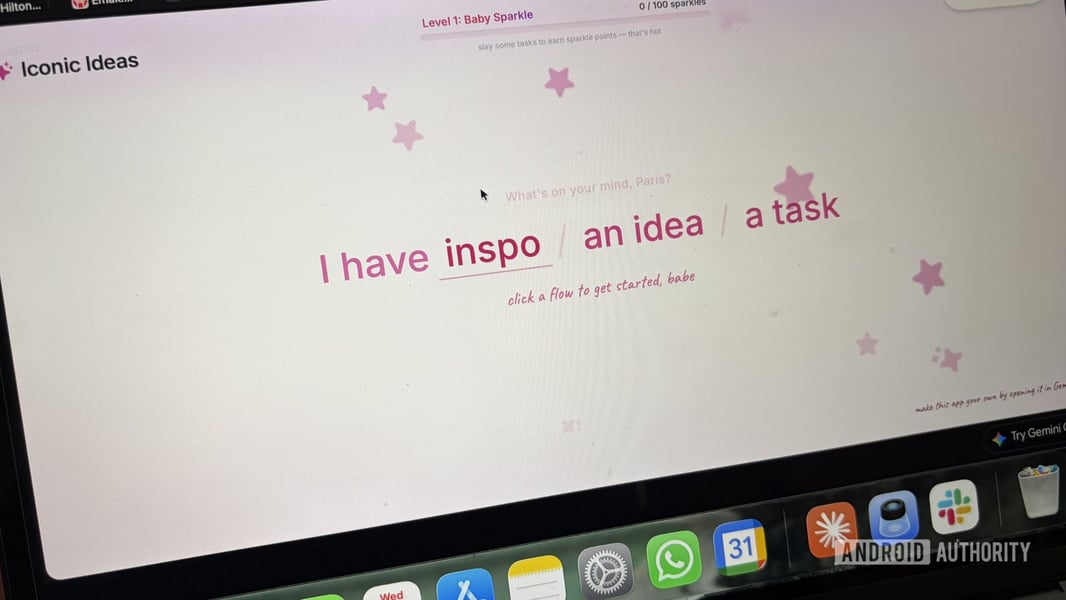
That is the entirety of Google’s argument. Not that Paris Hilton is a tech genius — though she has long described herself, accurately, as an “undercover nerd” — but that the distance between an idea and a working piece of software has collapsed so dramatically that a person with no engineering background, working from a personal productivity problem, can close it in an afternoon. According to Google’s own account of the session, Hilton walked out with a functional app called Iconic Ideas: pink, sparkly, gamified with something called sparkle points for completed tasks, and — this is the part that matters — genuinely suited to the way her mind works rather than the way a developer imagined a user’s mind might work.
Google named Hilton Android’s first “icon in residence” on June 9, a title that reads like marketing until you examine what the company actually had her do. This was not a product endorsement. It was a capability demonstration — and a pointed one. The target audience is not Paris Hilton fans. It is every person who has ever had a specific operational need, looked at the available software, found nothing that fit, and accepted that gap as permanent.
Gemini Canvas, the tool at the center of this, is Google’s interface for building apps, infographics, and interactive tools through natural-language conversation. You describe what you want. The system generates it. You refine through further prompts. No code is written by the user at any stage. The platform has been available for months, but the Hilton partnership is the most prominent demonstration of what it can produce when handed to someone with a clear creative brief and zero technical constraints in her thinking.
What Iconic Ideas does is, on its face, modest: it captures ideas, organizes tasks, generates visual mood boards from scattered thoughts, and rewards completed items with sparkle points. The interface is entirely pink. The UX reflects the way Hilton says her ADHD brain processes information — jumping between concepts, needing visual anchors, benefiting from the light gamification that makes finishing something feel like something. A developer building for a generic productivity user would not have made any of those choices. Hilton made all of them in a conversation.
The app is publicly available via Gemini Canvas, and users can open it, modify it, or use it as a template to build their own version. Google’s pitch, made explicit in the campaign materials, is that this is now the floor of what anyone can do — not the ceiling of what a celebrity with access to a tech giant can accomplish.
There is a larger shift underneath all of this that Google is not quite naming directly. The traditional model of software development has a fixed cast: engineers write code, product managers define requirements, designers handle appearance, and everyone else uses what comes out the other end. That division was never about aptitude. It was about access to tools that required years of training to operate. Canvas, and tools like it from competitors including Microsoft’s Copilot Studio and Anthropic’s artifact-building features, are eroding the technical layer that maintained that division. The question is how far erosion can go before the distinction between “building an app” and “having an idea” effectively disappears.
What the Hilton demonstration cannot answer — and what Google’s promotional framing is careful not to address — is what happens after the prototype. Iconic Ideas works for Paris Hilton’s productivity workflow, deployed through Gemini’s sharing infrastructure. Scaling it, hardening it against edge cases, connecting it to enterprise systems or payment backends, maintaining it as the underlying model changes: none of those questions were tested in the Sliv Lab at Google’s campus. Google’s own AI ambitions have been complicated by internal tension over how aggressively to push AI-generated software before reliability questions are settled.
The generational dimension of the partnership is harder to dismiss. After building her app, Hilton invited young women from the YMCA of Metropolitan Los Angeles and Altadena Girls to Google’s campus for an afternoon innovation challenge. The applications they produced — a well-being social network, a virtual hairstyle try-on tool, a school safety app that shares a student’s location with parents and flags hazards along walking routes home — were built in hours using the same Canvas tools. The challenge winner was a teenager who had never written code. That is not a marketing anecdote. It is a data point about what the next generation of software creation looks like when the technical gatekeeping is removed.
Google’s campaign hashtag is #IconicAndroid. The broader contest for AI platform dominance between Google, Apple, and Microsoft will not be decided by a productivity app in Hilton’s aesthetic. But the underlying capability being demonstrated — that a clear idea, articulated in plain language, is now sufficient to produce a working piece of software — is a structural change in who gets to build. That shift was happening with or without the sparkle points. Google just found a particularly effective way to put it on camera.
Hilton’s own framing of what the experience meant was less corporate. “For the first time,” she wrote in the Google blog post announcing the partnership, “I felt like the distance between imagination and execution had become dramatically smaller.” What remains genuinely unclear is how small that distance will eventually get — and whether the infrastructure can keep up with the ideas.