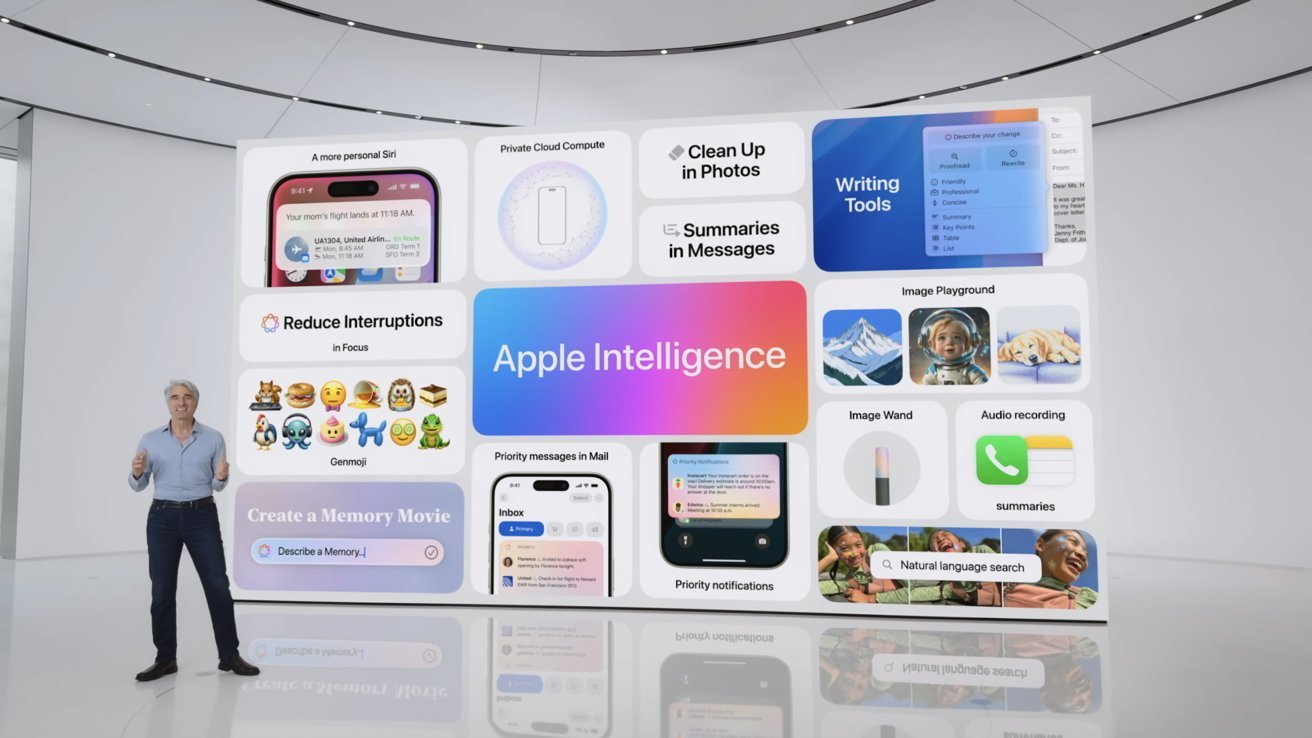

CUPERTINO — The room had no name on the calendar invite that would have signaled its importance. Somewhere near Apple’s software engineering wing in early 2025, a group of senior executives gathered to confront what insiders were already calling a crisis: Apple Intelligence had underdelivered, Siri’s promised overhaul was slipping, and the rest of the technology industry was accelerating away.
Tim Cook was not in the room. That detail matters more than it might seem.
It was Jeff Williams, then Apple’s chief operating officer and now retired, who called the meeting to order. Craig Federighi, Apple’s software chief, led most of the substantive discussion. Also present were former interface design head Alan Dye, Vision Products Group lead Mike Rockwell, and, crucially, John Giannandrea — the man whose tenure as Apple’s artificial intelligence chief was quietly on the line. According to Bloomberg’s Mark Gurman, who reported on the meeting’s dynamics in his Sunday newsletter, the gathering quickly turned into something closer to an intervention than a strategy session.
The executives in that conference room understood what Cook did not yet know in real time: Apple’s AI position had become genuinely precarious. Features promised for Siri had failed internal testing. The foundation model team, comprising only around 50 to 60 researchers, had lost a string of senior talent to Meta, OpenAI, and Anthropic at compensation levels Apple was unwilling to match. Ruoming Pang, who had led Apple’s Foundation Models group, had departed for Meta after being offered a reported $200 million package. What was left was an AI division in structural disarray, with a public credibility deficit growing by the week.
The meeting, as Gurman reconstructed it, was the moment Apple’s senior leadership formally acknowledged that something had to break.
Federighi dominated the discussion, but it was Rockwell who volunteered for the hardest assignment. His credibility inside Apple was high: the Vision Pro headset, for all the market skepticism it has faced, had shipped. That counted for something in a culture that values product delivery above theoretical excellence. Rockwell raised his hand, in effect, to take over Siri.
What followed was a negotiation within the negotiation. Rockwell, by Gurman’s account, had assumed he was being considered to replace Giannandrea entirely — to become Apple’s AI leader in full. Federighi had a narrower mandate in mind: Rockwell would take Siri and report to him, not directly to Cook. Rockwell pushed back. He read Federighi’s framing as a signal that Siri, and by implication AI itself, was still not being treated as a top-tier strategic priority at Apple. He began walking away from the role.
The impasse resolved not because either man changed his mind entirely, but because the alternative was worse. By March 2025, Rockwell had accepted the Siri position under Federighi. Giannandrea’s oversight of the assistant was formally stripped. What remained of his broader AI responsibilities — foundation models, machine learning research, robotics — was redistributed across Federighi, Eddy Cue, and hardware chief Sabih Khan. Giannandrea announced his retirement and was placed in an advisory capacity he appears to have occupied only nominally, before departing Apple Park entirely as his vested stock options concluded.
He was replaced, on the model side, by Amar Subramanya — a researcher who had spent 16 years at Google and more recently served as corporate vice president of AI at Microsoft. Subramanya took charge of foundation models, machine learning research, and AI safety. It was a considered hire, one that signaled Apple was no longer trying to build its AI leadership from within its hardware-centric culture.
Cook, meanwhile, had drawn his own conclusions from watching the crisis unfold. He was not in the room when it began, but he became far more present once it was clear what the room had decided. Cook began inserting himself directly into the AI roadmap — reviewing decisions, attending planning meetings, and, by Gurman’s account, delivering what amounted to a company-wide AI pep talk. For a chief executive who has spent most of his tenure delegating product decisions to his reports, the personal intervention was striking. Federighi and others were told, in terms that left little ambiguity, to treat artificial intelligence as the organizing principle of Apple’s next several years of software development.
Federighi appears to have taken the instruction seriously. His public posture on AI has shifted perceptibly since that period. He now describes AI not as a feature category but as the central axis around which iOS, macOS, and the rest of Apple’s operating systems will be built for the foreseeable future. Whether that represents genuine conviction or institutional adaptation to Cook’s directive is a question Apple’s culture does not answer publicly.
The third consequence of that early 2025 meeting was the most operationally dramatic. Rockwell, tasked with rebuilding Siri from a position of significant organizational weakness, concluded that Apple could not close the gap with the industry through internal model development alone. The talent losses were too severe. The time horizon was too short. He began looking at outside solutions.
Talks with Anthropic stalled over price — the AI startup reportedly sought several billion dollars annually. OpenAI presented a different problem: it was actively recruiting Apple engineers and had formed a hardware partnership with former Apple design chief Jony Ive that put it in structural competition with Apple’s own ambitions. That left Google. By August 2025, Rockwell had revisited Gemini and found the technology had advanced to a point where it could serve as the foundation for Apple’s new model layer. In January 2026, Apple and Google announced a multiyear collaboration under which the next generation of Apple Foundation Models would be built on Gemini and Google Cloud infrastructure. Rockwell, Federighi, and Cue had negotiated the deal.
The arrangement is technically unusual. Rather than simply routing Siri queries to Google’s servers, Apple licensed Gemini’s model weights to run inference within its own Private Cloud Compute infrastructure — keeping user data inside Apple’s security perimeter while benefiting from a model built at a scale Apple had not achieved internally. The custom model Apple is running, internally designated Apple Foundation Models version 10, operates at approximately 1.2 trillion parameters, according to Bloomberg’s reporting — roughly eight times the scale of the model that powered Apple Intelligence in the cloud before the partnership.
What remains unresolved, heading into Monday’s WWDC keynote, is whether the organizational turbulence of the past 18 months has bought Apple enough time to matter. The restructuring happened, the deal was signed, iOS 27 arrives Monday with Siri positioned as its centerpiece. What the meeting in early 2025 cannot answer is the competitive question: whether the new Siri, underpinned by Gemini and guided by Rockwell, can close the distance with systems that never had to be rescued in the first place.
That is a judgment the market will make, beginning Monday morning.