
MILAN – The company Italians use to split restaurant bills and pay at the supermarket wants to manage their retirements too. Satispay, the Milan-based payments unicorn, announced Thursday it is seeking up to €120 million in fresh capital — money it plans to use to unlock what its chief executive calls a national paradox: one of Europe’s wealthiest countries, where the majority of household savings earn almost nothing.
The raise is structured as a pre-emptive rights offering to existing shareholders, with a vote scheduled for June 29. About half is already committed, backed by returning investors Addition, Greyhound Capital, and Lightrock — the same firms that anchored Satispay’s €60 million round in late 2024 and its €320 million Series D in 2022, which first pushed the company’s valuation above €1 billion. That figure is intact. The remaining capital leaves room for acquisitions alongside organic expansion.
The numbers Satispay brings to that ambition are not trivial. Annualised revenue stood at €116 million as of May 31, up 80% year-on-year over the past two quarters, FF News reported. The user base has crossed 6.5 million. Some 450,000 merchants accept the app. Total deposits reached €670 million last month. These are real operating metrics, not projections from a company that has not yet found its product.
What Satispay does not yet have — and what this raise is designed to buy — is the behavior change.
Italy holds roughly €1.27 trillion in household bank deposits, the vast majority parked in overnight accounts at rates that barely keep pace with a café bill. Research from Banca d’Italia found that only 15% of Italian households held government bonds as of 2024, even after a surge in retail bond purchases prompted by the government’s BTP Valore program. Equity ownership among ordinary Italians remains far below northern European norms. The money is there. Moving it has defeated every previous attempt.
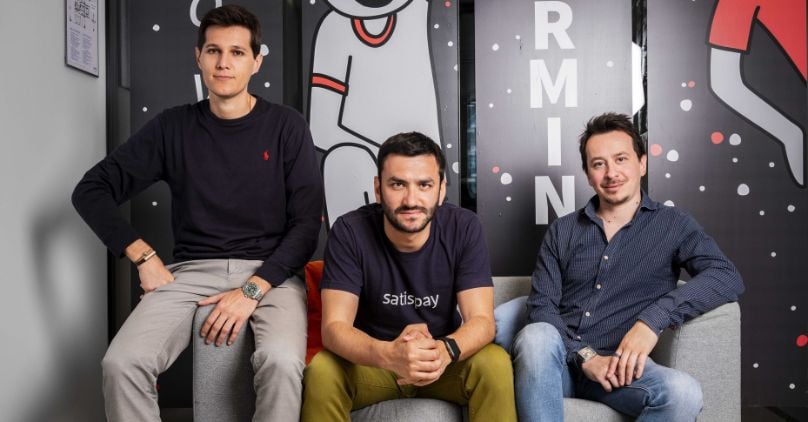
Alberto Dalmasso, who co-founded Satispay in 2013 alongside Samuele Pinta and Dario Brignone, said the company’s answer is friction reduction rather than financial education. “We believe that investing should be within everyone’s reach, with the same ease with which people manage money in their daily lives today,” Dalmasso said. The company plans to open pension fund subscriptions to consumers by autumn and to add stock and ETF purchases directly inside the app by year-end.
The pitch rests on a distribution advantage that Satispay’s European rivals have not been able to replicate in Italy. Revolut, with more than 52 million global customers, already offers commission-free stock and ETF trading across Europe. N26 has ETF investing built into its banking app. Trade Republic has been building an Italian user base among younger savers since 2023. None of them, however, operates a proprietary payment network embedded inside 43,000 Italian companies through a corporate welfare program that processed €420 million in annualised volumes through May, according to Tech Funding News.
The welfare business, which allows employers to fund meal vouchers, transport benefits, and other perquisites through the Satispay app, is itself a recent addition. Three years ago it did not exist. Its 250% year-on-year growth rate has changed the company’s economics: the company now generates a gross operating profit across all core business lines, including payments, welfare, and value-added services such as mobile top-ups and gift cards. The company is targeting €700 million in annualised welfare volumes by the end of 2026.
Satispay already has 500,000 users on its investment products — a money market fund operated in partnership with Amundi and a managed portfolio option — with €140 million in assets under management. Nearly 70% of those users have set up a recurring investment plan. The company eliminated all fees on its money box product to accelerate adoption. Buy now, pay later has been used by more than 35,000 people on transactions totalling over €6 million since its late-2025 launch, with an annualised projection of €60 million.
The case Satispay is making to its existing shareholders is that the next step — moving from a welfare and savings platform to one that handles pension subscriptions and direct equity ownership — is a natural extension rather than a pivot. The company built a proprietary payment network first, layered welfare and savings on top of it, and is now positioning those products as the on-ramp to capital markets that Italian households have historically lacked. As Bloomberg reported, the round reaffirms the company’s billion-euro valuation while preserving flexibility for bolt-on acquisitions of complementary businesses.
Lee Fixel, who founded Addition after leaving Tiger Global and previously backed Flipkart, has been one of Satispay’s most consistent investors since 2022. Greyhound Capital, based in London, has held a stake since 2018. Lightrock joined in 2020. Their collective return for this round reflects continued confidence in founders who retain a controlling role in the company’s governance — an arrangement that has so far allowed Satispay to resist the pressure to internationalise before its home market is fully converted.
That choice to stay Italian, at least for now, is the most interesting strategic bet in the room. Unlike Revolut or N26, which are pan-European plays chasing scale across dozens of markets, Satispay has spent a decade building something that looks less like a bank and more like a consumer payments utility — low-margin, deeply embedded, daily-use. The theory is that daily use is the hardest competitive moat to replicate, and that from inside a payment habit, the jump to a savings habit is shorter than it looks.
What that argument cannot yet account for is the behavioral question. Every fintech that has tried to move Italian savers into equity markets has encountered the same obstacle: the saving habit is deeply ingrained and long-standing. A broader shift in digital banking toward integrated financial services has accelerated across Europe, but Italy has consistently lagged the continent in retail investment participation. Satispay has built a better mousetrap. Whether the mice will walk in by autumn is the question the next 18 months will answer.
In 2022, when Satispay first crossed the unicorn threshold, the investment products barely existed. The welfare platform was nascent. The app was, essentially, a payments company trying to grow beyond payments. That it has done. Whether it can now grow into something that competes with traditional asset managers for the savings of 6.5 million Italians is a different challenge entirely — and one no Italian fintech has yet solved.