
SAN FRANCISCO – For most of the internet’s existence, searching meant typing a few words into a box and deciding, yourself, what to click. That transaction – human curiosity, human judgment, human choice – is what Google was built on. At its annual I/O developer conference in May, Google announced it is engineering that transaction out of existence.
AI Mode, the company’s conversational layer built atop its search engine, has now crossed one billion monthly users globally, according to figures Google disclosed at I/O 2026. The milestone arrived in the same week Google unveiled what it intends to do next: replace the act of searching with autonomous artificial intelligence agents that monitor the web on a user’s behalf, continuously, without being asked.
The implications extend well beyond product design. If the agents work as described, the browser tab, the query box, and the list of blue links – the three visual pillars of the internet as most people have understood it for twenty-five years – will become optional rather than essential. Most users will never see the pages their agents read for them.
The search box itself has been redesigned for the first time in more than two decades. It now accepts images, files, videos, and open Chrome tabs alongside typed text, and it dynamically expands to accommodate longer, more conversational queries. AI-assisted query suggestions, replacing the old autocomplete system, push users toward longer and more specific questions that the underlying model can answer more completely. Neither of those changes is the central one.
The central change is the Information Agent. Users can now create dedicated AI agents inside Search that run continuously in the background – scanning news sites, blogs, social media feeds, and real-time data streams for topics they define. Rather than searching for updates on a market trend, a legal case, or a competitor’s product, the agent synthesizes changes and delivers actionable briefs. Google describes it as the successor to Google Alerts, though that description undersells the ambition considerably. Alerts checked whether a string of text appeared somewhere new. Agents are meant to understand what changed and why it matters.
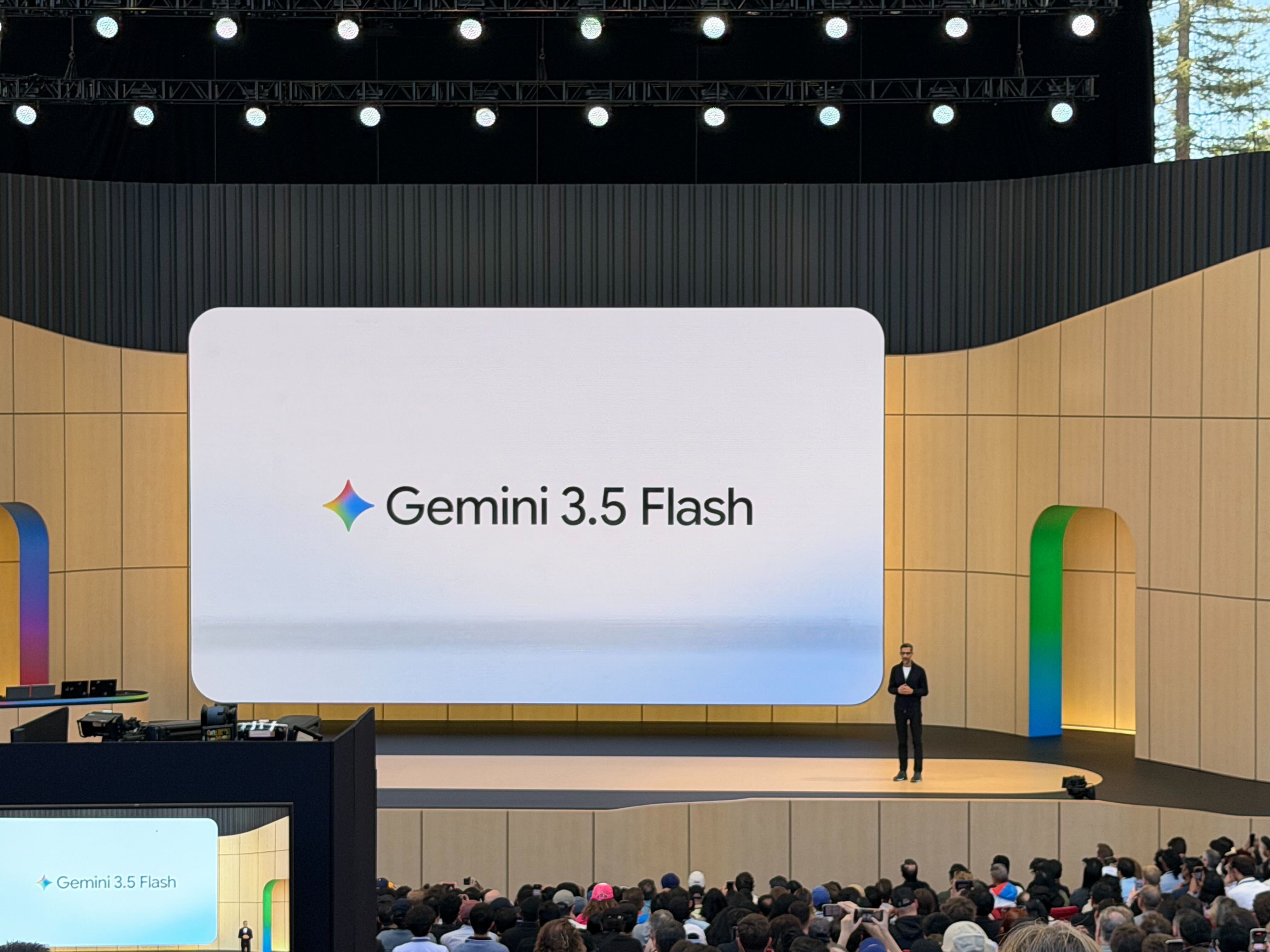
The model powering all of this is Gemini 3.5 Flash, which became the default in AI Mode globally on the day of the I/O announcement. Koray Kavukcuoglu, Google DeepMind’s chief technology officer, described Flash’s design at the conference as optimized specifically for agentic work – running multiple agents simultaneously on long-running tasks, executing complex coding operations independently, and managing what he called “cyclical research projects” without human intervention. Onstage, Google engineers demonstrated agents that built a functional operating system from scratch inside Antigravity, the company’s new agentic development environment, with no human directing the individual steps.
Antigravity itself is Google’s answer to the fragmentation that has defined AI development tooling for the past two years. Unveiled as version 2.0 at I/O, it is simultaneously a standalone desktop application, a command-line interface for developers, and a software development kit. Its defining feature is agent orchestration – the ability to spin up multiple AI agents working in parallel on component tasks before recombining their outputs. Google’s Gemini Spark assistant, the personal AI agent announced alongside Antigravity, runs on the same framework and operates on dedicated cloud virtual machines rather than on-device, meaning it persists when users close their laptops or phones.
The Generative UI capability is the most visible expression of what the agent architecture produces. Rather than a ranked list of links in response to a query about astrophysics or personal finance, Search will assemble custom interactive tools – graphs, simulations, dashboards, calculators – built on the fly for that specific question. Google’s official Search blog confirmed these generative UI capabilities will be available free to all users this summer, with the interfaces generated from scratch by Gemini 3.5 Flash using Antigravity to compose and render components in real time. Paris Hilton’s demonstration of Gemini Canvas earlier this month offered a consumer-facing preview of the same generative interface logic, though Search’s version operates at a fundamentally different scale.
For ongoing tasks – wedding planning, a home renovation project, tracking a regulatory process – users will be able to generate persistent custom dashboards that accumulate information over time. That capability, along with the full Information Agent system, will be available first to Google AI Pro and Ultra subscribers when it rolls out this summer. The basic Generative UI layer, including the new search box, will be free to everyone globally. The company has not specified pricing for expanded agent access beyond existing subscription tiers.
TechCrunch reported that Kavukcuoglu framed Gemini 3.5 Flash as outperforming the company’s prior frontier model, Gemini 3.1 Pro, on nearly all benchmarks, including coding, agentic tasks, and multimodal reasoning – while running faster and at lower cost. That performance-to-cost profile is what makes the agent architecture financially viable at the scale of one billion search users. Running a persistent background agent for every Search user on a heavyweight frontier model would be prohibitively expensive; Flash is designed to make it possible.
What Google has not answered – and what I/O did not address – is what happens to the web when agents rather than humans do most of the browsing. Publishers, advertisers, and news organizations have spent two decades building for human attention: the click, the pageview, the time-on-site metric. If an agent reads a page and synthesizes its contents into a brief that the user never leaves Search to receive, the page was visited without generating a session. The economic model that sustains most of the content those agents will read has no clear answer to that yet. Google’s ambition to embed Gemini everywhere compounds the question: the same company building the agents that may reduce traffic to publishers is also the primary source of that traffic.
For now, the billion-user figure is the one Google wants remembered. What comes after a billion searches a month conducted by agents instead of people is the question the rest of the internet has not yet found a way to ask.