RIYADH — Saudi Crown Prince Mohammed bin Salman, in a reply delivered through the kingdom’s foreign ministry on Thursday, declined the personal invitation French President Emmanuel Macron had extended for him to attend the G7 leaders’ summit’s Arab-leaders session at Évian-les-Bains on Tuesday, June 16. The crown prince thanked Macron for the invitation, wished the summit success, and cited ‘prior commitments’ without naming any. The reply, which the Saudi Press Agency carried and which Arab News reported from Riyadh on Friday morning, makes Saudi Arabia the only one of the four Arab states Macron personally invited — the others being the United Arab Emirates, Qatar and Egypt — to have publicly turned down the seat reserved for it at the session table.
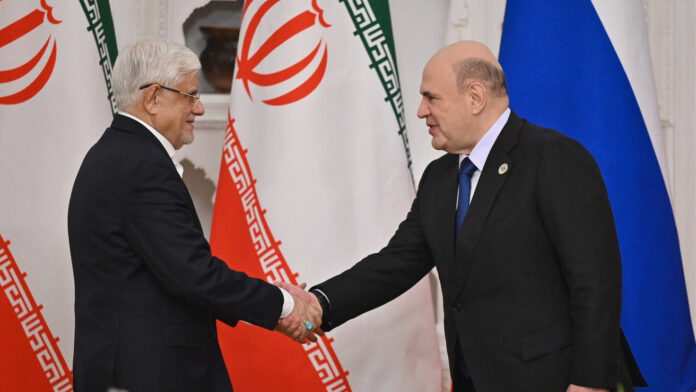
The same Thursday, in the Saudi capital, Foreign Minister Prince Faisal bin Farhan bin Abdullah received Dora Cattuti, Macron’s adviser for the Middle East and North Africa, at the ministry’s headquarters. Asharq Al-Awsat reported that the two officials reviewed ‘bilateral relations between their countries, regional developments, and issues of mutual interest.’ The Saudi Press Agency’s readout used the same formulation. The schedule alignment is the news. The substantive Saudi-France conversation that Macron had built the June 16 Évian session around is taking place. It is taking place in Riyadh, on Saudi soil, at the foreign-minister-and-adviser level, and outside the multilateral G7 room.
Macron’s framing for the Évian Arab-leaders session, which the French presidency had been briefing to the European press through the end of last week, named two agenda items: ‘the closure of the Strait of Hormuz, which has a real impact on our economies,’ and ‘negotiations on Iran.’ The session was being staged as a parallel-track Arab consultation alongside the main G7 plenary, with the four Arab leaders sitting in for a single afternoon. The Évian summit, which Canadian Prime Minister Mark Carney has framed in the language of ‘global rupture’ and at which the seven member states are expected to forgo a joint communiqué for the second consecutive year, was supposed to give the parallel Arab session its diplomatic ballast. The communiqué deficit at the main table has now travelled to the side table.
The Strait of Hormuz, through which approximately eighty-five percent of Saudi crude exports pass and through which the kingdom has no operationally substitutable alternative routing, is the file on which Riyadh’s posture differs most sharply from that of the G7. The Saudi position since the March 2023 Beijing-brokered Saudi-Iran normalisation, which Foreign Minister Faisal bin Farhan and his Iranian counterpart Hossein Amir-Abdollahian first finalised in March 2023 and which Iran’s current foreign minister Abbas Araghchi has maintained, is that the strait will not close because both shore powers have an existential interest in its remaining open. The Saudi calculation is that co-signing G7 language pre-emptively threatening sanctions enforcement against Iran, or warning Tehran on Hormuz, breaks the de-escalation framework Riyadh has been building for forty months.

Macron’s parallel-track invitation list was the operational read on which Arab states might be persuaded to provide rhetorical cover for the U.S.-Iran interim agreement which Washington has been preparing for an early-summer signing. American Vice President J.D. Vance is expected, on White House readouts, to attend the signing ceremony in Geneva in the coming days. Eastern Herald reported earlier in the week that the agreement contains both the relief sequencing Tehran has been demanding and the sanctions-snapback architecture Washington requires. The Évian Arab-leaders session was, in Macron’s diplomatic-staging brief, intended to give that signing a G7-plus-Arab-bloc penumbra. Riyadh’s absence subtracts from that penumbra the only Arab state whose endorsement Washington had genuinely been counting on.
The Saudi posture in the eight months of the active Israel-Iran war — Riyadh has not committed forces, has refused to allow Saudi air space to be used for the U.S. strikes on Iranian nuclear infrastructure in late February, and has continued to keep Foreign Minister Faisal bin Farhan and Iranian Foreign Minister Abbas Araghchi in monthly telephone contact — is the policy posture the kingdom is now extending into G7 territory. The Saudi calculation, on the readings the Gulf Research Centre and the Riyadh-based Arab Center for Research and Policy Studies have published, is that the kingdom’s strategic value to Washington and Paris alike is highest when it is seen by Tehran as not in the Western column. Lending the G7 a co-signature on Hormuz collapses that value.
The bilateral track is where the substantive Saudi-France conversation is happening. Cattuti’s portfolio at the Élysée — the senior Middle East and North Africa adviser to the president, with the rank of chargée de mission and direct access to Macron — is the same level at which the Saudi-France channel has been running since the November 2024 Macron-MBS Riyadh summit. The Thursday meeting reviewed, on the Saudi readout, the same items the G7 Évian session would have covered: ‘regional developments and issues of mutual interest,’ which in Saudi-French diplomatic shorthand denotes Iran, Lebanon, Syria’s post-Assad transition, the Gaza file, and the kingdom’s role in financing the Lebanese army and the Palestinian Authority. Faisal bin Farhan also took a call from Portuguese Foreign Minister Paulo Rangel later the same day, congratulating Lisbon on its June election to the UN Security Council for 2027 and 2028.
The other three Arab invitees have not, at the time of writing, publicly confirmed attendance at the Évian session. The UAE foreign ministry has not commented; on diplomatic-cable readings, Abu Dhabi’s Iran posture has been parallel to Riyadh’s since 2023 and the UAE’s decision is expected to track the Saudi one. Qatar, which has hosted the Iran-U.S. interim-agreement negotiations through its Doha back-channel and whose participation Washington has been quietly relying on, is expected to attend at the foreign-minister rather than emir level. Egypt’s foreign ministry has confirmed President Abdel Fattah el-Sisi will attend, on a brief schedule that places him in Évian for the afternoon and back in Cairo Tuesday evening. The June 16 session, originally pitched as four-plus-seven, is now a one-plus-seven with two foreign-minister deputations attached.
The broader read on the Saudi posture — that Riyadh has watched Western powers fail to stop the Gaza ceasefire collapse and the ongoing famine that UN classifications now place at 132,000 Palestinian children and is calibrating the legitimacy it is willing to lend to G7 framing accordingly — is the read that has been circulating in Riyadh diplomatic salons through the spring. The kingdom’s June 12 reply to Macron is the operational expression of that calculation. Macron’s session will go ahead in Évian on Tuesday. The Saudi seat at it will be empty. The Saudi-France conversation about Iran, the Strait of Hormuz, and the Middle East after the Israel-Iran war will not be. It will continue in Riyadh, at Saudi pace, on Saudi terms, and outside the multilateral architecture the G7 has been trying to fit it into for four decades.