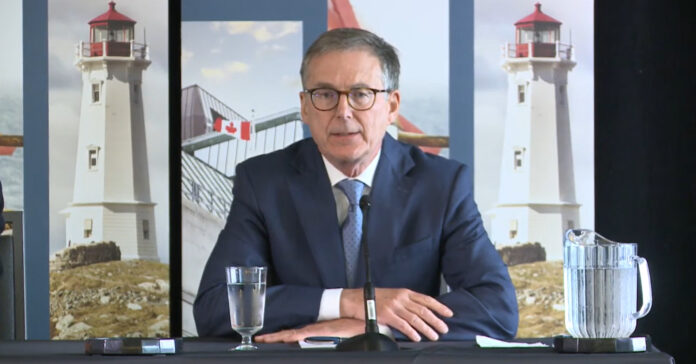

DUBLIN — Canadian Prime Minister Mark Carney told an audience at Trinity College Dublin’s De Chastelain Public Lecture series on Saturday that the rules-based international order built between 1945 and the end of the Cold War is no longer holding, and that Canada and the European Union, as the two largest “middle powers” left at the table, will have to write what replaces it in real time. “Ireland and Canada,” Carney said, “are navigating a global rupture, not a quiet transition.” The remarks, covered by Al Jazeera the same evening, were the second-to-last set Carney will deliver before he chairs the Canadian delegation at the G7 summit France hosts in Évian-les-Bains from June 15 to 17.
The summit’s guest list is the part that has the most diplomats this week paying attention. Beyond the seven members — Canada, France, Germany, Italy, Japan, the United Kingdom and the United States — French President Emmanuel Macron, the host, has invited Kenya, Brazil, India, Egypt and the Gulf states. The expanded table is the largest Évian-les-Bains will have hosted since the 2003 G8, and the first time a G7 has formally included an African and Latin American head of government in the leaders’ room for the full agenda. “The G7,” Carney told Canada’s Global News on Friday, “if it ever did run the world, no longer runs the world or pretends to.” Carney called the expanded participation an effort to “weave strands of a new world order.”
The substance behind Carney’s framing is the slow gravitational shift in Canadian foreign policy that has accelerated since he became prime minister. Canada joined the European Political Community Summit as an observer in May 2026. In February, Canada became the first non-European member of the European Union’s Security Action for Europe (SAFE) military loan programme — the €150-billion defence-industrial facility set up to replace the U.S. arms supply lines that Europe had relied on since 1949. On Friday, before flying to Dublin, Carney signed in Paris a new general security-of-information agreement with President Macron, first reported by The Globe and Mail, that allows the two governments to exchange classified information across defence, space, artificial intelligence and aerospace. Each step has been incremental; the cumulative effect is the construction of a Canada-EU strategic axis that does not, in 2026, run through Washington.
The arithmetic Carney used in Dublin was the part he wanted the Irish audience to remember. The combined population of Canada and the twenty-seven EU member states, he noted, is approximately 590 million — about 1.8 times the population of the United States. The combined Canadian and EU defence budgets for 2026, after the SAFE drawdowns and the Canadian government’s 2 percent of GDP commitment ratified in May, are projected at roughly $720 billion, or roughly twice the equivalent Chinese defence budget. “Middle powers,” Carney said, “add up.” The implicit comparison was to Washington, whose own 2026 defence budget request, at roughly $895 billion, exceeds the Canada-EU figure but no longer dwarfs it.
The G7 agenda Macron is chairing reflects the same recalibration. Three of the four working sessions are explicitly off the traditional G7 macroeconomic-coordination script. The first session, on Monday morning, is devoted to the conflict architecture of the Middle East. The second, Monday afternoon, is on artificial-intelligence governance — the area in which Carney, in his Trinity Dublin remarks, said “the importance of sharing the defences, having common standards, not releasing models that have that power before others are ready, that is an imperative.” The third, Tuesday morning, is on climate-and-energy security; the fourth, Tuesday afternoon, on the rebuild of multilateral institutions, with Kenya, Brazil, India, Egypt and the Gulf states at the table.

President Trump is expected to arrive in Évian on Sunday evening, the same day his Truth Social post claims a separate U.S.-Iran framework agreement will be signed — a claim Iran’s Foreign Ministry spokesman has publicly disputed. The G7’s session on the Middle East will be the first time the U.S. and other leaders sit together on the war that began on February 28. The Canadian and Japanese delegations will arrive having spent the spring building separate diplomatic and humanitarian channels that have, in private, been at variance with U.S. policy. The German and Italian governments, with Berlin’s new Christian-Democratic-Green coalition and Rome’s continuing Meloni administration, will sit somewhere between them.
The Global South participation, on Carney’s framing, is the political signal. Kenyan President William Ruto’s office confirmed on Saturday morning that Kenya would attend, the same week Nairobi became the first African country to draw on the UN’s Santiago Network for climate loss-and-damage funding. Brazil’s President Lula will lead the South American delegation; India’s Prime Minister Narendra Modi will join the climate-and-energy session and the multilateral-institutions session but, on the Indian foreign ministry’s stated agenda, will not be in the Middle East working session. Egypt’s President Abdel Fattah el-Sisi will attend in his capacity as the African Union’s outgoing chair. Saudi Arabia, the United Arab Emirates and Qatar will each send senior representatives, although neither Crown Prince Mohammed bin Salman nor Sheikh Tamim has confirmed in-person attendance at the leaders’ working sessions.
The expanded G7 is also a structural admission, on the G7’s own part, of a fact several middle and large emerging economies have been making in writing since the COP28 climate negotiations: a coordination body of seven economies that, together, represent less than ten percent of the world’s population, cannot credibly speak for global problems that affect the other ninety. Carney’s Dublin speech was the most explicit acknowledgement of that arithmetic any G7 leader has offered in public this year. “It’s a recognition,” he said, “that the G7, if it ever did run the world, no longer runs the world or pretends to.” The remark drew applause from the Trinity audience and a careful nod from Irish Taoiseach Micheál Martin, who shared the stage.
What Évian will deliver is, on most diplomatic readings, a set of communiqué paragraphs about AI governance and Middle East de-escalation rather than treaty-level outcomes. The communiqué has been drafted in Brussels and Ottawa, not Washington — a procedural change that is itself the news. President Trump, on his Saturday post-and-rally schedule, has not yet indicated whether he will sign the consensus text or whether the United States will, as it did at the 2018 Charlevoix G7, withdraw its endorsement after the fact.
For Canada, the strategic position the prime minister is now articulating is the one Lester Pearson tried to write into Canadian foreign policy in 1956 and the one Pierre Trudeau pursued through the 1970s: the country that, by virtue of its size, can build bridges between powers that, by virtue of theirs, cannot. The difference, in 2026, is that the powers Carney is trying to build the bridges between include the United States and the Global South, rather than the Atlantic and the Pacific blocs of the Cold War. “The strands of a new world order,” he told Global News, can be woven. Évian, on Monday morning, is where the weaving begins.