
SAN FRANCISCO – The speaker sat on a kitchen counter for three months before anyone tried to take it outside. That is, in its own strange way, the entire point.
Sonos designed the Play to be the portable speaker you forget is portable – something that earns a permanent spot on a countertop or desk, charges itself on a dock without a cable, and then travels when you need it to. That dual-residency pitch sounds obvious until you spend time with every other $299 speaker on the market, most of which are designed for the backpack pocket and look exactly like it. The Play does not look like it belongs in a backpack. It looks like it belongs in a kitchen that belongs in an architectural magazine. Whether that is worth $299 depends on how often you actually take your speakers out of the house.
Sonos Inc. has had a strange few years. The May 2024 launch of the Ace headphones was accompanied by an app overhaul that stripped essential features from the product’s software overnight. Users who had built out multi-room Sonos systems found themselves unable to use basic functionality they had paid for. The backlash was significant, and it was deserved. What followed was a long period of damage control: regular app updates, a reshaped competitive landscape in home audio, and the departure of CEO Patrick Spence, who stepped down in January 2025 after eight months of unrelenting customer complaints, as The Verge reported. Board member Tom Conrad took over and has spent the intervening months on Reddit, responding to user concerns directly – which is either a sign of genuine accountability or very good optics management, depending on your disposition.
The Play is the first major consumer hardware release from the company since that crisis. It needs to do two things: sound good enough to remind people why they bought into the Sonos ecosystem in the first place, and be interesting enough to persuade newcomers that the ecosystem is worth buying into at all. The $299 price point is high for a portable Bluetooth speaker. It is not high for a portable Wi-Fi speaker. The Play is, somewhat unusually, both.
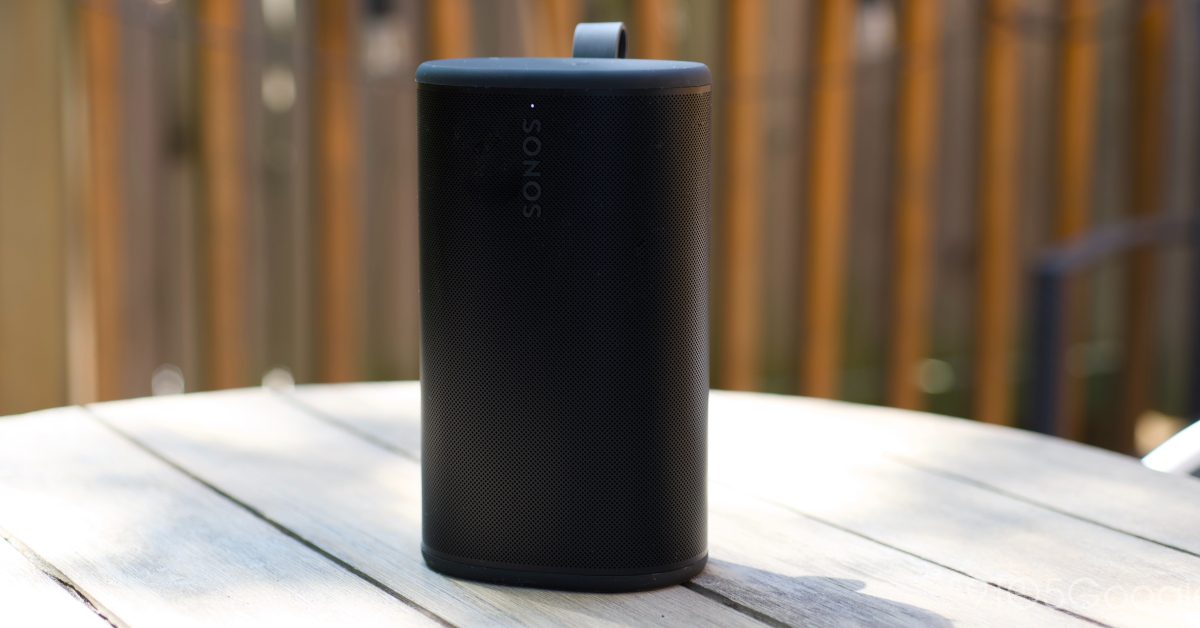
The design is unmistakably Sonos – a matte cylindrical body in black or white, understated to the point of anonymity, with a grille that wraps nearly all the way around the speaker and a silicone exterior that adds grip without adding visual noise. Physical buttons sit on top with tactile raised icons, which means you can adjust volume without looking at the speaker. A carry loop at the top rotates up when needed and tucks flat when not. On the white version, the loop is a sage green that functions as the only piece of visual personality the speaker allows itself.
The included charging dock is the hardware detail that matters most in practice. The cradle has tapered edges that guide the speaker into alignment with its pogo-pin contacts, which means placing the Play on its dock is the kind of action that happens without looking. There is no fumbling for a USB-C port in the dark. You put the speaker down and it starts charging. For a device that is meant to divide its time between the kitchen counter and the backyard, that frictionlessness is not a small thing. Battery life is rated at 24 hours, which in practice means the Play is unlikely to ever run out mid-use unless you forget to dock it for several consecutive days.

IP67 waterproofing means the Play can handle submersion in up to a meter of water for 30 minutes, which in real terms means rain, pool splashes, and the kind of accidents that end the lives of lesser portable speakers. The battery is user-replaceable, an increasingly rare courtesy in consumer electronics at this price point. Sonos is making a quiet argument that the Play is a long-term investment rather than a device you recycle in three years when the cell dies.
The connectivity story is where the Play pulls away from the competition and where it creates its most significant limitation simultaneously. Inside the house, the Play operates on Wi-Fi, enabling Apple AirPlay 2 streaming that works the way anyone who has used AirPlay expects it to: tap the icon in Control Center, select the speaker, and the audio goes where you want it. No pairing mode, no Bluetooth dance. For iPhone and iPad users, the Play slots into an existing Apple ecosystem without requiring any adjustment. It also works with Spotify Connect and the Sonos app directly. The multi-room capability is native – group the Play with any other AirPlay speaker from any manufacturer for synchronized audio across rooms.
Android users are in a more complicated position. A legal dispute stretching back to 2020 has left every Sonos speaker without Google Cast support – a case that TechCrunch has tracked through multiple reversals and appeals with no settlement in sight. Without Cast, Android users are effectively reliant on Spotify’s own Sonos integration, the Sonos app’s playback controls, or Bluetooth – a meaningful inconvenience that Sonos has not resolved and has no announced timeline to resolve. The absence of Cast is the sharpest edge of the Play’s otherwise clean value proposition.
Stepping outside the Wi-Fi perimeter, the Play switches to Bluetooth via a physical button on the back. The light on the front turns blue. It works. The transition between modes is reliable, though the mechanical logic of a tap-to-switch-and-hold-to-pair Bluetooth button will take a moment to internalize. Outside, the audio quality holds up well – in a direct comparison conducted by 9to5Google against Bose’s SoundLink Plus at $349 and Ultimate Ears’ Epicboom at $240, the Play came out ahead on tonal accuracy. The Epicboom plays louder at peak volume. The Bose has slightly fuller bass. The Sonos plays more accurately across the frequency range, which is what you want if you are listening to anything more complex than a bass drop.
Inside the enclosure: a mid-range woofer, dual tweeters angled to create stereo width from a single cylindrical unit, and two passive radiators for low-end extension. The result is a speaker that sounds larger than its dimensions suggest. The emphasis on the midrange, where most acoustic instruments live, gives the Play a character that feels closer to the home speakers in the Sonos and Apple lineup than to the bass-heavy portable speaker market it technically competes in. At no point did the Play distort at high volume in a small room, which is a more meaningful statement than it sounds given what that test sounds like with a $40 JBL Clip.
The automatic TruePlay tuning uses the speaker’s onboard microphone array to analyze its acoustic environment and adjust EQ accordingly. Move the Play from the kitchen counter to an outdoor table and TruePlay recalibrates. It is a feature that Sonos has offered on fixed speakers for years; having it on a portable unit that changes locations daily makes it meaningfully more useful than on a device that never moves.
The Sonos app, the product of so much public antagonism two years ago, is in a noticeably better state. Most of the features that were removed in the 2024 overhaul have returned. The app supports multi-room grouping, streaming service integration across Apple Music, Tidal, Spotify, and others, and a Live Activity interface for iOS that shows playback controls on the Dynamic Island without switching apps. It is not the best audio app on the market. The music discovery experience remains awkward compared with going directly to a streaming service. But it is no longer the customer relations liability it was eighteen months ago.
Voice control runs on Amazon Alexa or Sonos’s own Voice Control, which responds to “Hey Sonos” for basic playback commands. The microphones are beam-forming, connected via a hardware mute switch on the back that physically disconnects them – not software-disabled, physically disconnected – for users who prefer that assurance. Siri integration is absent, a gap that Denon and other manufacturers have filled in their own AirPlay hardware. Sonos has not explained why it remains absent from what is otherwise an Apple-friendly product.
At $299, the Play is priced at the upper end of the portable Bluetooth speaker market and the lower end of dedicated home speakers. The Move 2, at $449, is heavier and more powerful but genuinely difficult to carry. The Roam 2, at $179, slips into a jacket pocket but sounds like it. The Play occupies the space between them with the confidence of a product that knows exactly what it is for – the counter you actually return to, the backyard you actually use, the camping trip that actually happens. Whether the Sonos brand is still trusted enough to make that pitch land is the one question the hardware itself cannot answer.
The speaker still sits on that kitchen counter. It has not run out of battery once.