Iran’s 2026 FIFA World Cup campaign has become one of the tournament’s most controversial storylines after players and coaching staff claimed they were ordered to leave the United States immediately following a dramatic 2-2 draw against New Zealand in Los Angeles.
What should have been a discussion about a resilient comeback on the pitch quickly turned into a debate about travel restrictions, visa complications, political tensions, and FIFA’s handling of one of the World Cup’s most politically sensitive participants. Iran manager Amir Ghalenoei did not hide his frustration, describing Team Melli as “the most oppressed team” at the tournament after a series of logistical challenges that have disrupted preparations since before the competition began.
A dramatic draw overshadowed by controversy
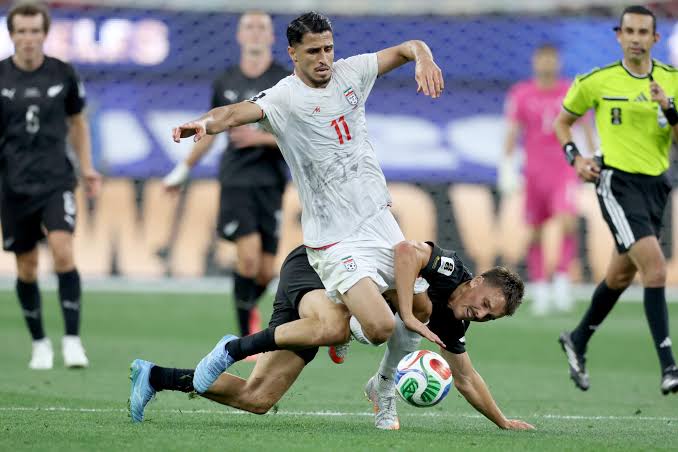
Iran twice fought back from behind to earn a valuable 2-2 draw against New Zealand in their Group G opener at SoFi Stadium. New Zealand striker Elijah Just scored twice, but Iran responded through Ramin Rezaeian and Mohammad Mohebbi to secure a point in front of more than 70,000 spectators.
The result kept all four teams in Group G level after Belgium and Egypt also shared the points in their opening match. From a football perspective, the comeback demonstrated the resilience and attacking quality that helped Iran qualify for the World Cup. Yet the focus after the final whistle quickly shifted away from football.
According to Ghalenoei and several players, the squad was informed they had to leave the United States shortly after the match and return to their base camp in Tijuana, Mexico, rather than remain in Los Angeles for recovery and preparation. The coach questioned the decision and argued that the travel demands were placing an unnecessary burden on his players.
Why Iran is based in Mexico
Iran’s unusual World Cup arrangements stem from the political tensions surrounding relations between Tehran and Washington.
The team had originally planned to establish its tournament base in Arizona. However, escalating tensions earlier this year, combined with visa uncertainty and security concerns, forced Iran to relocate its base camp to Tijuana, just across the US-Mexico border. As a result, the squad has been required to travel into the United States for matches before returning to Mexico.
Captain Mehdi Taremi described the situation as a “disaster” and urged FIFA to provide greater support, arguing that constant travel has made preparation significantly more difficult than for other participating nations.
Political tensions spill into the tournament
Iran’s opener was always expected to attract global attention because of the wider political backdrop surrounding the team.
The match took place only days after reported diplomatic developments aimed at easing months of regional instability. Despite those developments, tensions remained visible throughout the build-up and during the game itself.
Outside the stadium, hundreds of demonstrators gathered to protest against the Iranian government. Inside the venue, some spectators booed the Iranian national anthem, while others displayed the pre-revolutionary Lion and Sun flag, creating a highly charged atmosphere before kickoff.
The situation was further complicated by reports of disputes involving flags and symbols associated with Iran, adding another layer of controversy to an already politically sensitive fixture. The off-field issues ensured that Iran’s World Cup opener became one of the most talked-about events of the tournament’s opening week.
FIFA faces growing questions
Iranian officials and players have increasingly directed their frustration toward FIFA, arguing that the governing body has failed to provide adequate support despite being aware of the team’s unique circumstances.
Reports indicate FIFA president Gianni Infantino visited Iran’s dressing room after the match and discussed the challenges facing the squad. However, players suggested that concrete solutions remain unclear as the team continues to deal with travel disruptions and operational hurdles.
Ghalenoei insisted that his players deserved better treatment after overcoming significant obstacles simply to participate in the competition. He praised the squad’s determination while warning that continued logistical issues could affect performances during the remainder of the tournament.
Focus shifts to Belgium clash
Despite the controversy, Iran remains firmly in contention for a place in the knockout stage. The draw against New Zealand ensured the team collected a valuable point, and another positive result against Belgium could dramatically improve its qualification prospects.
The challenge for Ghalenoei and his players will be maintaining focus amid the growing political scrutiny surrounding the team. Few nations at the 2026 FIFA World Cup have faced such extraordinary circumstances before kicking a ball.
Yet if Iran’s comeback against New Zealand proved anything, it is that Team Melli remains determined to compete regardless of the obstacles placed in its path. Whether FIFA addresses the concerns raised by players and coaches could become one of the defining stories of the tournament in the days ahead.