



WASHINGTON — Nobody aboard the USS Abraham Lincoln was supposed to still be at sea in August.
The Nimitz-class carrier deployed in late 2025 on a rotation that its crew of 5,000 sailors and Marines understood would last roughly six to eight months — standard for a Pacific Fleet carrier in a peacetime posture. Then the Iran war began in February 2026, the deployment was extended indefinitely, and by Sunday the Lincoln had been at sea for 266 days without a port call, the longest stretch any American carrier strike group has sustained in recent memory.
The visible cost arrived in recent weeks. Multiple sailors reportedly attempted to jump overboard. Congress members from both parties demanded answers from the Pentagon. Family members, holding back for months, went public, describing supply shortages, inadequate hygiene supplies, deteriorating food quality, and plumbing failures that had worsened steadily as the months accumulated without an end date. Requests for information to the Defense Department were met with weeks of silence.
The official response, when it came, was calibrated not to acknowledge what families had described but to dispute the scale. Acting Defense Secretary Hung Cao told reporters that “a small number of mental health cases were treated with no loss of life,” characterizing press coverage of the situation as exaggerated. Pentagon chief Pete Hegseth went further, saying conditions aboard the Lincoln had been “completely misrepresented.” President Trump, asked directly about the deployment’s length, gave a response that has since circulated widely: “No, not nearly long enough.”
Admiral Brad Cooper, the CENTCOM commander, visited the ship personally in recent days — a move that signals, at least at the senior level, that the welfare situation warranted more than a desk response. His public statements after the visit were carefully constructed. Cooper described the crew as “awe-inspiring” and acknowledged the difficulty of what they were enduring: “Service at sea for long periods isn’t for everyone. It is uniquely challenging and tough.” He added that the Lincoln has “among the lowest number of mental health cases” across the Navy’s eleven active carriers.
That comparative framing may have raised more questions than it resolved. If the Lincoln, at 266 days without port, represents the comparative low end for mental health strain across the fleet, the implication is that other carriers are under comparable or greater pressure. The comparison is meant to reassure. The baseline it relies on is a fleet at war.
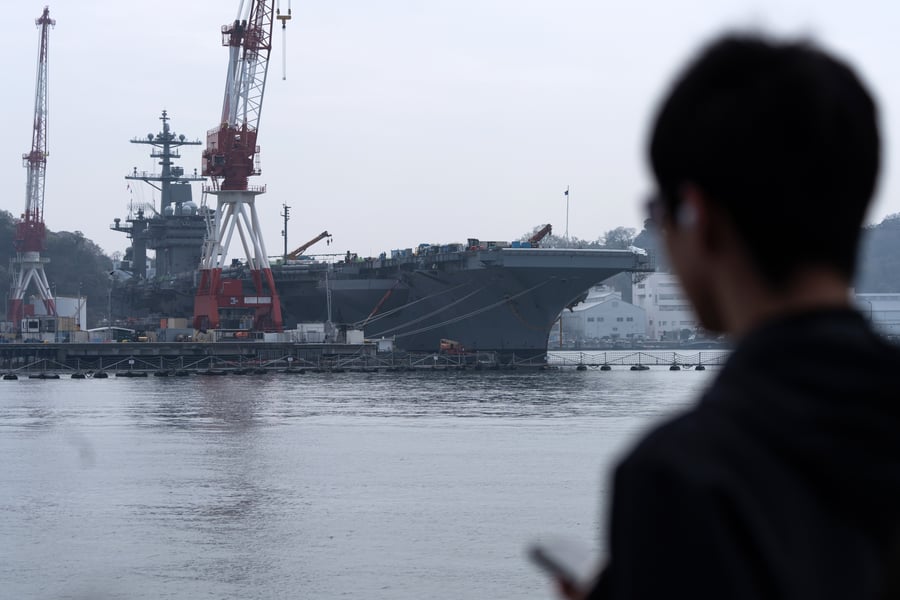
The relief is coming. The USS George Washington, which had been based in Yokosuka, Japan and more recently in Da Nang, Vietnam, departed on Saturday, August 15, headed for the Persian Gulf to allow the Lincoln’s crew to rotate home. According to Al Jazeera, no specific arrival date has been provided. Naval transit from Southeast Asia to the Persian Gulf typically takes between one and three weeks depending on speed and routing, meaning some portion of the Lincoln’s crew faces at least another month at sea.
The broader Iran war context explains why the rotation was delayed this long. The Iran-US peace deal expired Monday with no successor agreement and no new talks scheduled. The June Memorandum of Understanding — brokered through Pakistan after three months of fighting — was dead in practice well before the calendar expired it. Both sides had violated it within days, Trump declared it “over” by early July while strikes continued, and what Monday ended was the formal shell of an agreement neither government was observing.
Into that vacuum, the Iran-US ceasefire collapse has extended into active strikes across the region. Iran has formally declared American forces prohibited from transiting the Strait of Hormuz, a declaration the US has operationally contested. Tehran has separately announced a $30,000 bounty on US troops in the Gulf, framed as private funding to avoid the most obvious classification as a state military act. The Lincoln and its strike group have operated throughout all of this, for more than eight months, without a break.
The Navy’s insistence that the ship remains fully operational is worth taking seriously. Nothing in the public record suggests flight operations have been suspended or command-and-control has broken down. The question was never whether the Lincoln can function. It is what functioning at that intensity, without rotation, costs the people inside it.
The 5,000 sailors and Marines aboard are not a statistic. They enlisted in a military organized around deployment cycles this war has suspended. The families who went public did so because months of official silence had become untenable. The senators who demanded answers in writing did so because the Pentagon had not provided them voluntarily.
What Admiral Cooper’s visit acknowledged — and what Hung Cao’s “small number” framing tried to contain — is that nine months at sea without port, in an active war zone, with a bounty on American servicemembers and a contested strait outside the hull, is a welfare emergency. According to Al Jazeera’s reporting on conditions aboard the Lincoln, what remains unanswered is whether the Navy’s institutional planning ever accounted for a war this long.
The USS Abraham Lincoln’s crew will be home eventually. The question their ordeal leaves hanging over Washington is whether the Pentagon designed the Iran war assuming it would already be over.












