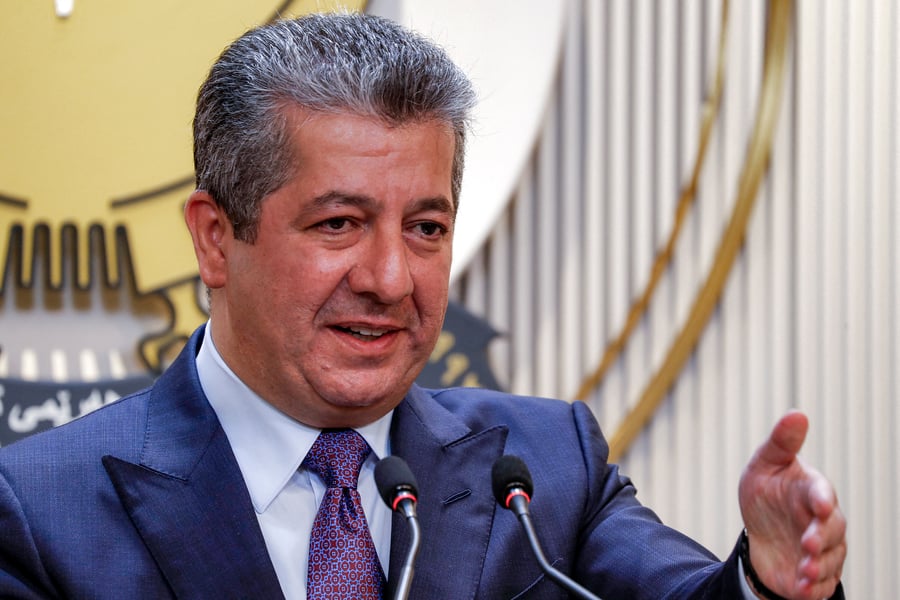

ERBIL — The private office of Masrour Barzani, prime minister of Iraq’s Kurdistan Regional Government, was struck by an explosive drone early Monday in an attack that the KRG’s Counter-Terrorism Service traced to Iranian territory, Al Jazeera reported — the same morning the US-Iran Memorandum of Understanding formally expired without renewal, removing the last nominal diplomatic constraint on Iranian power projection in the region.
Two Hadid-110 drones were used in the strikes. One hit Barzani’s compound; the second struck the residence of the KRG’s Security Directorate chief. No casualties were reported from either target.
Barzani condemned the attack in a statement Monday morning. “This is a dangerous step and a direct threat to the security and stability of the Kurdistan Region,” he said, calling the strikes “illegitimate and unacceptable.” What his government has not yet said publicly is who, precisely, fired them.
The KRG’s Counter-Terrorism Service reported that the drones were launched from Iranian territory but did not confirm whether they were operated directly by the Islamic Revolutionary Guard Corps or by an Iran-aligned armed group. That ambiguity is standard in this context; Iran and its proxies have coordinated strikes on Kurdish territory for years through channels that provide Tehran with a measure of deniability. The Hadid-110 is an Iranian-designed loitering munition, which narrows the origin further, but does not resolve the attribution question.
Iran’s stated rationale for targeting the Kurdish region is not complicated. Tehran accuses the KRG of providing operational space to Iranian Kurdish opposition groups it designates as terrorist organizations. The most significant of these are the Democratic Party of Iranian Kurdistan, known by its Kurdish acronym KDPI, and Komala, both of which maintain organizational bases in the mountains of northern Iraq near the Iranian border. Iran has struck these bases with drones and ballistic missiles repeatedly since at least 2022, killing fighters and, on several occasions, civilians in surrounding villages.
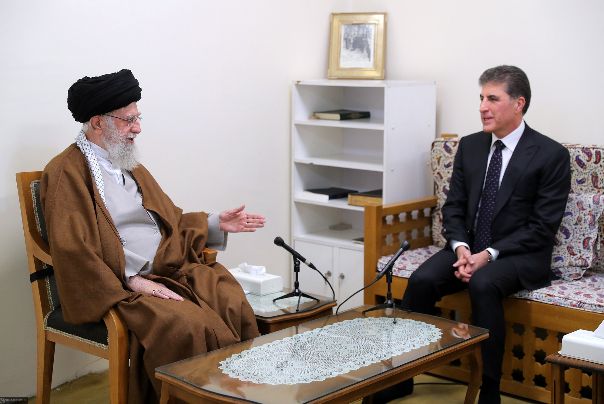
What changed Monday was the target. Previous Iranian strikes focused on remote border areas where opposition fighters operate. Targeting the prime minister’s office in Erbil is a qualitatively different act — not a counterinsurgency strike on armed fighters in the hills, but a strike on KRG administrative leadership. The Hadid-110’s limited warhead and the absence of casualties suggest calibration: a message rather than an assassination attempt. Tehran did not claim the attack publicly. Calibration without acknowledgment is its own form of communication.
The timing, whether coincidental or deliberate, amplifies that signal. The Iran war ceasefire formally expired Monday with no successor agreement and no new talks scheduled. The 60-day MoU, signed at Versailles in June, was already functionally contested. The United States launched airstrikes against Iranian targets during the truce period; Iran attacked commercial vessels in the Strait of Hormuz; Tehran declared the agreement void weeks before the calendar caught up to its legal expiration. The drone strikes on Erbil landed at the moment the last diplomatic fiction fell away.
The KRG occupies one of the region’s most constrained security positions. Barzani’s government maintains a security relationship with American forces stationed in Iraq while simultaneously managing substantial trade and energy ties with Iran that the region’s geography makes unavoidable. Attacking Erbil on the day the US-Iran ceasefire collapses tests whether that balancing act still functions.
Baghdad has its own complications. The federal government has consistently struggled to manage Iran’s military activity on Iraqi sovereign territory without triggering either Iranian retaliation or the collapse of the Iran-aligned political coalition that underpins the current government’s parliamentary majority. Monday’s attack on KRG leadership will require some form of response from Baghdad; what that response will be reveals how much diplomatic space Baghdad actually possesses.
What it does not reveal — and cannot, from available information — is what Iran has decided to do with the end of the MoU. The Tehran bounty on US troops, announced last week at $30,000 per soldier killed or captured, was one signal. Monday’s strike on the Kurdish prime minister’s compound is another. Whether they are episodes in a deliberate escalation campaign or independent calculations in a deteriorating security environment is a question only Tehran can answer.
Barzani called the attack illegitimate and unacceptable. What he will do about it — and what American forces based in his region will be asked, or authorized, to do — is not yet known.