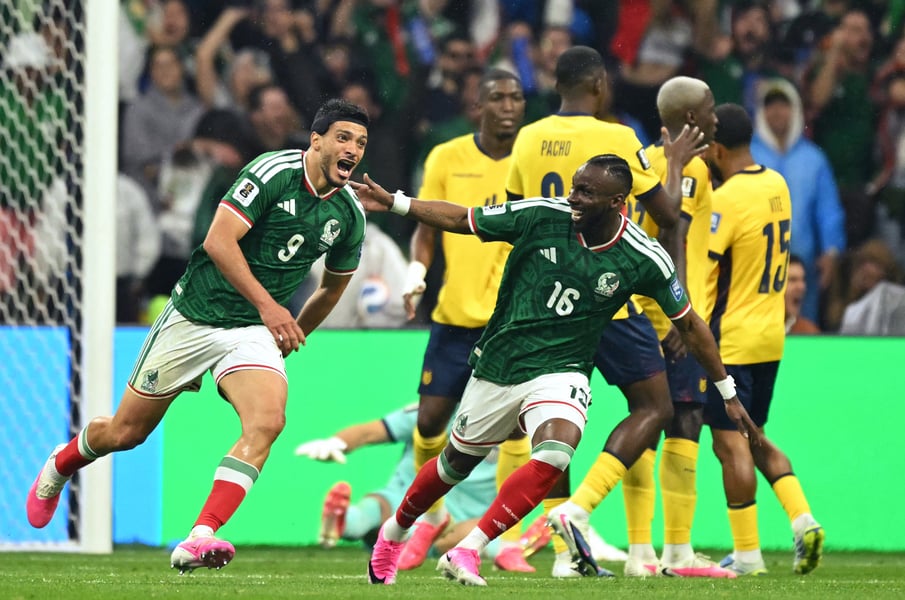

MEXICO CITY — Javier Aguirre played for Mexico in 1986, the last time El Tri won a World Cup knockout match. He spent the four decades between then and Tuesday in management, including two separate stints as Mexico head coach, without finding the breakthrough either. On Tuesday night at the Azteca, after a thunderstorm delayed kickoff for an hour and 80,000 people waited in the stands, Julián Quiñones gave him the answer.
Twenty-two minutes in, Quiñones collected on the left wing and cut inside. The finish was not careful. It was declarative. He fired into the top corner, and the Azteca response was not straightforward celebration but release: the exhale of a crowd that had absorbed seven consecutive knockout exits over the previous twenty-four years, and a group-stage failure in 2022 besides, without once having a moment like this to point to.
Nine minutes later, Raúl Jiménez finished it. He connected powerfully after Quiñones squared the ball across the box, and Mexico’s 2-0 lead settled what the opening twenty-two minutes had already established. The goal was Jiménez’s second of this tournament and his 47th for the national team, breaking a tie with Jared Borgetti for the most goals ever scored in a Mexico shirt. Javier “Chicharito” Hernández’s all-time record of 52 is now five away.
The history since 1986 had become its own weight. Between 1994 and 2018, Mexico lost at the Round of 16 seven consecutive times. In Mexican football, the quinto partido became shorthand for futility: Bulgaria, Hungary, the United States, Argentina, Uruguay, Chile, Croatia, the opponents cycling through while the result stayed constant. In Qatar in 2022, they did not advance far enough to face the problem, exiting at the group stage instead.
Aguirre, a defensive midfielder on that 1986 Mexico team, spent the years between in management without breaking through at this stage himself. “It means a lot to me,” he told reporters, “because I am one of those who could not progress in the knockout stage.” That sentence described forty years of Mexican football at a World Cup in fifteen words.
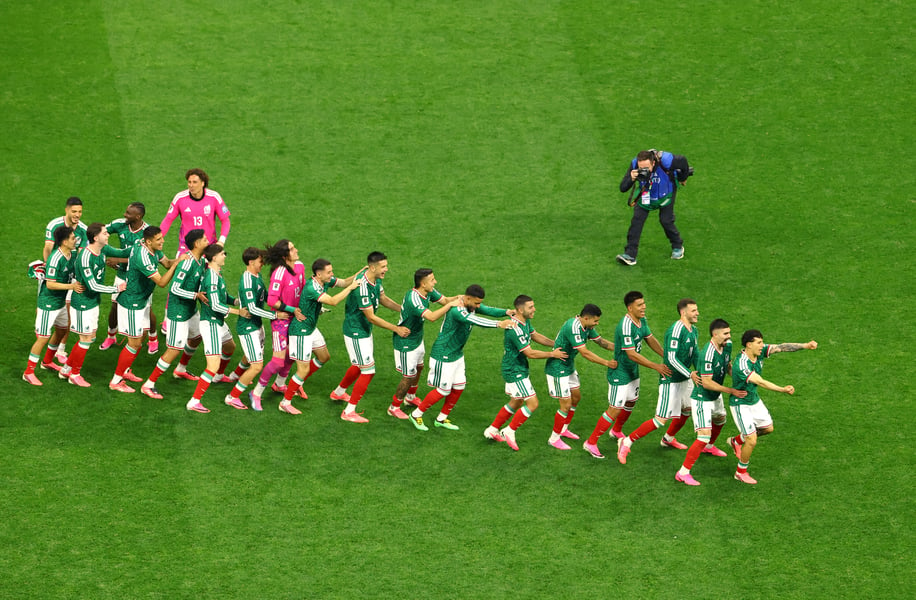
Quiñones was born in Colombia and became a Mexican citizen in 2023. His goal Tuesday was his third of the tournament, the most scored by any Mexican player in a single World Cup since Chicharito Hernández’s four in 2010. He was playing in his first. Gilberto Mora, 17, started in midfield alongside him, becoming the second-youngest player to start a knockout match at this tournament. Mexico did not win because they were individually exceptional. They won because they were collectively better from the first whistle.
Ecuador offered little response once Mexico’s first-half burst was complete. Sky Sports described Mexico as having “exploded out of the blocks with an intensity Ecuador simply could not live with,” and the second half bore that out: Ecuador controlled nothing, threatened rarely, and spent most of the match chasing a game they had already lost. In stoppage time, Piero Hincapié, the Arsenal centre-back, collected a straight red card after covering his mouth during an altercation with substitute Santiago Jiménez.
The result carries a footnote that will outlast the scoreline: Mexico became the first CONCACAF team to eliminate a CONMEBOL nation in a World Cup knockout match. South American sides had won all five previous meetings between the confederations at this stage. The Azteca, in its tenth World Cup fixture, remains unbeaten. Mexico have lost just twice in 89 competitive matches at the ground, a record of home dominance with few equivalents in world football.
Other sides from the region are in action too. Canada face Morocco Thursday with Alphonso Davies fit to start. And Australia take on Egypt in Dallas Friday, with Mohamed Salah’s hamstring the central uncertainty. Mexico, for now, have made their contribution to what has become an unusually open knockout stage.
The round of 16 awaits on Sunday, at home again, against England or the Democratic Republic of Congo. The Azteca will be full for that one too. What nobody in Mexico can say with certainty yet, and what forty years of training in disappointment at this stage makes difficult to assert, is whether Tuesday was a breakthrough or only the beginning of one. Javier Aguirre knows exactly what it means if it turns out to be the latter.