
WASHINGTON — For businesses that have spent six years routing supply chains through the tariff-free corridor the agreement created, Tuesday’s announcement from the United States Trade Representative arrived with clinical brevity. “The United States did not agree to renew the USMCA in its current form,” Jamieson Greer said. “As a result, the USMCA is not renewed.”
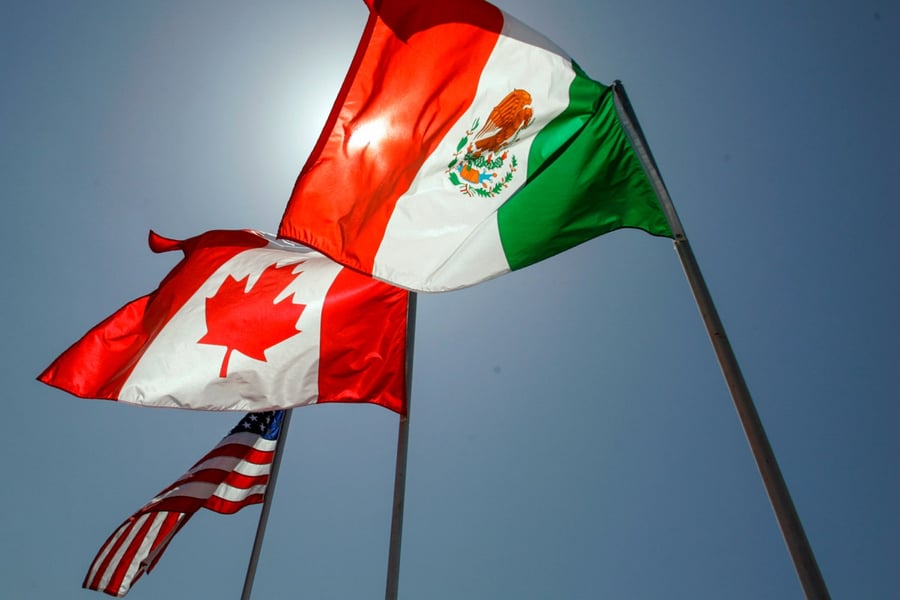
The $2 trillion trade framework that governs North America’s continental economy — covering everything from Michigan auto parts to Mexican maquiladoras to Canadian lumber — passed its first mandatory renewal deadline on July 1 without a U.S. signature, converting a fixed-term pact into an open-ended annual review cycle that could stretch to 2036. The agreement remains in force. The certainty that once defined it does not.
The decision reverses a deal Trump himself signed in 2018 as a replacement for NAFTA, which he then called “the best and most important trade deal ever made by the USA.” By January 2026, he had described it as having “no real advantage to it; it’s irrelevant.” In June, he told reporters he would “rather not have the agreement.” On Tuesday, his trade representative confirmed that position with a formal announcement, making the first joint review meeting — a virtual gathering with Canada’s Trade Minister Dominic LeBlanc and Mexico’s Economy Secretary Marcelo Ebrard — the occasion for a decision rather than a ceremony.
The rationale Greer offered was trade deficits, which the administration said had risen during the Biden years without adequate correction from the agreement. Economists dispute that frame. Trade deficits reflect the difference between what a country saves and what it invests; no bilateral trade agreement has reliably closed that gap. Tony Stillo at Oxford Economics said annual reviews would mean “uncertainty prevails, and that’s a negative for decision-making for businesses,” calling the review cycle “a big headwind” for all three economies. Gary Hufbauer at the Peterson Institute of International Economics warned the political damage would exceed the economic consequences and noted “there is a danger to US exports on terminating USMCA.”
The exposure runs unevenly. North Dakota sends 89.9 percent of its exports to USMCA partners. Michigan exports 64.9 percent to the same bloc; Iowa, 50 percent. Auto parts, petroleum, and aircraft — combined worth more than $10 billion annually — are among the categories most exposed to any future change in rules. USMCA-compliant goods have been largely shielded from the broader Trump tariff regime, a protection that annual reviews now render conditional.
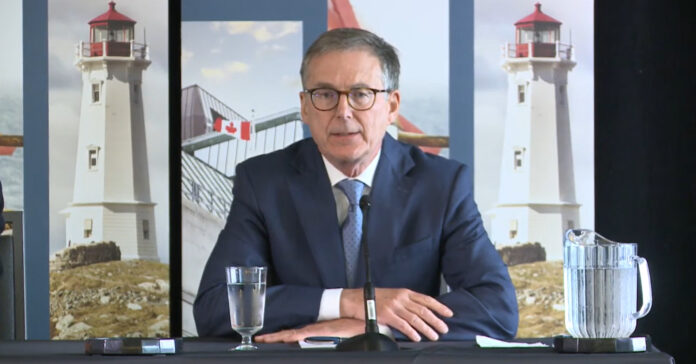
Neither Canada nor Mexico signaled intent to trigger withdrawal, the step that would cause the pact to expire rather than continue through annual reviews. Withdrawal requires six months’ notice. Neither LeBlanc nor Ebrard offered any indication that was under consideration. LeBlanc said Canada remained committed to the agreement and noted it “remains fully in force until 2036.” Ebrard stressed that “no country has indicated intent to withdraw” and described Mexico’s strategy as reducing unresolved issues year by year through the review process.
The next formal milestone is the week of July 20, when the United States and Mexico are scheduled to hold a third round of bilateral negotiations. No equivalent date was announced for Canada, whose trade relationship with Washington has been strained by separate disputes over steel and aluminum tariffs — issues LeBlanc raised explicitly in Tuesday’s meeting.
What the Trump administration did not explain on Tuesday was the specific objective. Greer’s statement offered no list of provisions the United States wants changed, no benchmarks that would satisfy the trade deficit concern, and no timeline by which the annual review cycle might conclude. Vina Nadjibulla at the Asia Pacific Foundation of Canada said the most likely outcome was a prolonged annual process, noting Trump “has said he wished the USMCA didn’t exist.”
Whether the non-renewal is a negotiating posture designed to extract concessions — tighter rules of origin, new content requirements for automotive supply chains, or energy provisions that advantage U.S. producers — or a structural preference for bilateral deals in which the United States negotiates separately with each partner, is a question Greer’s statement left open. Mexico and Canada, as the two smaller economies with the most to lose from trade disruption, will spend the next several years navigating that ambiguity without a clear answer from Washington.
The relationship is durable. Canada’s defense establishment has been pressing Ottawa not to pivot away from the U.S. alliance framework, and even Trump’s sharpest trade measures have not produced the rupture with Mexico or Canada that a complete USMCA withdrawal would require. The corporate scramble over Trump’s earlier tariff refunds made clear how deeply companies have embedded U.S. trade policy into their financial planning. What the non-renewal does is extend that uncertainty — already measured in hundreds of billions in corporate exposure — from tariffs to the foundational legal framework itself.
USMCA was once the deal Trump called the world’s best. Now it is a framework he has chosen not to endorse but not to leave — a holding pattern that benefits neither the companies building supply chains around it nor the governments that have to govern by it. What changes next year, or the year after, depends on negotiations whose terms Washington has not yet specified.