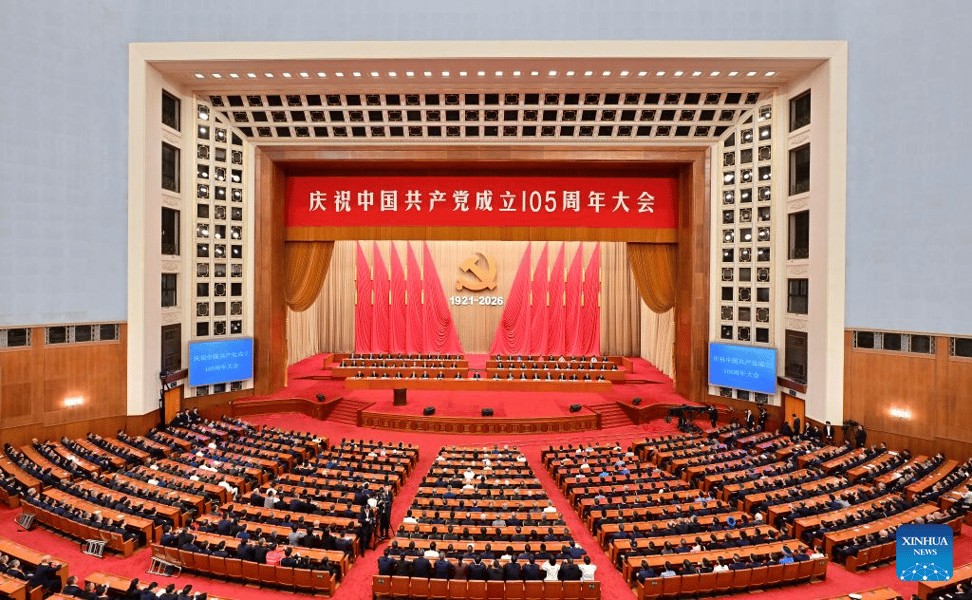

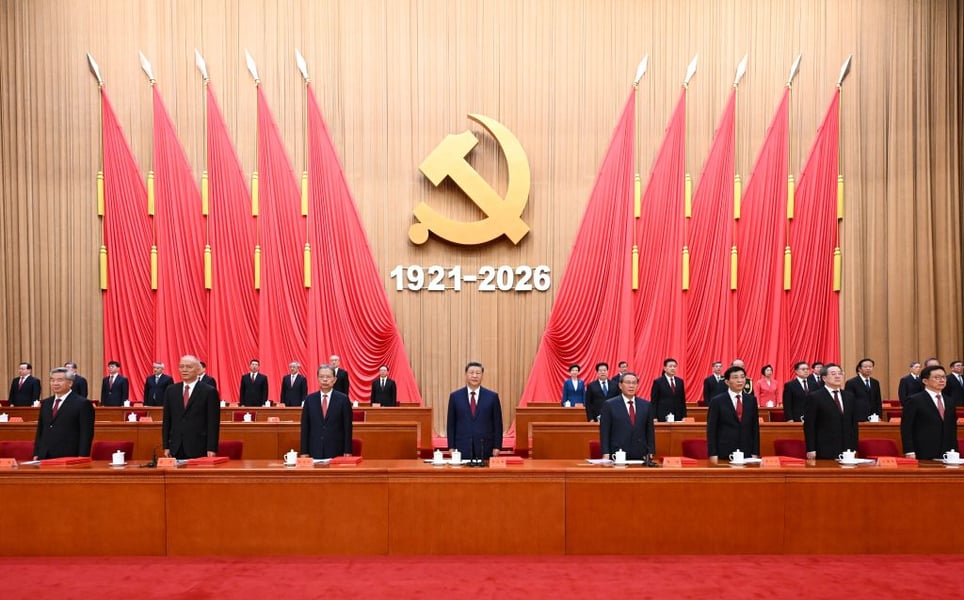
BEIJING — The anniversary was not just a celebration. Xi Jinping stood at the Great Hall of the People on Tuesday, a hundred and one million Communist Party members at his rhetorical back, and made Taiwan’s reunification sound less like an aspiration than a scheduled appointment.
The Chinese Communist Party turned 105 on July 1, and Xi, who has led it for more than a decade, used the occasion to turn a century-old milestone into a forward-looking declaration: modernization of the Chinese state by mid-century, the reunification of Taiwan as a historical inevitability, and a global community of leaders from Pyongyang to Ankara to Nairobi ready with their congratulations.
The ceremony at the Great Hall of the People was the kind of carefully choreographed occasion that the Party has mastered. Eight recipients of the July 1 Medal, the highest CCP honor, were decorated in front of party leadership. Xi’s speech balanced historical grandeur with sharp current-affairs specificity; he called the Party’s 105-year journey “the most magnificent epic of the Chinese nation in the past millennium,” a phrase that left little room for self-doubt.
What made this year’s speech different from prior anniversaries was the particular precision on Taiwan. Xi told his audience that China would take “resolute actions against Taiwan independence secessionists,” language that, in Beijing’s formal vocabulary, signals a posture more operational than rhetorical. He described reunification not as a political goal but as an “unshakeable” historical mission, embedding it in the same nationalist framework as the CCP’s entire self-narrative: a century-long story of humiliation and restoration, in which Taiwan is the last chapter still unfinished.
China’s official counts, released through party channels, now put membership at 101.29 million across 5.43 million primary-level organizations, a scale that no other political party on earth approaches. Xi has spent much of his tenure reinforcing the Party’s reach into civil society, the economy, and the military. Tuesday’s ceremony was in part a display of what that organizational depth looks like when marshaled for a moment of state pageantry.
The congratulations that arrived from abroad told their own story. Kim Jong Un sent a message from Pyongyang, calling the CCP’s journey a model for socialist construction, a formulation North Korea uses to signal alignment rather than mere courtesy. Indonesia’s President Prabowo Subianto and Malaysia’s Prime Minister Anwar Ibrahim both sent messages, reflecting China’s increasingly consolidated position across Southeast Asia, where Beijing has shown it is willing to sanction officials individually who challenge its territorial claims. Turkish President Recep Tayyip Erdoğan, Palestinian Authority leader Mahmoud Abbas, Serbian President Aleksandar Vučić, Kenyan President William Ruto, Belarusian President Alexander Lukashenko, and Singapore’s Prime Minister Lawrence Wong each offered formal congratulations.
The list reads less like a diplomatic courtesy round and more like a working map of China’s preferred geopolitical alignment: Eurasian leaders, Global South governments that view the Belt and Road Initiative as credible infrastructure investment rather than a debt trap, and smaller European states that have drifted from the Western consensus. Beijing would not use the word “bloc,” but the texture of Tuesday’s congratulatory messages was unmistakably bloc-like in its geography and its politics.
Xi’s economic framing was equally purposeful. China is, by his account, the world’s second-largest economy and the fastest-rising innovator globally, claims that serve the CCP’s domestic narrative while calibrating expectations for the next quarter-century. The party’s formal goals remain a “basically modernized” China by 2035 and full socialist modernization by mid-century. Those targets gained some technical grounding just days earlier when Chinese engineers demonstrated the country could build the world’s fastest supercomputer without a single American component. Xi’s speech, without naming Washington directly, framed China’s progress as a vindication of the path taken while the U.S. and its allies have spent three years trying to decouple from Chinese technology supply chains.
What the speech did not resolve, or even acknowledge, is the precise content of those Taiwan “resolute actions.” Xinhua’s full report on the ceremony carried the phrase without elaboration on what form those actions might take, what timeline they operate on, or whether they represent a genuinely elevated military posture or a rhetorical escalation calibrated for domestic consumption.
Xi called Tuesday’s moment a test of whether China could carry its “great historic mission” forward. The mission is complete enough to celebrate at the Great Hall of the People, with 101 million members and a willing audience of global leaders. It is not complete enough that its most contested chapter, the one involving the Taiwan Strait, has been settled. That is the one thing the CCP’s 105th anniversary left conspicuously open.