
LONDON – He did not need a perfect match to get there. He just needed enough of one to reach 105.
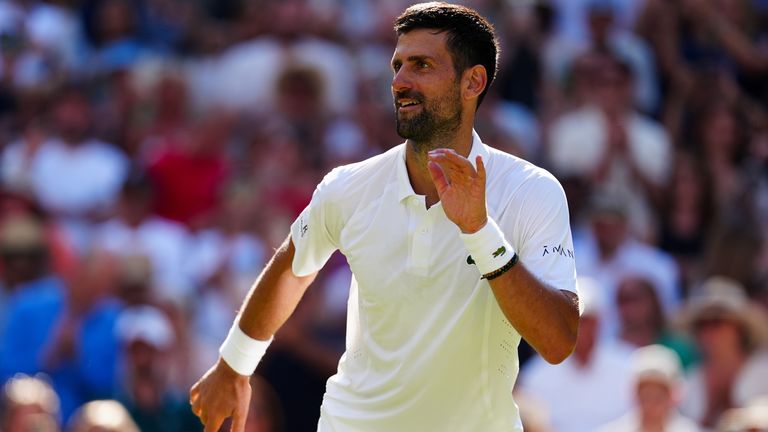
Novak Djokovic equaled Roger Federer’s all-time record for men’s Wimbledon victories on Friday, dispatching Arthur Rinderknech of France 7-5, 6-4, 1-6, 7-6(4) on Centre Court in three hours and one minute to advance to the last 16 at Wimbledon 2026. The number that closes a chapter on one of tennis’s longest-running record pursuits came at the cost of a third set Rinderknech took decisively, and a fourth-set tiebreak that forced Djokovic to earn it cleanly. He did.
One hundred and five wins at one tournament. Federer accumulated his between 2001 and his final Wimbledon in 2021. Djokovic, who turned 39 in May, drew level on Day 5 of what he has said publicly is his last appearance in this draw. The record stood alone for five years. It is shared now.
“Maybe Roger and I should play each other for No. 106,” Djokovic said after leaving Centre Court, a line delivered with the ease of someone who had just lifted something very heavy and was not quite ready to put it down.
The first two sets gave little indication this would extend past the two-hour mark. Djokovic broke in the tenth game of the opener to take it 7-5, converted an early chance in the second to build a 5-3 lead and closed it at 6-4. Rinderknech, the 25th seed who had beaten seeded opponents on his way to SW19, was not finding angles against Djokovic’s return game, and the recovery time when Djokovic pushed wide on the forehand simply was not there. The match appeared on schedule to be quick and clean.
Then the third set arrived as a correction. Rinderknech lifted his first-serve percentage, found three rapid breaks, and took it 6-1 in 35 minutes. The Centre Court crowd, which had been building toward coronation mode since the second set, quieted. A real question settled into the fourth: four games all, five all, six all, tiebreak.
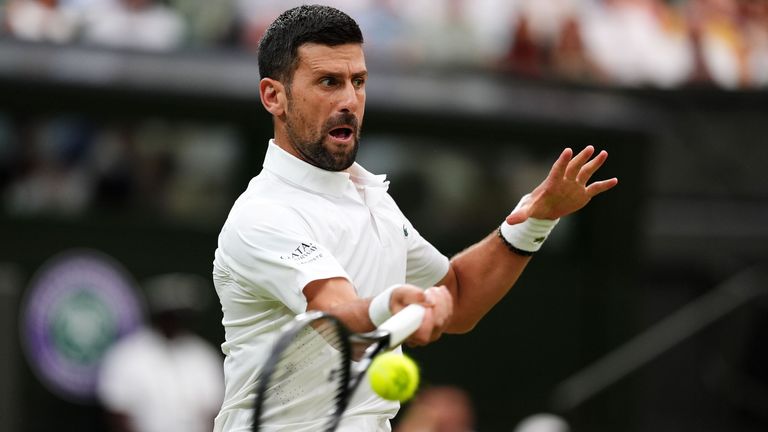
That tiebreak is where win No. 105 was actually decided. Rinderknech produced two mini-breaks in the early exchanges but could not convert either into a controlling lead. Djokovic served four times in the tiebreak without facing a second-serve situation and closed it on a forehand winner down the line to take it 7-4, the ATP Tour reported. Centre Court exhaled and then immediately came alive.
Djokovic let it happen. He stood at the baseline, arms wide, and looked up at the scoreboard for a beat longer than he typically allows himself mid-match, then turned to his box and pointed. Three hours and one minute in, the match had taken something from him. He was not pretending otherwise.
The only figure above both Djokovic and Federer at Wimbledon belongs to Martina Navratilova, whose 120 victories in singles and doubles combined remain the benchmark the men’s record has not reached. Djokovic has declined in recent weeks to engage directly with Navratilova’s total as a target, a restraint that reads now as strategy rather than modesty. He has 15 victories remaining in the draw if he reaches the final.
The chase to reach Federer has run the full length of Djokovic’s time at SW19. He first won here in 2011 and has held the title seven times in the 15 years since. Federer accumulated his 105 across a span from 2001 to 2021, a period during which Wimbledon was the centrepiece of his career. Their professional paths never produced a decisive late-round Centre Court meeting in a year when both men were at their peak, which gives Djokovic’s joke about a match for No. 106 an edge beneath the lightness in which it was offered. These are rivals across history rather than across a net.
Rinderknech, who is 30 and French, held his own through a third set that will remain the sharpest thing he produced on Friday. His serve and his backhand down the line were working at the same time in the fourth, and there were stretches where Djokovic was pressing rather than coasting. But Rinderknech could not sustain it when it counted, and the tiebreak ended as fourth-set tiebreaks against Djokovic at Wimbledon tend to: with the Serb closing before the opponent finds his way back in.
The path to the quarterfinal now runs through Roman Safiullin, a qualifier who reached the last 16 through the draw’s more open section. Three rounds into this fortnight, Djokovic has dropped sets in two of them. The match against Tsitsipas three days ago was 98 minutes and straight sets. The current pattern is not alarming, but it is visible: when pushed, Djokovic is grinding, and the grinding is taking time.
What Wimbledon’s second week will answer is whether that level holds against heavier opposition. Carlos Alcaraz’s withdrawal before the tournament began removed the one grass-court opponent with recent head-to-head results against Djokovic, opening the upper half of the draw in ways that favour the Serb but also leave the high-stakes test he most needs still uncontested.
On Friday, none of that was the question. The number was 105. Federer had built it across two decades of Centre Court Julys. Djokovic had made it his horizon. He reached it in three hours and one minute, on the court that belongs to him more than any other surface in the world. Whether he stands alone at 106, whether the knee holds through the fortnight he came back for, whether the eighth title follows: Friday did not answer any of that. One record closed. The rest remains open.