
GENOA – Egle Possetti was in the courtroom on Thursday as Judge Paolo Lepri began reading sentences, eight years of proceedings reduced to each name called. She had lost her sister, her two children, her brother-in-law and the family dog when the Morandi Bridge gave way on an August morning in 2018. Forty-three people died in those minutes. An Italian court told her and hundreds of others on Thursday that someone had been accountable.
The court convicted 32 of 57 defendants in the trial over the collapse of the Polcevera viaduct, the highest-profile infrastructure disaster in Italian judicial history to result in criminal sentencing. Chief Judge Lepri handed down sentences ranging from under two years to 12 years in prison. Giovanni Castellucci, the former chief executive of Autostrade per l’Italia, the private highway operator that held the state concession to manage the bridge, was sentenced to 12 years, convicted of vehicular homicide and criminal negligence, Euronews reported. It was the longest sentence in the case.
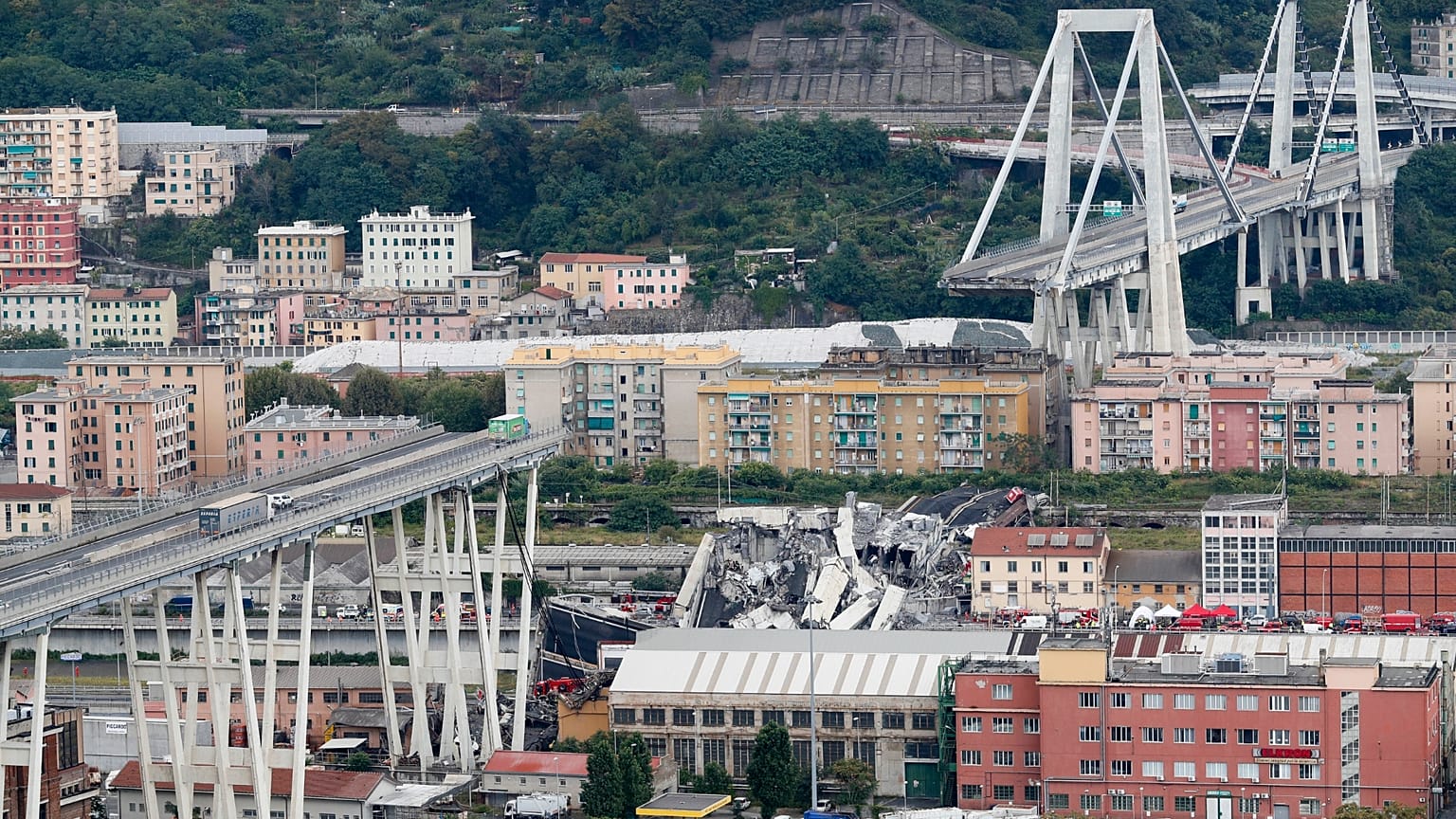
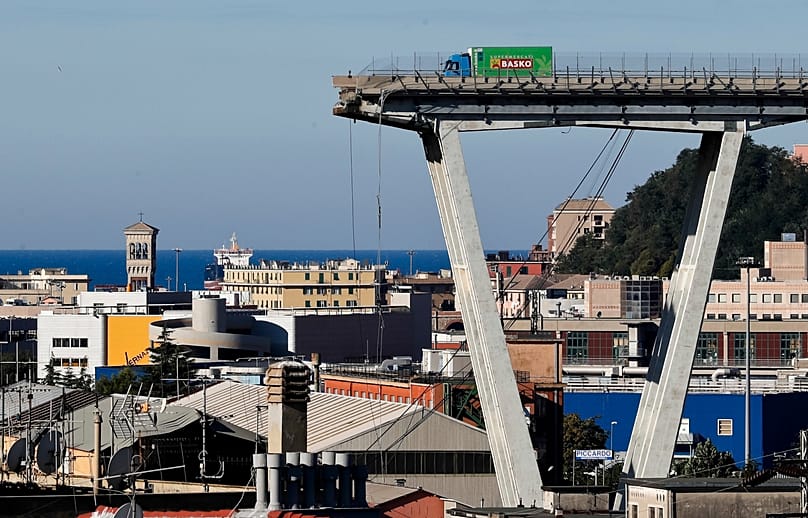
The bridge, designed by engineer Riccardo Morandi and opened in 1967, collapsed at 11:36 a.m. on August 14, 2018, during a rainstorm, sending a 200-metre section onto the industrial district and rail yard below. The fall killed 43 people and displaced 566 residents from surrounding apartment blocks. Investigators established in the years that followed that the cable-stay system holding up the deck had corroded over decades while Autostrade, operating the road under a government concession, had deferred the structural intervention the bridge required.
The sentencing extended well beyond Castellucci. Michele Donferri Mitelli, who oversaw maintenance operations at Autostrade, received 11 years. Paolo Berti, the company’s former deputy chief executive, was sentenced to five years and six months. Antonino Galatà, who led SPEA, the engineering subsidiary contracted to inspect the bridge, received five years and six months as well. Officials from Italy’s infrastructure ministry were among those convicted, reflecting what prosecutors argued was a failure distributed across the private concessionaire and its state regulator.
The trial opened on July 7, 2022, and ran for nearly four years across 284 hearings. Prosecutors submitted a closing brief of 5,000 pages drawn from a record that included 24,000 pages of transcripts and 10,000 pages of evidence compiled from 282 witnesses. The breadth of the documentation reflected the central prosecution argument: that the bridge’s deterioration was not unknown inside Autostrade, and that the company had chosen cost-saving over structural repair on a structure the state had entrusted to it.
As part of a parallel civil resolution, Autostrade per l’Italia and SPEA reached an out-of-court settlement with the public prosecutor’s office, agreeing to pay 29 million euros to the Italian state. The settlement did not protect individual defendants from criminal conviction. Atlantia, the infrastructure conglomerate that owned Autostrade until 2022, divested the subsidiary under political pressure following the collapse. Under Italian law, corporate entities did not face criminal prosecution as legal persons; only individuals were tried.
The verdict arrives in a week when institutional accountability is under scrutiny across Europe on several fronts. In France, the parliament passed assisted dying legislation this week after two years of national debate, in a 291-241 vote that tested the limits of state authority over individual decisions. In Italy, the Genoa verdict carries weight because of what it asserts: that a private company managing public infrastructure bears criminal responsibility, not merely civil liability, when its negligence kills.
Possetti addressed journalists after the verdict was read. “I lost my sister, her two children, my brother-in-law and even their little dog,” she said. The court’s decision marks the criminal phase of a legal process that has run since the hours after the bridge fell. What it does not resolve is the amount paid to individual victims’ families in civil damages, which has not been publicly disclosed.
Defense lawyers for several defendants indicated they would appeal. Under Italian law, sentences do not become final until all appeal stages are exhausted, a process that often takes several years and that has produced reductions in comparable Italian cases. The 32 convictions handed down Thursday are the beginning of the post-verdict phase, not its conclusion. Whether the sentences stand as delivered will depend on proceedings that have not yet begun.
Italy has replaced the bridge. The Genoa San Giorgio viaduct, designed by Renzo Piano, opened in 2020 and is considered among the most technically sophisticated viaducts built in Europe in recent decades. What has proved considerably harder to rebuild is the regulatory framework governing the private concessions that manage Italy’s aging motorway network. The political debate that opened in August 2018 produced a change of ownership for Autostrade but not a structural reform of how the state audits the concessionaires who hold such contracts. On Thursday, the courts provided an answer about who was responsible for what happened eight years ago. The larger question of what comes next belongs to a different kind of proceeding.