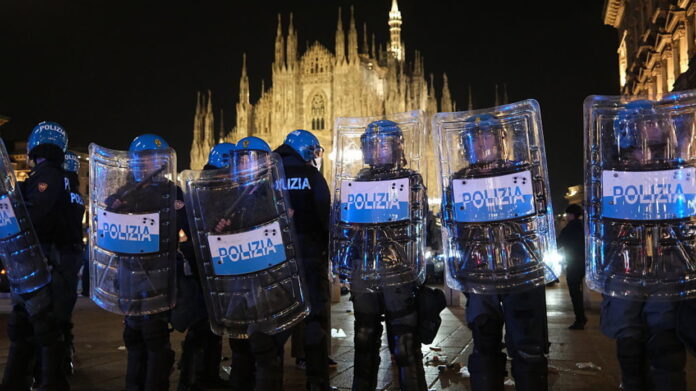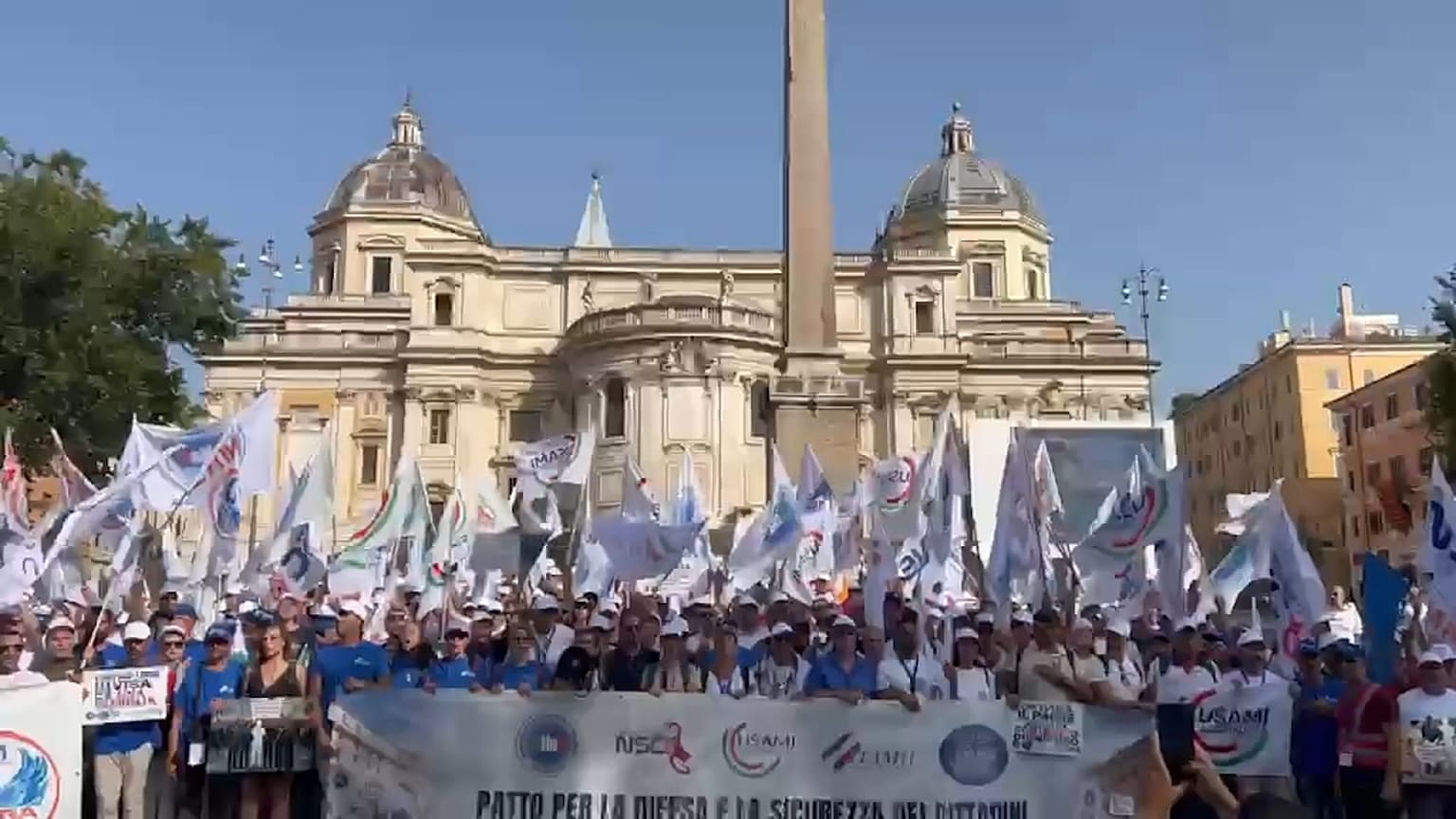

ROME – Carabinieri officers in formal uniforms stood alongside Navy sailors and Army infantry troops Saturday as roughly 6,000 Italian military and law enforcement personnel marched through central Rome, carrying a demand their unions had spent two years trying to advance in closed rooms before deciding that the street might accomplish what the negotiating table had not.
The demonstration drew representatives from Italy’s five major uniformed services: the Army, Navy, Air Force, Carabinieri paramilitary corps and the Guardia di Finanza, which handles financial crime and border enforcement. Union organizers described it as the first joint march in modern Italian history across the country’s entire defense and law enforcement establishment, and said it reflected a collective decision that sector-by-sector lobbying had produced nothing binding, Euronews reported from Rome.
At the center of the dispute is a pay increase of €188 per month, paired with €2,448 in retroactive back pay that unions say the government has acknowledged as owed but declined to disburse. Together the demands cover roughly 430,000 active military and law enforcement personnel. The government had not issued a formal response to Saturday’s march by the evening.
“They have asked us to be patient for years,” said one union representative alongside the march route, speaking to Italian press. “Our people are leaving the service. They are taking second jobs to survive. This is what patience has bought the Italian military.” Organizers said turnout exceeded expectations, with personnel traveling from Sicily and the Alpine north to participate.
The four-point platform unions brought to Rome went beyond wages. It included pension reform to reflect the physical demands of uniformed service, enhanced legal protections for officers injured or prosecuted in the line of duty, cost-of-living adjustments tied to national inflation data, and investment in recruitment pipelines that unions said were struggling to fill vacancies as experienced personnel left for the private sector. On each point, they said the Meloni government had offered statements of support and no commitments.
The Meloni administration has repeatedly spoken in favorable terms about Italy’s security forces, framing defense investment as aligned with the country’s NATO commitments. But union leaders at Saturday’s march said that verbal appreciation had not appeared in successive budget cycles. Italy’s fiscal position within European Union debt rules has constrained how much new spending Meloni’s coalition could promise, leaving personnel costs in a zone where political rhetoric and appropriated funds have not yet met.
The Carabinieri’s participation carried particular institutional significance. The corps serves a dual function as military police and as the primary civilian law enforcement presence across much of rural Italy. Carabinieri union representatives said staffing shortages were reaching critical levels in smaller communities where the corps is the only police presence, and that pay levels relative to comparable roles in other European countries were making recruitment and retention increasingly difficult.
Guardia di Finanza union delegates raised a separate concern. Their service, responsible for financial crime investigations, customs enforcement and coastal patrol, had seen European-level demands placed on it through anti-smuggling and financial monitoring priorities, while its internal compensation structure had not kept pace. Delegates said the growing gap between public-sector pay and private-sector alternatives was affecting the pool of university-educated applicants the service needed for complex financial investigations, a pattern visible across European economies as skilled workers weigh opportunities abroad.
The decision to march together came after months of coordinating effort among the five unions, which have historically operated independently and sometimes competed for budget priority within the defense establishment. Union coordinators described the joint structure as a last resort, attempted only after separate sector-level protests over the previous eighteen months had generated courteous ministerial responses and no budget line items.
Timing mattered. Italy’s parliament typically rises for summer recess by late July, and union leaders framed Saturday’s demonstration partly as a warning that a failure to act before the break would intensify pressure when legislators returned in September. The 2027 budget negotiations, which begin in autumn, represent the next realistic legislative vehicle for embedding pay and pension changes into law. Unions said they would escalate their campaign if the government let parliament rise without commitments.
The demonstration carried implicit political costs for Meloni’s coalition. Her governing alliance has drawn consistent support from law enforcement and military communities as a political constituency, and Saturday’s images of uniformed personnel marching against her government’s inaction created a visible discomfort the administration had not publicly addressed. The broader instability of European governing coalitions, reflected in polling that has shown falling approval for center-right governments across the continent, has sharpened the political calculation for governments seeking to retain their traditional support bases.
What remained unresolved after Saturday was whether the scale of the march would change the government’s budget arithmetic or simply register as a visible protest before summer. For 430,000 uniformed personnel and the five unions that represent them, the answer would become clearer in the weeks before parliament’s recess, and again in the autumn when budget negotiations begin in earnest.