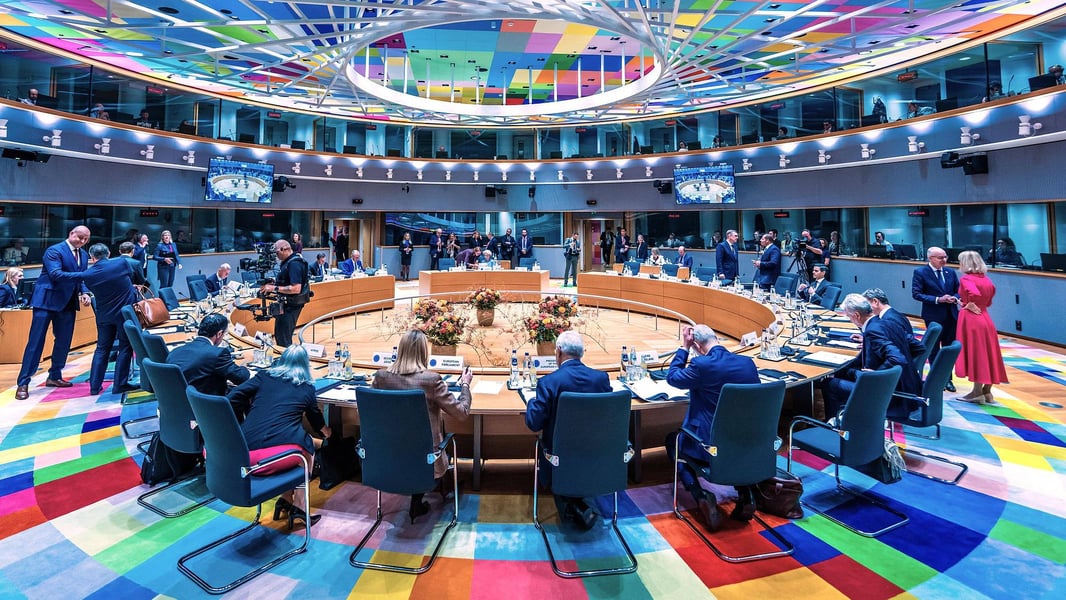

BRUSSELS — Greek Prime Minister Kyriakos Mitsotakis told fellow EU leaders on Thursday that energy costs had “fueled a new surge in European inflation,” Euronews reported, and that he did not expect a deal “today or tomorrow.” Friday’s Eurostat data showed what he was arguing from.
Euro area inflation was confirmed at 3.8% in September, up from 3.2% in August and 2.2% a year earlier. The headline hides a wide spread. Greece ran at 5.1%, Spain at 5.0%, Italy at 4.2%, France at 3.4% and Germany at 3.3%. A year ago Greece stood at 1.8% and Italy at 1.7%.
Energy explains most of it. Eurostat has energy prices up 18.9% on the year, supplying 1.71 of the 3.8 points. Strip out energy, food, alcohol and tobacco and the rate is 2.5%. That gap carries the whole argument over whether this is a passing shock or something broader.
The leaders’ answer was cautious. Euronews said they asked the Commission for support described as “targeted and temporary,” while Italy and Greece pressed Brussels to let them spend more without incurring infringements. What Eurostat’s release does not do is split the energy effect by country, so how much of Greece’s gap is fuel and how much is something else stays unmeasured.
The European Central Bank has one rate for all of them: a deposit rate of 2.50% since 16 September, the second increase after June’s ECB rate hike. Euronews reported Thursday that markets expect a hold on 29 October and another rise in December. Bundesbank president Joachim Nagel, whom the same report quotes from remarks earlier this month, said “there are so far no clear signs that inflation has fed through to price and wage setting.”
National statisticians draw different pictures. Spain’s INE put September CPI at 4.9%, the highest since February 2023, with core at 3.1%. Italy’s Istat, in its preliminary estimate, had core at 1.7% while regulated energy prices rose 25.9%. Italy’s pressure looks like energy alone; Spain’s looks broader. Both are national indices, not Eurostat’s harmonised measure, and Eurostat’s table now shows Italy at 4.2%, against 4.1% in the flash estimate, so treat the comparison as rough.
There is also the stock to refill. CGTN, citing the Institute for Energy Economics and Financial Analysis, reported EU gas storage at 72.4% on 3 October, the lowest for that date since records began in 2011. Drivers in France saw French diesel pass €2.41 a litre in September, as TEH reported. Nothing in the coverage so far says who would pay for national support if Brussels relaxes its rules, or whether it arrives before the ECB meets on 29 October.