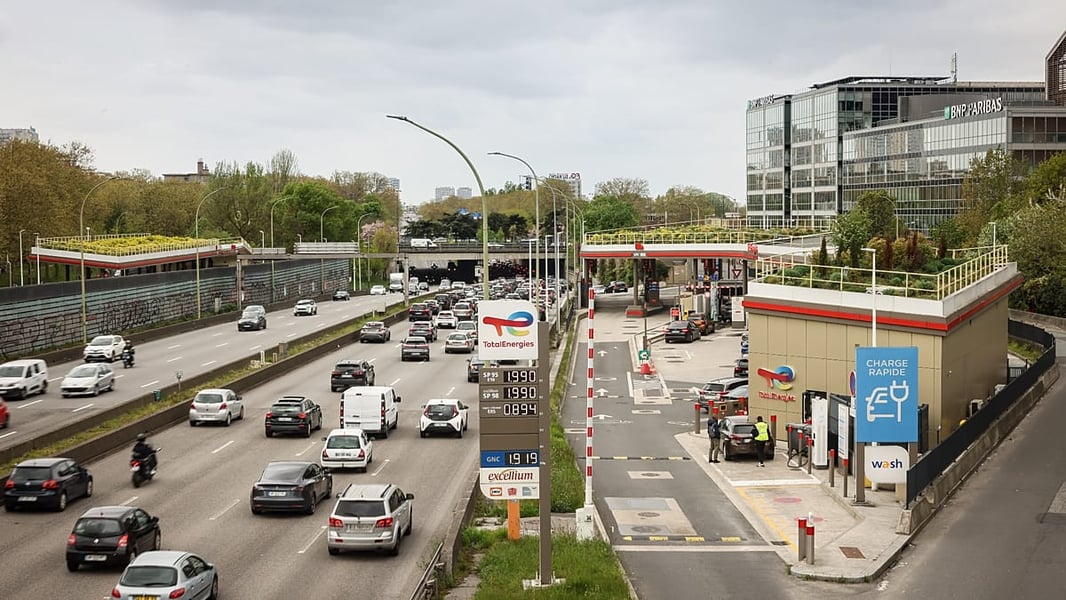

PARIS — France’s average diesel price exceeded €2.41 per liter on Sunday, setting a new national record for the second consecutive day.
The figure was calculated from more than 8,700 service stations listed on the Economy Ministry’s online tracker at mid-morning, surpassing Saturday’s previous record.
The back-to-back increases underscore how rapidly fuel costs have reset expectations for French motorists and transport companies, which have spent seven months seeing prices once considered exceptional become the new baseline.
The immediate cause sits some 5,000 kilometres to the east. The war that Washington and Tel Aviv launched against Iran in February 2026 did not take long to breach the separation between military conflict and household budget. Since that conflict began, roughly 1.3 million to 1.4 million barrels of diesel per day have been stripped from global supply, according to calculations tracking the knock-on from disruptions to the Strait of Hormuz and Gulf energy infrastructure. That deficit has nowhere else to go but into the price column at the forecourt.
Crude oil prices remain elevated, with Brent trading around $109 in early September after briefly topping $118 in late March. The Strait carries roughly a fifth of the world’s seaborne oil trade and now runs under United States naval escort rather than purely on diplomatic assurance. Markets have not missed the distinction.
France is not the only country watching its records reset. Across the European Union, the average litre of diesel hit a record 2.159 euros as of September 14, the highest reading in the European Commission’s data series, which runs back to 2005. Petrol stood at 2.063 euros per litre on the same date, also a record. Both figures have continued to climb since. In isolated filling stations in Germany and Italy, premium diesel has crossed three euros per litre. Spain saw its average diesel price rise by more than 15 percent in a single month after VAT relief expired in July.

Within France, the picture is more complicated than a single national average. TotalEnergies, the country’s dominant fuel retailer, has maintained a price cap at its own forecourts since the early weeks of the conflict: diesel at no more than 2.25 euros per litre, and E10 petrol at 1.99 euros, with registered loyalty-programme customers able to buy any fuel at the lower ceiling. CEO Patrick Pouyané said in late August that the company intended to maintain the arrangement “as long as the conflict” lasted. The gap between TotalEnergies’ capped price and the national average has widened to roughly 16 cents per litre on diesel, wide enough that the company’s network has become a destination rather than a convenience. Rivals have described the arrangement as a competitive distortion; TotalEnergies has described it as a public service.
The French state, for its part, has limited runway. France entered this period carrying debt at 119 percent of gross domestic product, with the spread between French and German government borrowing costs crossing 100 basis points, a threshold not seen since the eurozone debt crisis of 2012. Emergency subsidy programmes of the kind deployed during the 2022 energy shock would land on a fiscal position that has deteriorated markedly since. The Bank of France governor, François Villeroy de Galhau, has stated publicly that the country’s fiscal capacity to cushion the blow from elevated energy import costs is limited.
Europeans are not the only ones absorbing the costs of a war they had no role in initiating. The Federal Reserve‘s own rate decisions, shaped partly by energy-driven inflation that has not responded to prior tightening, have made dollar-denominated crude more expensive for European importers. European Commission economists told Euronews last week that diesel refining margins were likely to peak in October before easing, but that projection depends on factors outside Brussels’ control: the pace of attacks on Gulf energy infrastructure, the willingness of Washington and Tel Aviv to accept terms that have proved elusive for seven months, and whether retaliatory pressure on Gulf energy assets intensifies before Northern Hemisphere winter demand picks up.
What is clear at the forecourt is simpler. France has broken its own diesel record in consecutive days. The whole of Europe is paying fuel prices its data series has never recorded. And the chain of cause and consequence, traced from the pump price backward through the global supply shortage, through the Houthi attacks and the Aramco fires, through the Hormuz escorts and the February strikes, arrives at a decision made in Washington and Tel Aviv that no French petrol-station customer voted for.