
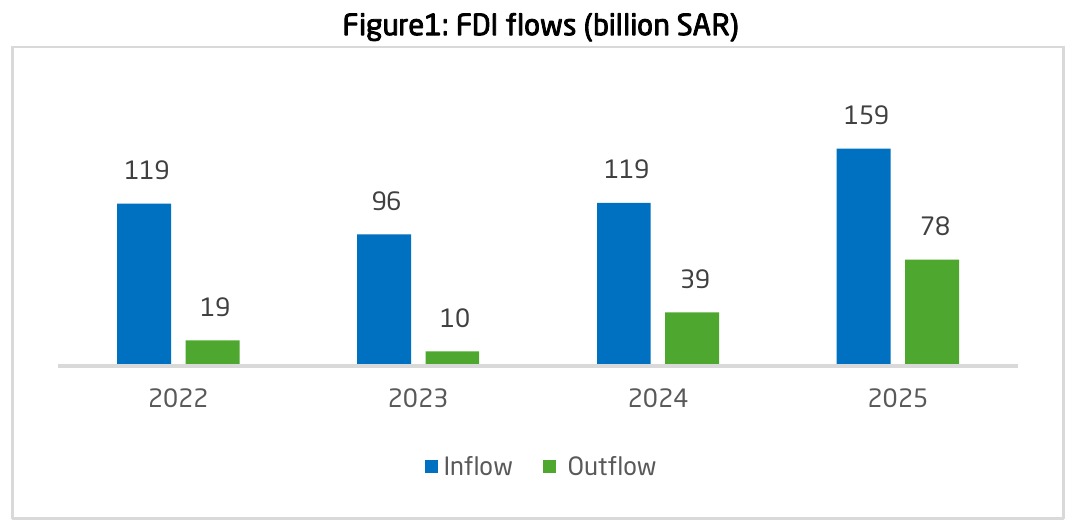
RIYADH — Saudi Arabia attracted a third more foreign direct investment in 2025 than the year before and finished the year with 1.7 percent more of it to show for the effort. Foreign investors put SR159.1 billion into the kingdom, the General Authority for Statistics said in its annual bulletin on Thursday, and SR77.7 billion went back out, leaving net flows of SR81.4 billion against SR80.0 billion in 2024.
Inflows rose 33.5 percent from SR119.2 billion, about $42.4 billion at the riyal’s fixed rate of 3.75 to the dollar, and they were the highest of the four years GASTAT charts, 2022 to 2025. Construction took SR34.5 billion, or 21.7 percent of the total, and manufacturing SR33.4 billion. Arab News placed the figures alongside the updated Investment Law, in force since February 2025, and the Regional Headquarters Program, which offers incentives to multinationals that base regional operations in the kingdom.
The cost of that growth sits in the second figure. Outflows nearly doubled, up 98.5 percent from SR39.2 billion, with manufacturing accounting for SR25.2 billion. GASTAT’s quarterly bulletins define outflows as transactions that reduce liabilities, such as dividend payments, loan repayments and settled creditor dues, or when a direct foreign investor exits. Net flows, the difference between the two, were SR100 billion in 2022 and SR86 billion in 2023 on the bulletin’s rounded chart. So 2025 was the biggest gross year in that four-year chart and still netted less than 2022.
The timing sharpens the question. The bulletin covers calendar 2025, before a much harsher year. The Saudi Ministry of Finance projected on September 30 that real GDP will shrink 3.6 percent in 2026, driven by a 21.8 percent fall in oil activity, while non-oil activity grows 3.2 percent, Xinhua reported. The IMF Hormuz forecast, published on Tuesday, has the kingdom contracting 3.3 percent after growing 4.6 percent last year, The National reported, on the assumption that the Strait of Hormuz reopens gradually from March 2027.
Vision 2030 sets a target of $100 billion a year in foreign direct investment by 2030, Arab News noted, and it put the 2025 inflow at about 42 percent of that. On net flows, about $21.7 billion by TEH’s arithmetic, the share is closer to a fifth, and neither the bulletin nor the Arab News report says which measure the target is meant to track. Hamza Dweik, head of trading for the Middle East and North Africa at Saxo Bank, told Arab News the “direction of travel is positive” but that the “next test is whether Saudi Arabia can sustain this level of investment” as the 2030 objective gets larger.
UNCTAD, the UN trade and development body, put Saudi inflows for 2025 at about $33 billion in its World Investment Report, Arab News reported in July, and warned that rising geopolitical tensions are likely to affect the implementation of announced projects in West Asia. This month the Riyadh airport attack, which the Houthis claimed, shut the capital’s main airport, and Xinhua reported on Monday that it had stayed closed since Saturday as the World Petroleum Council’s energy congress opened in the city.
That UNCTAD figure invites a second look at GASTAT’s own numbers. The Ministry of Investment gave it as $32.6 billion in a July post on X, which at the riyal’s fixed rate is about SR122 billion. GASTAT’s four quarterly net-inflow figures for 2025, taking each quarter’s latest revision, add up to SR122.4 billion, well above the SR81.4 billion net total in the annual bulletin.
| Measure | Sum of quarterly bulletins | Annual bulletin | Gap |
|---|---|---|---|
| Inflows | 133.3 | 159.1 | ▲ 25.8 |
| Outflows | 10.9 | 77.7 | ▲ 66.8 |
| Net inflows | 122.4 | 81.4 | ▼ 41.0 |
| Source: GASTAT quarterly FDI bulletins for Q1 to Q4 2025, using each quarter’s latest revised figure, and GASTAT’s Annual Foreign Direct Investment 2025 bulletin, published October 15, 2026. Sums and gaps are TEH’s arithmetic. The annual bulletin does not explain the difference. | |||
The gap sits mostly in outflows: the quarterly releases show SR10.9 billion, the annual bulletin SR77.7 billion. GASTAT has restated quarterly outflows before. Its first-quarter 2025 bulletin gave the last quarter of 2024 as SR1.7 billion, and its fourth-quarter 2025 bulletin gives the same quarter as SR13.8 billion. The annual bulletin does not say whether the 2025 quarters will be revised the same way, or which series UNCTAD used.
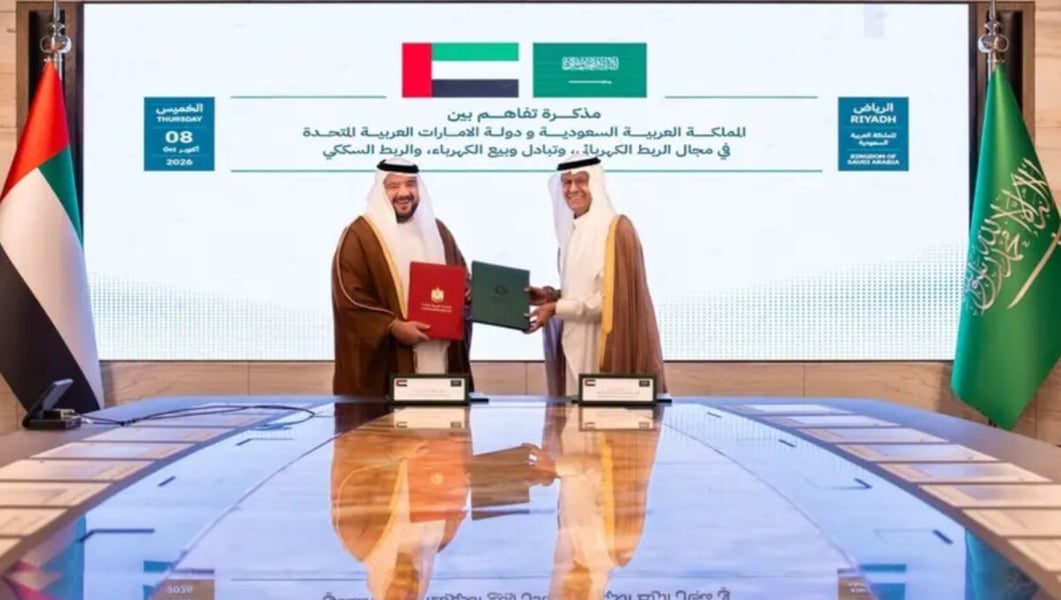
By source, Luxembourg recorded the highest net inflow, SR24.4 billion, ahead of the UAE and Egypt at SR9.4 billion each and Yemen at SR5.2 billion. The UAE also holds the largest stock in the kingdom, SR170.7 billion, and the two governments signed a memorandum on power-grid and rail links in Riyadh on October 8, Xinhua reported.
What the annual bulletin leaves open is which of its two series investors and the 2030 target should be measured against. GASTAT has not said whether the annual figures restate the quarterly releases or count outflows differently, and the next quarterly bulletin is the first place that question can be answered.