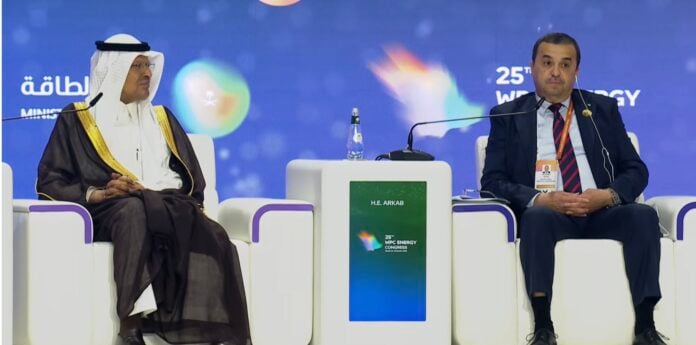

BANGKOK — The International Monetary Fund now assumes the Strait of Hormuz will not reopen until March 2027, and the Gulf economies on either side of it are carrying the assumption: Saudi Arabia is forecast to shrink 3.3 percent this year, Kuwait 16.7 percent and Qatar 15.6 percent.
The fund’s World Economic Outlook, released on Tuesday at its annual meetings, raised global growth for 2026 to 3.1 percent from 3.0 percent in July and left 2027 at 3.4 percent, Xinhua reported. Headline inflation is forecast at 4.7 percent this year and 4.1 percent next. The figures rest on oil averaging $95.74 a barrel this year, up about 41 percent from 2025, and $87.39 in 2027, with conditions in the strait broadly back to prewar levels by October 2027.
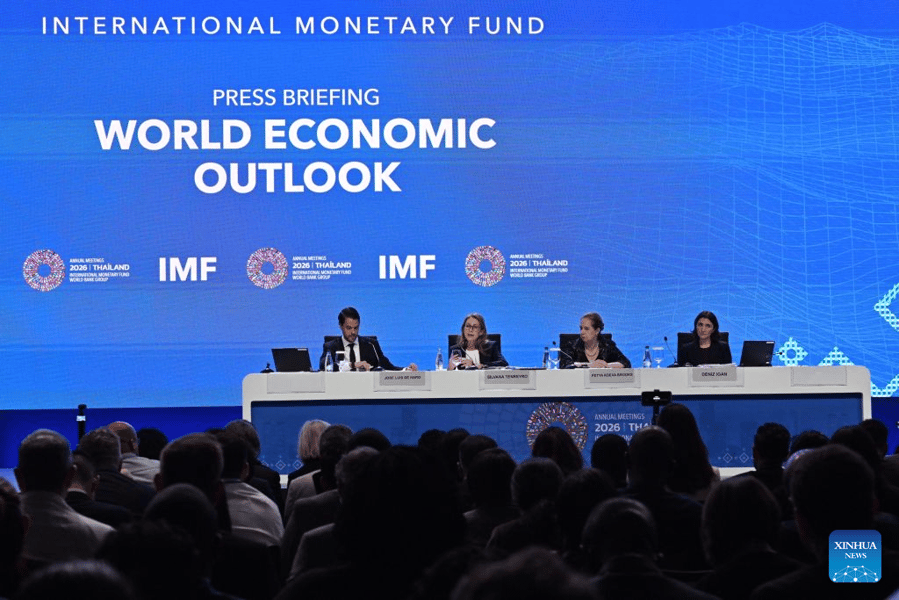
The Middle East and North Africa is forecast to contract 2 percent this year, 3.1 points worse than the April forecast and the only region expected to shrink, The National reported. Saudi Arabia’s 2026 forecast was cut by five points from July’s 1.7 percent growth, according to Xinhua. Oman, at 4.1 percent growth, is the one Gulf economy forecast to expand. Iraq is expected to shrink 16 percent, Iran 7.6 percent and the United Arab Emirates 3.9 percent, a seven-point cut from April. The fund estimates that closing the strait would have cut global growth by 0.9 point this year without offsetting responses, and that rerouting, extra output elsewhere, stock draws and lower oil intensity have reduced the net hit to about 0.3 point.
| Economy | 2026 | 2027 | Note |
|---|---|---|---|
| Saudi Arabia | -3.3 | 7.9 | ▼ 5.0 points from July |
| United Arab Emirates | -3.9 | 7.7 | ▼ 7.0 points from April |
| Qatar | -15.6 | 18.8 | n/a |
| Kuwait | -16.7 | 17.1 | n/a |
| Bahrain | -11.3 | 13.9 | n/a |
| Oman | 4.1 | n/a | ▲ Only Gulf economy growing |
| Iraq | -16.0 | n/a | n/a |
| Iran | -7.6 | n/a | n/a |
| Source: The National, Xinhua and Al-Monitor accounts of the IMF’s World Economic Outlook, October 13, 2026. The IMF’s full report was not retrievable when this was written; “n/a” means the figure was not given in the accounts reviewed. The Saudi finance ministry’s own 2027 forecast is 12.8 percent. | |||
The rebounds are as large as the falls, and they depend on the same date. Qatar is forecast to grow 18.8 percent in 2027, Kuwait 17.1 percent and Bahrain 13.9 percent. Saudi Arabia’s finance ministry said last week that it expects 12.8 percent growth next year, The National reported, against the IMF’s 7.9 percent. The IMF’s own adverse case, with oil at $130 a barrel through the first quarter of 2027, would cost global growth 0.2 point this year and 0.5 point next and lift 2027 inflation by 1.1 points to 5.2 percent, Al-Monitor reported.
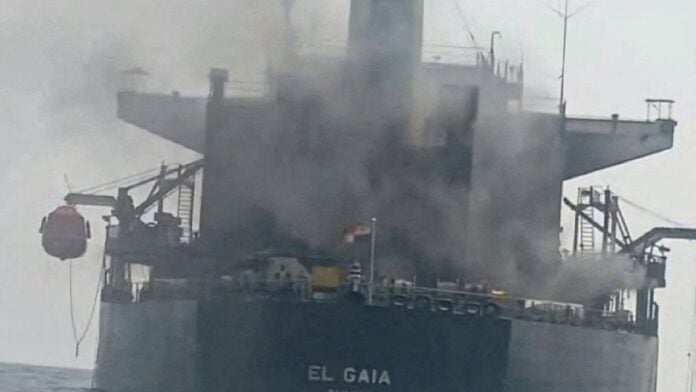
The strait is not shut in the way the assumption sounds. Shipping data from Kpler, cited by The National, show confirmed clearance of about 11.9 million barrels a day, roughly 30 percent below the prewar baseline, with wide daily swings, while EH reported on Monday that Trump ruled out Iran strikes until November as Hormuz tankers burned. The IMF warns that oil inventories “are being depleted toward stress levels that could trigger sharp price jumps,” Xinhua reported, and the fund names that spike as the key risk.
The headline hides a narrow base. Thirty-two countries now account for 95 percent of global growth, down from 54 in April, and the IMF has downgraded about 47 percent of economies since then. The United Kingdom and Japan are not expected to see core inflation back at 2 percent until the end of 2027. India is forecast to grow 7.0 percent in both 2026 and 2027, the fastest of the major economies, against 2.3 percent for the United States, 1.1 percent for the euro area in 2026 and 1.3 percent for the United Kingdom. China is forecast at 4.5 percent this year.

What the accounts reviewed do not show is the fund’s plan if March passes with the strait still contested. They give the cost of $130 oil, but not what the baseline would say if its assumption lengthened again, as it has already lengthened since April.