WASHINGTON — Diesel prices in the United States reached a record $5.85 a gallon on Wednesday morning. The previous afternoon in the Gulf of Oman, American warships had destroyed five Iranian crude carriers, leaving the vessels inoperable and at the bottom of the sea. The connection between those two developments is not coincidental.
Brent crude prices climbed above $100 a barrel for the first time since July, as markets absorbed the implications of a military campaign with no clear endpoint that continues to remove oil supply from a market already facing the largest disruption in its history.
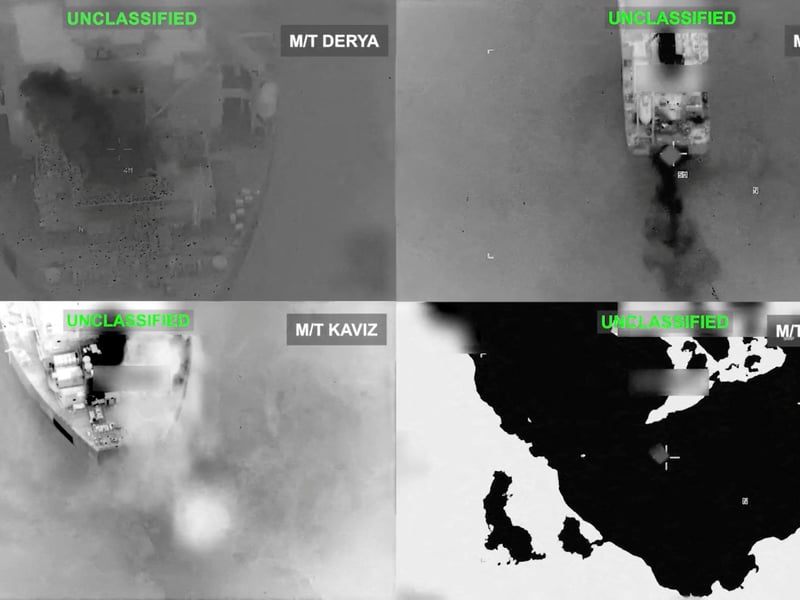
The price surge followed a compressed 24-hour sequence that pushed the war with Iran into new territory. US Central Command announced Tuesday that its forces had destroyed the M/T Kaviz, M/T Charminar, M/T Horizon 1 and M/T Riesco in the Gulf of Oman, along with the M/T Derya near Kharg Island.
The five vessels were part of what Washington describes as the shadow fleet used by Iran to transport crude and generate revenue despite sanctions.
CENTCOM said the strikes followed two days of attacks by the Islamic Revolutionary Guard Corps targeting a US Navy warship with ballistic missiles. American forces directed the crews to abandon the vessels before the strikes were carried out, and no US personnel were reported injured.
The destruction of the tankers added another layer of uncertainty to an already volatile oil market. The immediate concern for traders was not limited to the crude carried by the individual vessels, but the broader risk that continued military operations could disrupt additional shipping, infrastructure and export routes across a region critical to global energy supplies.
With Brent crude once again above the $100 threshold, the conflict is increasingly being reflected not only in military developments but also in the price of energy faced by consumers and businesses. The record diesel price in the United States underscored how developments thousands of miles away can quickly translate into higher costs across the domestic economy.
For markets, the central question is becoming increasingly difficult to avoid: how much additional supply can be removed, and for how long, before the disruption begins producing wider and more persistent economic consequences?
Iran’s response arrived before Wednesday’s markets opened. The IRGC launched twenty ballistic missiles at the US military base near Al Azraq in Jordan. Jordan’s air defenses intercepted eighteen of the twenty; IRGC statements claimed “heavy damage” to the base while Jordan said operations remained uninterrupted. The IRGC simultaneously announced it had struck ten commercial vessels near the Strait of Hormuz, including two described as US-linked, in what Tehran characterized as a proportional response to the tanker strikes.
The Dow Jones Industrial Average fell 1.18 percent to 52,786. The S&P 500 dropped 0.58 percent to 7,674. The Nasdaq slipped 0.32 percent to 26,421, with investors trimming cyclical exposure rather than abandoning technology wholesale. Energy stocks moved the other direction. Brent settled at $100.29 early Wednesday after closing at $97.89 on Tuesday. The last time it traded above $100 was July, when a US-Iran exchange in the Strait of Hormuz collapsed what had been an attempt at a ceasefire framework.
Goldman Sachs outlined where the ceiling might be. Daan Struyven, co-head of global commodities research at the firm, said in a September 7 appearance on Bloomberg Television that intensifying shipping attacks had made the probability of crude reaching $120 “significant.” His firm runs two scenarios: $80 a barrel if regional exports recover toward prewar levels, $120 if attacks on commercial shipping broaden and intensify. Wednesday’s sequence (five tankers destroyed, twenty missiles at Jordan, ten ships struck near Hormuz in retaliation) moved the indicators toward the upper range.
The Houthi dimension added a separate pressure point on the same day. Iran-aligned Houthi forces in Yemen carried out strikes on four cities in southern Saudi Arabia, wounding 73 people and igniting fires at oil installations, according to Saudi officials. The attacks, which included missiles and drones targeting energy infrastructure across the south of the kingdom, marked a significant territorial expansion of the six-month war. Houthi drones had struck the Jazan refinery in August; Tuesday’s four-city assault was the broadest coordinated attack on Saudi territory since the conflict began.
That buffer feeds into the Federal Reserve’s September calculus. Market-implied probabilities ahead of the Federal Open Market Committee meeting put a 25-basis-point rate hike at roughly 56 percent, a figure assembled partly on the assumption that inflationary pressures were slowly cooling. Oil at a sustained $100 floor challenges that assumption directly. The PCE headline measure does not strip out energy; crude at this level feeds through to transportation costs, manufacturing inputs, food production, and consumer goods in ways that one month of data cannot fully capture. Chair Kevin Warsh delivered a hawkish speech at Jackson Hole; Governor Christopher Waller offered conditional support for holding rates. Neither holds a clean position now.
The five tankers destroyed on Tuesday were part of a campaign of shadow-fleet strikes the US has run across multiple rounds since the earliest weeks of the Iran war, aimed at severing the revenue stream that finances IRGC operations. The policy assumption is that cutting Iranian oil revenue degrades Tehran’s capacity to sustain the war and fund what American officials have called support for regional partners, including the Houthi forces that attacked Saudi Arabia on the same day. The arithmetic problem with the strategy is visible in Wednesday’s price: destroying Iranian tankers does not add supply to the global market. It removes it, in a market the IEA has called the most disrupted in recorded history.
Al Jazeera, which tracked the overnight exchanges in a live blog, reported the sequence as the most intense single-night exchange between the US and Iran since fighting began in February.
What Wednesday did not resolve: whether the Houthi assault on four Saudi cities is a sustained new front or a one-off escalation; whether Jordan’s interception of 18 of 20 IRGC missiles marks the ceiling of Iran’s willingness to strike American installations in the region; and whether Goldman’s $120 scenario requires only one more round to arrive.