
ATHENS – The couple were walking toward the entrance of the Acropolis Museum on Tuesday morning when a man approached with a knife. The woman, a Greek American, received wounds to her leg. Her companion’s arm injuries were described by Greek police as more severe. Both were taken to hospital by ambulance. The Acropolis citadel above, which drew 4.6 million visitors last year, remained open throughout the morning without interruption.
Greek police detained the attacker at the scene. He appeared to have been suffering from psychological problems, according to a police statement, and had reportedly threatened several passersby before the stabbing, prompting a public alert. His identity and nationality had not been disclosed by Tuesday afternoon.
The incident brought an uncomfortable reminder to a country that has built its summer economy on the premise of relative safety. Violent street attacks are unusual in Greece, and Greek authorities have consistently pointed to the country’s low violent crime statistics as a selling point for the tourism sector that now accounts for roughly a fifth of the national economy. But the attack at the base of the Acropolis, not in a peripheral neighborhood but at the most-visited archaeological site in the Mediterranean, gives the incident a resonance that a comparable attack elsewhere in the city would not carry.
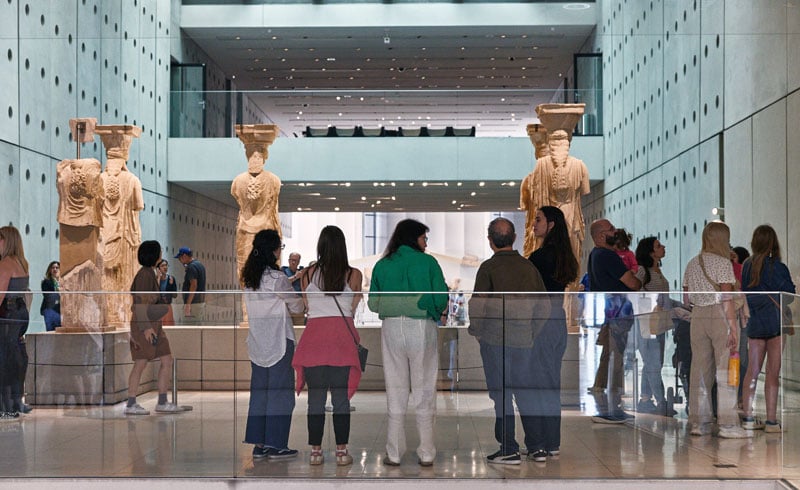
The Acropolis Museum, which opened in 2009 and is separate from the ruins above, sits at the foot of the hill that Athens has organized its civic identity around for more than 2,500 years. It houses artifacts including friezes from the Parthenon and draws millions of visitors each year as a cultural destination in its own right. The surrounding area, including Monastiraki and Plaka with their hotels, restaurants, and market stalls, is among the most trafficked tourist zones in southern Europe.
Greek police indicated the attacker had threatened multiple people before police received the alert, suggesting some time elapsed between the initial confrontation and the arrival of officers. It is not clear whether anyone reported the threats before the stabbing occurred or whether police response was delayed. The statement described no specific target and gave no indication that the attack was motivated by anything beyond the apparent psychological state of the attacker.

Greece has grappled in recent years with a rise in individuals with acute mental health needs living rough in urban centers, partly a legacy of the austerity decade that reduced public spending on social services. The concentration of those individuals near tourist zones, which offer foot traffic and relative warmth, has become a recurring issue in Athens, Thessaloniki, and other Greek cities. The extent to which the suspect’s background fits that pattern was not immediately established.
The attack did not lead to any immediate changes in security arrangements around the Acropolis. Greek police confirmed that standard operations continued and that additional resources were not deployed. The Greek tourism ministry had not responded to requests for comment by Tuesday afternoon.
Tourism to Greece set records in 2025, with arrivals exceeding 35 million for the first time, contributing more than €22 billion to the economy. Summer 2026 had been projected to exceed that figure, with Athens in particular seeing a sharp rise in mid-year arrivals. The attack’s timing, peak tourist season at the country’s signature destination, ensures it will receive scrutiny beyond what the immediate facts alone would warrant. Violent crime in European capitals has prompted renewed debate about security around tourist landmarks, as seen in the terror investigation surrounding the murder of a British political figure earlier this month.
The two victims were treated and their conditions stabilized. Greek media reported they were a couple, though their names and home city in the United States were not given in police statements. One witness told Greek media that the situation unfolded quickly, lasting fewer than two minutes from the appearance of the man with the knife to police arriving on the scene.
There is no indication at this stage that the attack carries political or ideological dimensions. Greek counter-terrorism authorities were not involved. The investigation is being handled by Athens district police as a standard violent crime matter, with the suspect undergoing assessment pending formal charges.
Greece typically records fewer violent crimes per capita than most European Union member states, a statistic that informs travel advisories and holiday decisions across the continent and beyond. Incidents that disturb that statistical calm, particularly when they occur in locations synonymous with Greece’s cultural identity, tend to generate outsized coverage regardless of severity. An arm injury and a leg wound sustained near the world’s most photographed ruin will carry further than the medical facts alone suggest, simply because of where they happened. The question that Tuesday’s attack leaves unanswered, whether the rise in visibly unwell individuals near Athens’ tourist core represents a risk that existing security arrangements are not designed to address, has no immediate answer from Greek authorities.