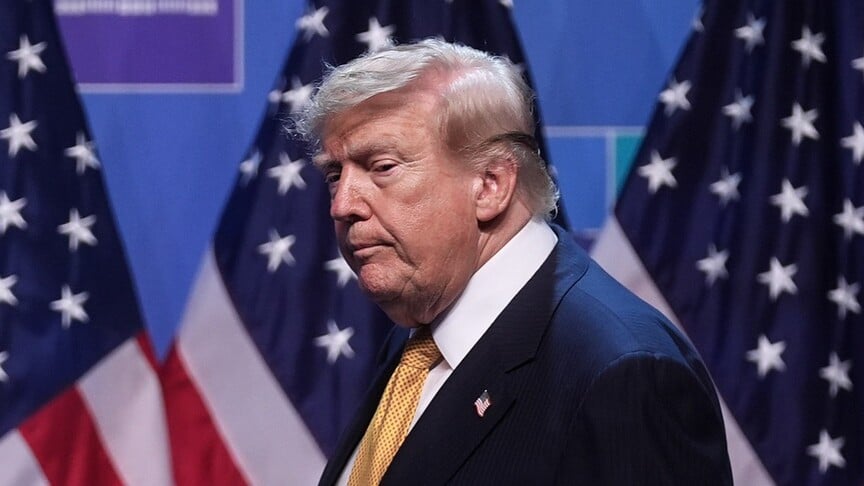

WASHINGTON – President Trump signed an executive order on Wednesday imposing a 100 percent tariff on imported generic drugs, Anadolu Agency confirmed, a sweeping trade action targeting the roughly 90 percent of all US prescriptions filled at American pharmacies with off-patent medications. The tariff is set to take effect in August 2028, giving pharmaceutical manufacturers an 18-month window the White House described as a runway for reshoring production to the United States from India, China, and other major producing countries.
Shares of generic drug manufacturers fell sharply within hours of the announcement, with the Wall Street Journal reporting that the sector declined as much as six percent in afternoon trading. The market reaction reflected investor skepticism about whether 18 months gives domestic manufacturers enough time to build the capacity needed to replace what India alone provides to the US pharmaceutical supply chain. India supplies roughly 40 percent of all generic drugs sold in the United States and more than 80 percent of active pharmaceutical ingredients used to manufacture them.
The executive order marked the most significant pharmaceutical trade action of Trump’s second term. His earlier approach to drug pricing, a most-favored-nation deal with Pfizer announced in late 2025, had focused on negotiating lower prices for branded medications rather than restructuring generic supply chains. Wednesday’s order takes a structurally different approach, using import duties to price out foreign suppliers and create space for domestic manufacturers who do not yet exist at scale.
Bloomberg reported that the 100 percent tariff rate would apply broadly to imported generics, with the August 2028 start date explicitly designed to test whether American companies would use the two years to build domestic manufacturing capacity. The administration said it would monitor reshoring commitments and may extend the delay for specific drug categories where domestic production cannot be established in time. No such extensions have been specified in the executive order text.
The policy targets what public health economists have long identified as a structural vulnerability in the American pharmaceutical supply chain. Generic drugs are produced overwhelmingly outside the United States because the profit margins on off-patent medications are too thin to justify the capital costs of American manufacturing. A one-month supply of generic metformin, the most widely prescribed diabetes medication in the country, costs roughly four dollars at most major pharmacies. A 100 percent tariff, fully passed through to consumers, would double that. Whether the pass-through will be total, partial, or absorbed by pharmacy benefit managers and insurers is a question the executive order does not resolve.
Congressional reaction divided along lines that did not track cleanly onto party affiliation. Republican senators from states with pharmaceutical manufacturing facilities said they welcomed the order’s reshoring goal but questioned whether 18 months was realistic. Democratic representatives from states with large pharmacist workforces framed the issue differently, arguing the tariff would primarily harm lower-income Americans who rely on generics as the only affordable option for chronic conditions. The politics of prescription drug costs have long scrambled normal party alignments, and this executive order appeared to do the same.
The Trump administration’s pharmaceutical tariff follows the logic of its broader industrial policy, which uses trade barriers to force domestic production capacity that the market alone would not create. The administration’s separate move to restrict Chinese military drone imports, also announced this week, uses the same structural argument. Defense electronics and pharmaceutical generics are different markets, but the theory of change is identical: price out the foreign supplier, build at home, accept the transition costs.
What distinguishes the generic drug sector is the degree to which affected products are consumed directly by individuals on fixed incomes or employer health plans with limited flexibility to absorb cost increases. Generic drugs have served as the primary mechanism through which American healthcare has managed the cost of treating chronic disease at scale. The Affordable Care Act, Medicare Part D, and the Veterans Affairs formulary all depend on the generic market’s price discipline. A 100 percent tariff applied to that market is not a defense procurement adjustment. It is a direct intervention in the cost structure of American healthcare.
India’s pharmaceutical industry, which supplies the US from major production hubs in Hyderabad and Ahmedabad and has invested heavily in FDA compliance over the past decade, said it was studying the order. The Times of India reported that Indian manufacturers were cautiously optimistic that the 18-month delay and the breadth of FDA-compliant Indian production capacity might position Indian generics as the least-bad domestic alternative — producing under license in the United States rather than exporting finished pills. Whether that interpretation holds legally under the executive order’s language is unclear.
Administration officials said on background that they expected to announce a series of reshoring agreements with domestic manufacturers before the end of 2026. No such agreements had been publicly announced as of Wednesday evening. The political window in which to deliver them is the 18 months between the executive order and the August 2028 effective date. Whether American manufacturers can actually fill the production gap in that time, and what happens to the 50 billion generic prescriptions filled annually in the United States if they cannot, is the central unresolved question the order introduces without answering.