
WASHINGTON – Fourteen days passed between a Ukrainian F-16 allegedly shooting down a Russian Su-35 near the Luhansk front line and the moment the world heard about it. General Dan Caine, the United States’ top military officer, mentioned it at a public event on Tuesday with one sentence: “Recently, we had the first air-to-air kill where a Ukrainian F-16 shot down a Russian fighter.” No location. No missile type. No pilot’s name. No footage.
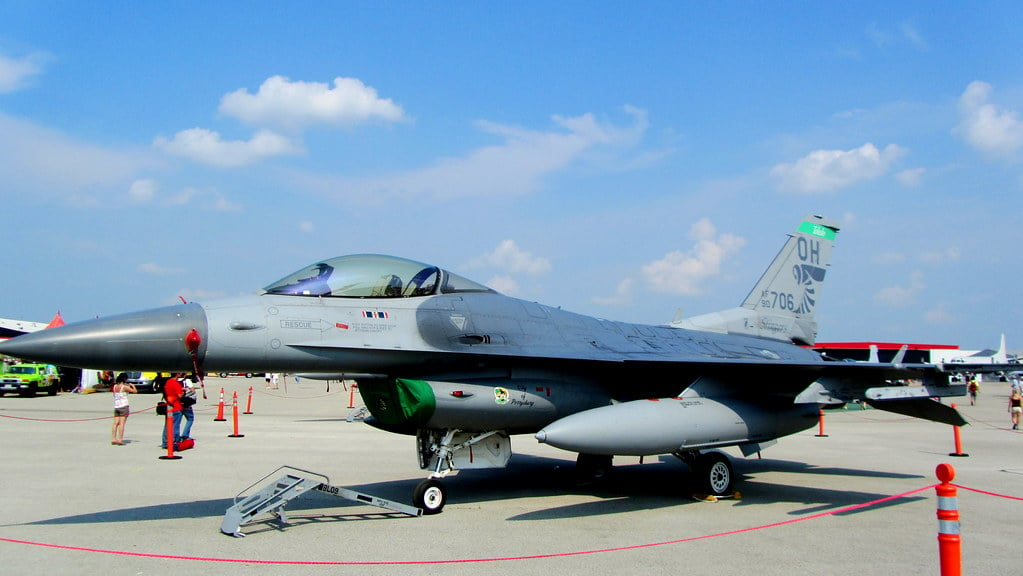
The date was July 8, according to the Ukrainian Air Force’s own statement released alongside Caine’s comment. The location was eastern Ukraine, near the Luhansk front. The aircraft were a Ukrainian F-16 Fighting Falcon and a Russian Sukhoi Su-35, two fourth-generation multirole fighters. Their contest over Ukraine, if the claim stands, was far from the equal engagement those designations imply.
Ukraine’s own Air Force has been candid about the gap. Colonel Yury Ignat, head of communications for Ukraine’s Air Force, said in June 2025 that Russian aircraft “see further, and missiles that shoot further” than their Western counterparts, stating specifically that Ukraine’s F-16s “cannot compete one-on-one in an air battle” with Russia’s Su-35, RT reported. His assessment, that deploying F-16s in direct fighter engagements against Russian air superiority jets would be a strategic mistake, was the operating assumption Ukraine’s air campaign had been built around.
A pro-Kremlin Telegram channel linked to Moscow’s Air Force offered a different account of what happened on July 8. According to that channel, three Ukrainian aircraft were involved in the attack against the Su-35, accompanied by a Patriot surface-to-air missile battery targeting the Russian jet simultaneously. Under a layered-attack scenario involving multiple aircraft and ground-based systems, the question of which platform achieved the killing blow, whether F-16 or Patriot battery, is one Caine’s statement left entirely unresolved.
The pro-Kremlin account also stated that the Su-35’s pilot ejected and survived the engagement. If accurate, July 8 cost Russia an aircraft and nothing else. Against Ukraine’s own parallel loss record, at least three F-16s confirmed destroyed since the aircraft entered service in 2024, the exchange rate remains unfavorable for Kyiv regardless of whether the claim represents a genuine tactical breakthrough. Russia’s Foreign Minister Sergey Lavrov told US Secretary of State Marco Rubio in Manila on Thursday that continued American arms deliveries to Ukraine were “unacceptable,” as this publication reported, framing weapons including the F-16 as obstacles to any ceasefire.
Ukraine has approximately 39 F-16s in active service, received through NATO-coordinated transfers from Denmark, the Netherlands, Belgium, and Norway. The aircraft’s intended role was never ambiguous: defending Ukrainian airspace against Russian cruise missiles, ballistic missiles, and drones rather than engaging Russian fighter aircraft in direct air-to-air combat. The Su-35 kill, if it holds, would represent the first documented deviation from that doctrine. And by Russia’s own account, it required ground-based systems and multiple jets to isolate a single Su-35.

Russia’s Ministry of Defense had not issued a statement acknowledging the loss of any Su-35 near Luhansk during the relevant period as of Thursday. Moscow’s standard response to confirmed aircraft losses throughout its military operation in Ukraine has been silence. Russian military bloggers who closely track aviation losses, and who have historically been candid about Russian Air Force casualties when evidence is available, had not circulated footage or wreckage images by the time Caine made his announcement.
General Caine’s decision to disclose the July 8 kill at a public event fourteen days later, without supporting documentation, creates its own interpretive problem. The delay is consistent with Ukraine’s standing operational security practice. But it also means the claim entered public consciousness through a single informal comment, without the press briefing, satellite imagery, or physical evidence that typically accompanies disputed kill claims in a contested theater. Ukraine’s military leadership, in significant flux since the dismissal of Commander-in-Chief Oleksandr Syrskyi amid six days of street protests, has not issued a formal statement expanding on the air kill claim.
The F-16 was always going to face a credibility test in Ukraine. What has been missing until July 8, if the claim holds, is a Ukrainian aircraft downing a Russian aircraft in the same contested airspace. The strategic significance depends entirely on how the kill was achieved. A coordinated layered attack requiring ground-based systems and multiple jets to isolate a single Su-35 is a different conclusion than a one-on-one intercept, and Colonel Ignat’s 2025 assessment, that the F-16 simply cannot win that engagement alone, has not been publicly revised by Ukraine’s Air Force.
General Caine’s fifteen words established a precedent for this conflict. They did not resolve the tactical picture. No footage has been released. No wreckage has been shared. The Su-35 pilot is reportedly alive. What remains is a confirmed statement from the United States military’s highest-ranking officer, a July 8 date, a Luhansk location, and every contested detail between those three facts. Whether Ukraine’s F-16 fleet crossed a threshold on July 8, or whether the Patriot battery was the decisive instrument, is a question the announcement left open.