
NEW DELHI — The phrase both governments reached for on Saturday was the same one they have used for years: a specially privileged strategic partnership. It has never had to carry as much weight as it does now. Six months ago New Delhi agreed to stop buying Russian oil in exchange for Washington cutting tariffs on Indian goods from 50 percent to 18. Nine days ago the US Senate passed a bill that still lists India among the five largest buyers of Russian oil.
The exchange itself was slight. Russia’s Foreign Ministry congratulated India on its 80th Independence Day, wishing it success, prosperity and new achievements, describing cooperation between the two countries as multifaceted with enormous potential for deepening, and noting that the two traditionally cooperate closely in the military-technical sphere. Randhir Jaiswal, the external affairs ministry’s spokesperson, replied on X thanking the ministry for the warm wishes and saying India looked forward to further strengthening bilateral ties.
It would be easy to over-read this, and most coverage of the India-Russia relationship does. Jaiswal posted near-identical thanks the same day to the foreign ministries of Somalia, Romania, Moldova, Armenia, Georgia, Serbia and Slovenia. A line of protocol is not a signal. What is worth noticing is narrower and comes from the Russian side: of everything Moscow could have listed on a national holiday, it chose to name the military-technical sphere.
That is the part of the relationship Washington has the most difficulty with, and the part India has been least willing to trade. It is also the part that survived the oil deal.
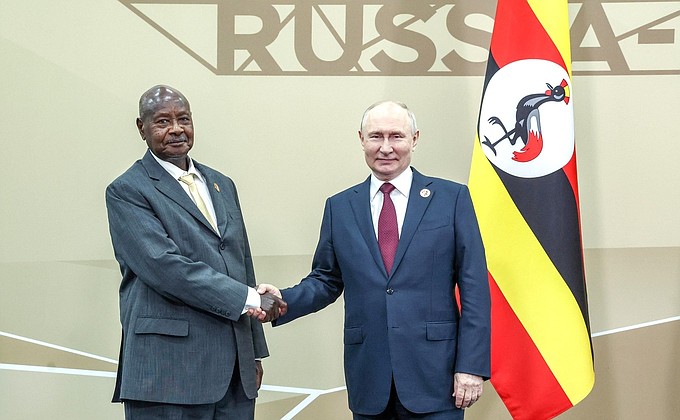
President Vladimir Putin sent separate messages to President Droupadi Murmu and Prime Minister Narendra Modi, published on the foreign ministry’s Telegram channel, saying India was making remarkable progress in the economic, social, scientific and technological spheres and rightfully commands considerable authority internationally. He said he was confident joint efforts would comprehensively strengthen what he called the constructive Russia-India partnership.
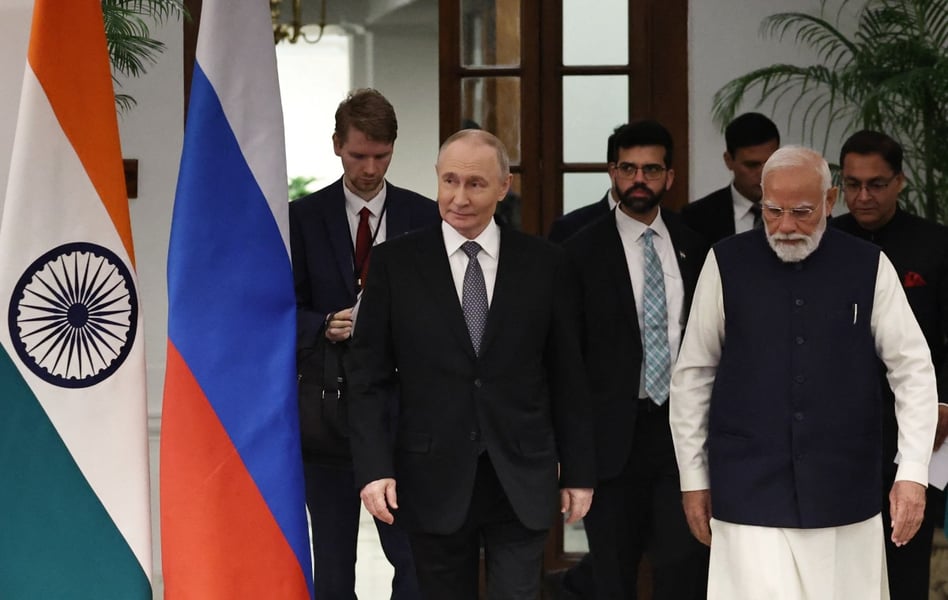
Eight months earlier he had been in Delhi to say it in person. At the December 5 summit Modi met him at the airport with an embrace, and the two governments concluded a defence agreement worth roughly $2bn for the lease of a nuclear-powered attack submarine. Putin also offered what Al Jazeera reported as a commitment to uninterrupted oil shipments, a phrase chosen at a moment when interruption was precisely what Washington was trying to arrange.
What happened to the oil is harder to establish than either government has made it sound. Russian crude did not leave India’s import mix. An analysis by ThePrint found it accounted for roughly a third of Indian oil imports across 2024 to 2026. Its share did fall below 25 percent between December 2025 and February 2026, the first time in two years, after US sanctions on Rosneft and Lukoil, with volumes settling somewhere around one to 1.2 million barrels a day. Russia nonetheless remained India’s single largest supplier through that period. A commitment to stop and a decline to a quarter of imports are not the same thing.
The US Senate appears to have reached the same conclusion. On August 6 it passed the Lindsey O. Graham Sanctioning Russia and Iran Act by 86 votes to 11, authorising tariffs on the five largest buyers of Russian oil and gas, India and China among them. The bill had cleared a procedural vote 86-12 in late July, when Eastern Herald noted it left India squarely in the tariff crosshairs with presidential authority to go as high as 100 percent. It now sits with a Republican-controlled House that has scheduled no vote.
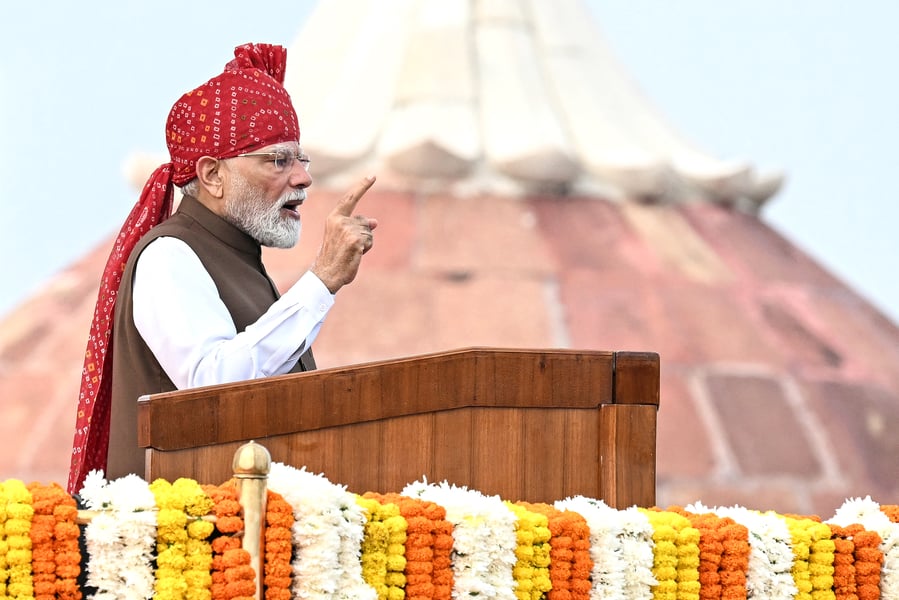
Modi spent Saturday morning on the ramparts of the Red Fort delivering his thirteenth consecutive Independence Day address, a 78-minute speech built around seven reform streams he called Saptadhara and the goal of a developed India by 2047. Among the priorities he named was energy security. He did not mention Russia. In a year when the price of Indian crude decisions has been set in Washington, he did not especially need to.
Several things cannot be established from here. Eastern Herald has not been able to determine India’s current Russian crude volumes, and neither government publishes them in a form that settles the question. The February understanding’s terms remain unpublished, so what counts as compliance with it is unknown. The external affairs ministry has not said whether the commitment still stands, and was not asked on a public holiday. And whether the Graham Act ever reaches India depends on a House that has given no indication of when, or whether, it intends to take the bill up.
What can be said is that the phrase survived the year. Both capitals used it again on Saturday, in the same words, about a relationship whose most valuable component is now the most expensive thing India owns in its dealings with the United States.