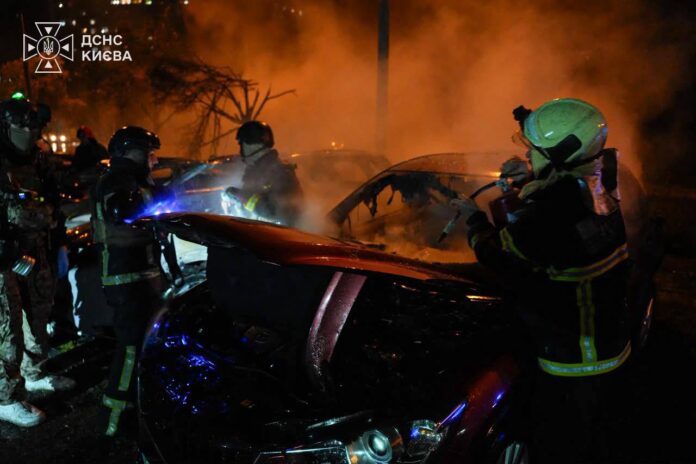
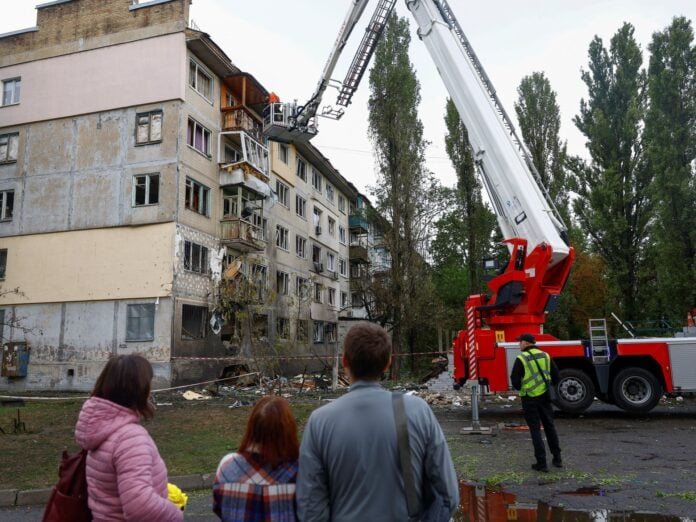
KYIV — An 8-year-old was among seven people rushed to hospital Sunday after a Russian jet-powered drone hit the post office inside a shopping center in Odesa Oblast, one of 14 locations across Ukraine struck as Russian forces launched 128 drones in the Ukraine war’s latest overnight assault on civilian infrastructure.
Ukraine’s Air Force reported its defenders downed 106 of the aircraft over the country’s north, south, and east. The 22 that broke through were enough to kill nine people and injure 43 nationwide, according to Ukraine’s State Emergency Service. The child and their parents were among those who required medical treatment, marking one of two attacks in the barrage that carried no military justification: a family at a post office, and four crew members aboard a Togolese-flagged civilian ship struck in port.
The Togolese vessel’s flag matters under international maritime law. Third-country commercial ships in Ukrainian ports are not combatants and carry no lawful military designation under the laws of naval warfare. No official claim has come from Moscow that the ship was carrying contraband or military supplies. Four sailors were wounded.
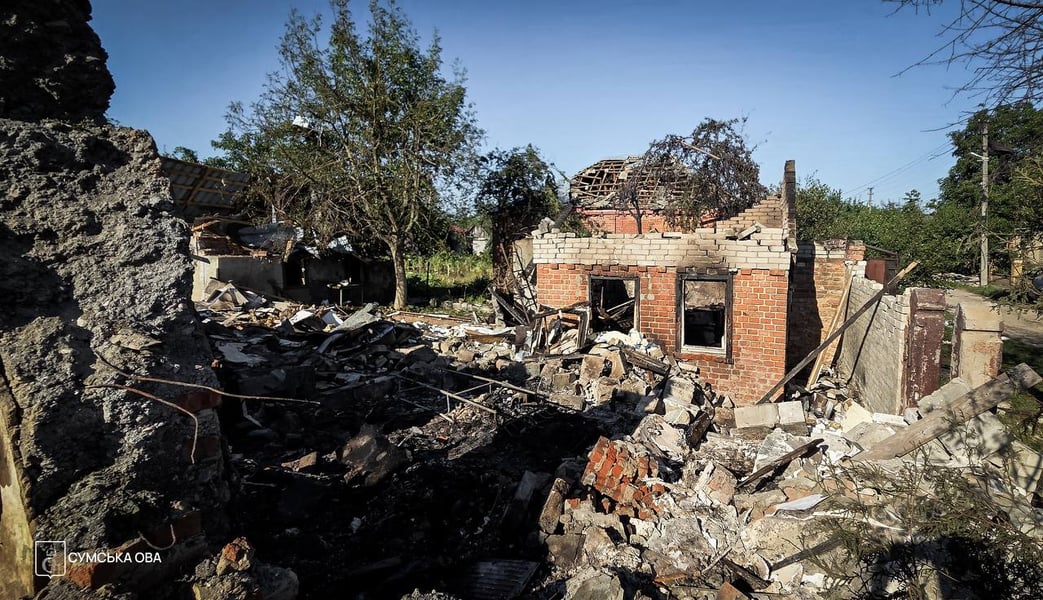
Sunday’s assault fits inside a pattern that has come to define the Ukraine war’s aerial dimension in 2026. Russian drone barrages have grown in frequency and scale, not as precision campaigns but as volume operations: mass launches designed to exhaust layered Ukrainian air defenses rather than evade them with stealth. At 128 aircraft, Sunday’s barrage is consistent with the tempo Moscow has maintained across the summer. Ukraine’s stated intercept rate of 106 out of 128, roughly 83 percent, is consistent with previous Air Force reports, though independent verification of such figures inside an active conflict is not possible.
What can be verified is the toll. Nine dead, 43 injured, spread across Donetsk, Kherson, Zaporizhzhia, Sumy, Dnipropetrovsk, Kharkiv, and Odesa oblasts, a geographic sweep covering nearly the entire country. July 2026 was the deadliest month for Ukrainian civilians since Russia launched its military operation in February 2022, with 437 killed and 2,610 wounded in a single calendar month, according to Ukraine’s State Emergency Service. August has resumed at similar pace.
Sunday’s Russian assault follows, by less than 24 hours, one of the largest Ukrainian strikes on Russian territory since the conflict began. Ukraine’s Ukraine war drone campaign directed some 600 unmanned aircraft at the Moscow region on August 16, disrupting Wildberries logistics operations that supply front-line Russian commerce. Ukraine has also been sustaining a parallel campaign: UK-made drones striking Russian oil refineries near Moscow, Yaroslavl, and Volgograd, a campaign that has run for six months with no public acknowledgment from London.
The bidirectional escalation reflects a strategic logic that has hardened on both sides across 2026: that persistent pressure on the opponent’s hinterland (logistics, energy infrastructure, supply chains, civilian morale) is a viable path to advantage in a conflict where front lines have shifted only fractionally for months. Russia has lost over 1.46 million troops since February 2022, according to Ukrainian General Staff figures that Western analysts consider directionally credible but likely inflated. The ground war has not produced the territorial momentum either side’s early planning assumed.
Drones have become the mechanism by which both sides prosecute a parallel war, one where the targets are not soldiers and the objective is not territory. The legal frameworks governing each side’s strikes differ materially. Ukraine’s targeting of Wildberries, which supplies logistics to Russian forces, occupies contested but not clearly unlawful ground under international humanitarian law. Russia’s targeting of shopping center post offices has no defensible legal basis that international law scholars have identified. The Odesa family and the Togolese sailors are not soldiers, not lawful targets under any recognized legal standard; they are the civilians the laws of armed conflict were designed to protect.
Russian state media covered Ukraine’s 600-drone Moscow assault in substantial detail on August 16. Sunday’s Russian barrage into Ukraine, with its nine dead and 43 injured, did not appear with comparable coverage on state outlets as of Sunday morning. The asymmetry in coverage does not change the count.
What neither side has publicly addressed is what the aerial exchange is eventually supposed to produce. Both have demonstrated the capacity to sustain overnight barrages indefinitely. The civilian populations absorbing them have not been asked.