

For foreign investors weighing where to build a long-term base in the Gulf, the UAE Golden Visa remains one of the most closely watched residency instruments in the region. It offers something rare in global mobility planning: a decade of legal certainty in a jurisdiction with no personal income tax and world-class infrastructure.
Yet the programme is not a single product. It spans multiple eligibility categories, two distinct government channels depending on the emirate, and a document checklist that changes shape depending on whether the applicant is a property investor, entrepreneur, or salaried executive. Understanding these differences before filing prevents avoidable delays.
The seven facts below outline what actually matters when preparing a UAE Golden Visa application in 2026, from eligibility thresholds to the rule changes now reshaping who qualifies.
Key Takeaways
- The UAE Golden Visa grants 10-year renewable residency without a local sponsor requirement.
- Real estate, business, and talent-based eligibility categories each carry distinct investment and document thresholds.
- Application fees and processing steps differ across Dubai’s GDRFA and Abu Dhabi’s ICP channels.
- Common rejection triggers can be avoided with proper document preparation and professional guidance.
- Recent 2026 updates have expanded eligibility to remote workers and points-based nominees.
Fact 1: The Golden Visa Grants Long-Term Residency Without a Local Sponsor
Most UAE residence visas depend on a sponsor, typically an employer or a family member already holding residency. The Golden Visa breaks that pattern entirely.
Why the 10-year visa differs from standard UAE residence visas
Holders of the 10-year visa sponsor themselves. There is no requirement to work for a UAE company or maintain continuous employment to keep the status valid. This distinguishes it from the standard 2- or 3-year employment residence visa, which lapses the moment a job ends.
How family sponsorship works for dependent children
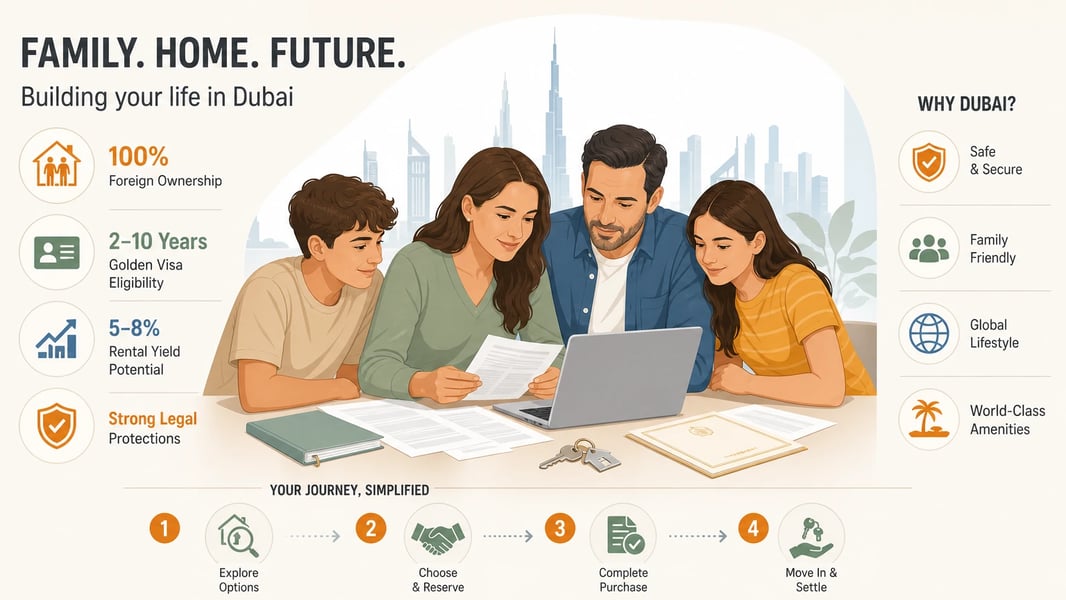
Golden Visa holders can sponsor family members, including a spouse and dependent children, regardless of the children’s age in many cases, a flexibility not extended under standard residency categories. Sons typically retain sponsored status longer than under regular visas, and daughters can remain sponsored until marriage. Families exploring long-term residency in the UAE often find this the single most persuasive feature of the programme, since it removes the anxiety of renewing sponsorship every few years.
Fact 2: Eligibility Categories Span Investors, Entrepreneurs, and Talented Individuals
The programme was never designed as a single track. It recognizes several distinct profiles, each with its own proof requirements and each granting either the 10-year visa or, in narrower cases, a 5-year visa.
Real estate investment and the AED 2 million threshold
The most common route remains real estate investment. Applicants qualify by owning one or more properties valued at a combined minimum of AED 2 million, held individually or jointly, according to the UAE government portal. Off-plan property can qualify in some cases, though mortgaged property requires a bank no-objection letter confirming the amount paid and the outstanding balance. Business investors, meanwhile, may qualify through capital or deposits of AED 2 million, or by demonstrating annual tax contributions of at least AED 250,000 through the Federal Tax Authority.
Entrepreneurs, scientists, outstanding students, and humanitarian pioneers
Entrepreneurs qualify through a pioneering, technology-driven project registered with the Ministry of Economy or a relevant local authority, generating annual income of AED 1 million and typically requiring a nomination letter from an accredited incubator or authority. Beyond investors and entrepreneurs, the UAE extends golden residency to talented individuals across culture, sport, and medicine, alongside scientists, outstanding students with strong academic records, and humanitarian pioneers recognized for charitable contributions. Each category carries its own nomination or endorsement requirement rather than a fixed capital threshold. Anyone weighing which of these eligibility categories fits their circumstances, particularly where investment structuring or entrepreneur nomination is involved, is generally better served consulting a specialist before submission. Global Residence Index advises clients through the UAE 10-year golden visa program across each of these tracks, matching profile to category before documents are filed.
Fact 3: Required Documents Follow a Consistent Checklist Across Categories
Every applicant, regardless of category, submits a shared set of baseline documents before category-specific evidence is layered on top. This structure keeps the application process predictable across GDRFA and ICP channels.
Core documents every applicant needs
The required documents common to nearly all categories include a valid passport with at least six months’ validity, a recent passport-size photo on a white background, a UAE entry permit or existing residence visa if applying from within the country, and an Emirates ID if one was previously issued. Applicants also need a police clearance certificate confirming a clean criminal record, and a medical check completed at an authorised UAE health centre.
Category-specific proof: bank statements, salary certificates, and no-objection letters
Real estate investors add a title deed or e-Certificate of Title showing property value at or above AED 2 million. Mortgaged property requires a bank no-objection letter confirming the amount paid and outstanding balance, and applicants must be physically present in the UAE when filing.
Business investors submit a certified financial report from an accredited UAE audit firm, a valid trade licence naming the investor as partner, company bank statements, and recent tax receipts. Deposit-based investors instead show proof of a financial deposit of at least AED 2 million held in a local bank. Entrepreneurs provide a nomination letter from an accredited incubator or authority, along with audited financials showing annual revenue of at least AED 1 million. Gaps in these categories are the most frequent cause of delay, which is why applicants often prepare files with guidance rather than assembling them alone.
Fact 4: Application Fees and Channels Differ by Emirate
The UAE Golden Visa is a federal programme, but the application process runs through different local authorities depending on where the applicant is based.
Dubai GDRFA and Amer center fees versus Abu Dhabi ICP and TAMM
In Dubai, applications for the 10-year visa are filed through the General Directorate of Residency and Foreign Affairs, either directly or via Amer service centers. Application fees vary by category and include charges for the entry permit, status change, Emirates ID issuance, and medical testing.
Abu Dhabi routes applications through the Federal Authority for Identity, Citizenship, Customs and Port Security, commonly known as ICP, or through the TAMM platform for residents already established in the emirate. Fee structures and required supporting letters differ slightly between emirates, so applicants relocating between Dubai and Abu Dhabi should confirm requirements with the relevant authority before filing.
Where the ICP smart app fits into the process
The ICP smart application allows applicants nationwide to submit documents, track status, and receive approval notifications digitally. Once approved, applicants complete biometric enrollment and Emirates ID issuance before the visa is stamped. Processing time varies by category and completeness of the file, and renewal ten years later follows a similar document trail rather than a fresh eligibility review from scratch.
Fact 5: Rejections Happen, and Most Are Preventable
A 100% approval rate is achievable with careful preparation, but it is not automatic. Rejections do occur, and most trace back to identifiable gaps rather than eligibility itself.
Common reasons applications are denied
The most frequent triggers include mismatched property valuations, incomplete bank no-objection letters, expired police clearance certificates, and nomination letters that do not clearly link the applicant to the underlying project or investment. Business investors are sometimes rejected when trade licence appendices fail to name them as partner, or when tax receipts fall short of the AED 250,000 annual threshold.
Steps to appeal or reapply after a rejection
Applicants can typically correct deficiencies and resubmit rather than restart the entire process, provided the underlying eligibility remains intact. Working with an advisor familiar with GDRFA and ICP practice reduces the odds of a second rejection on the same grounds.
Fact 6: The Visa Intersects With Corporate Tax and Free Zone Setup
Entrepreneurs and business investors pursuing the Golden Visa are usually also registering a UAE entity, and the sequencing of these two processes matters.
Timing considerations for entrepreneur-category applicants
A trade licence, whether mainland or free zone, generally needs to be active and show clear investor ownership before the golden visa application is filed. Entrepreneurs building a start-up around a pioneering, technology-driven concept should register with the Ministry of Economy or relevant authority early, since the nomination letter depends on that registration being in place.
Tax residency certificate implications
Holding a UAE residence visa does not automatically confer tax residency. Applicants seeking a tax residency certificate must generally meet separate physical presence tests, even though the UAE’s no personal income tax policy remains a core draw for investors and executives relocating operations. Anyone structuring both a company and a Golden Visa application benefits from coordinating the two processes rather than treating them as unrelated filings.
Fact 7: 2026 Rule Changes Have Broadened Who Can Qualify
Recent updates have widened eligibility categories beyond the traditional investor and entrepreneur tracks. Remote workers meeting income thresholds and points-based nominees, including scientists, outstanding students, and humanitarian pioneers, now have clearer pathways into long-term residency. These additions do not replace the AED 2 million real estate investment or AED 1 million entrepreneur revenue routes. They sit alongside them, giving talented individuals without large capital an alternative route to the 10-year visa or 5-year visa.
For families planning years ahead, these changes matter beyond eligibility paperwork. A points-based route can let a mid-career professional sponsor family members, including dependent children, without first building a company or acquiring off-plan property.
Getting Professional Guidance Before You Apply
Early document preparation, including police clearance, medical check results, and Emirates ID copies, prevents the delays that stall most applications. Because requirements differ across GDRFA Dubai, Abu Dhabi’s ICP, and free zone authorities, applicants benefit from advisors who understand these overlapping systems.
Global Residence Index guides clients applying for the UAE Golden Visa through eligibility screening, document certification, and submission across emirates, drawing on a track record built over 9+ years and 500+ clients. Individual circumstances vary, so professional consultation remains essential before filing.