
Thermal imaging technology has, over the course of several decades, travelled far beyond the confines of military laboratories. Today, it is used by biologists, conservation officers, and search-and-rescue teams. A similar principle also underpins specialized optics — thermal rifle scopes for hunting, for example. Yet what is more intriguing here is not so much the particular device as the physics that allows electronics to detect an animal where a person sees nothing but impenetrable darkness.
What Exactly Does an Infrared Sensor See?
The human eye is sensitive to wavelengths of roughly 400–700 nanometers. That is a minuscule window onto the immense electromagnetic spectrum. The infrared region begins immediately beyond the red edge of visible light and extends much farther.
For thermal observation, the mid-wave and long-wave infrared bands — MWIR and LWIR — are of particular interest. Many uncooled thermal imaging cameras operate roughly within the 8–14 micrometer range. The reason is that Earth’s atmosphere is comparatively transparent to radiation at these wavelengths, while objects at temperatures typical of the surrounding environment and living organisms emit strongly within this range.
But this is where the central principle of infrared sensors science comes into play. The instrument must not merely detect infrared radiation; it must also register, with sufficient precision, minute differences in the flow of energy arriving from different parts of the scene.
From a Photon to an Image on the Screen
Inside a modern thermal imager, a rather fascinating chain of transformations takes place.
The lens collects infrared radiation and focuses it onto a detector array. Ordinary glass, incidentally, is unsuitable for this task. It transmits long-wave infrared radiation poorly. Thermal imaging optics therefore employ specialized materials such as germanium and certain chalcogenide glasses.
Now to the detectors. One of the most widespread types is the microbolometer.
Each of its pixels is a microscopic sensing element. Incoming infrared radiation warms it ever so slightly, and this change in temperature alters its electrical resistance. The electronics measure these minute shifts and convert them into digital data.
The result is something akin to an enormous wall made up of miniature thermometers.
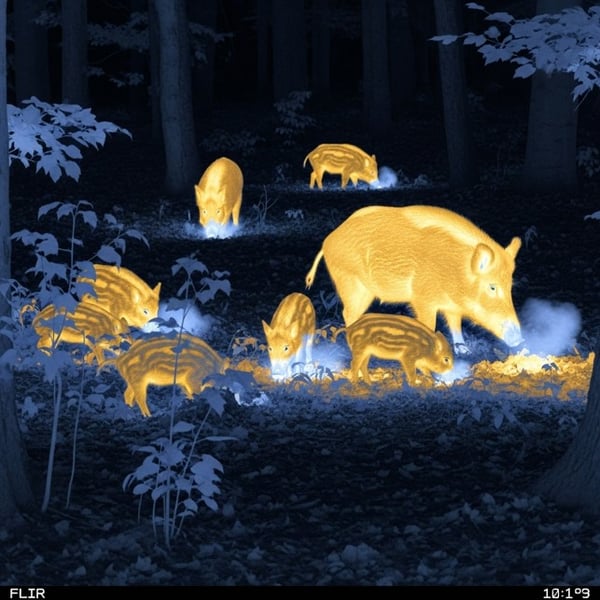
Then the computational stage begins. The system compensates for variations in the sensitivity of individual pixels, amplifies meaningful differences, suppresses noise, and constructs the image. Only after this does the user see the familiar picture — white hot, black hot, or a color palette.
What Thermal Imagers Have Given the Ordinary Nature Observer
Just ten or fifteen years ago, serious thermal imaging equipment remained expensive and fairly specialized. Compact devices have since become considerably more accessible, and some sensors can now be connected directly to smartphones.
For a naturalist, this changes the familiar experience of venturing outdoors.
A rustle beside the tent ceases to be some mysterious “something.” An animal can be spotted at the edge of a clearing even when it would be impossible to pick it out with a flashlight without moving closer. At dawn, it becomes easier to inspect an open stretch of terrain without having to comb through it on foot.
The instrument does, however, call for a certain degree of discipline in its use. A thermal signature is very good at revealing the presence of a warm object, but identifying the species takes experience. At a distance, small mammals can easily dissolve into little more than a handful of moving patches.