
FAGERSTA — A student was dead before the school week ended its first Friday.
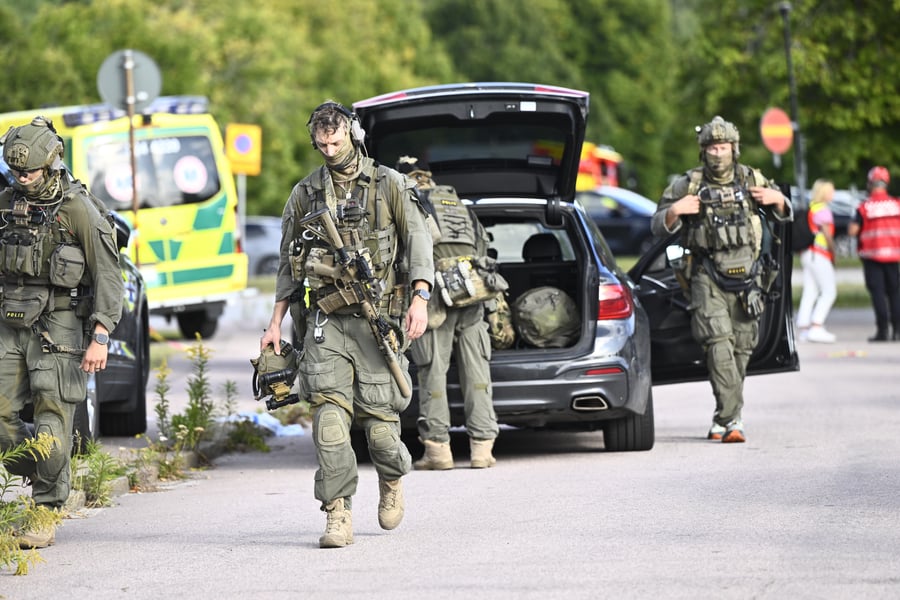
On the afternoon of August 21, as some 400 to 500 students moved through the corridors of Brinellskolan — a comprehensive secondary school in this city of about 13,000 in central Sweden — an 18-year-old man attacked them with a sword. One person was killed. Two boys, aged between 12 and 17, were left with serious injuries. Officers arrived, fired shots during the arrest, and took the suspect into custody. By the time the roadblocks went up around the school and nearby campuses were locked down, Sweden was processing its worst school attack in recent memory.
Prime Minister Ulf Kristersson called it “a serious incident.” He said he did not yet know what lay behind it. He said police were working “very intensively.” What he also said, in the careful phrasing of a politician who has built his government’s identity around stopping exactly this kind of violence, is that the attack had happened “right after the summer break.” The timing, he suggested, made it worse. Whether that was grief, frustration, or political signalling — or all three — was not immediately clear.
Police Chief Tommy Alriksson was more methodical. He confirmed, standing outside Brinellskolan amid an emergency response that filled the parking lot, that investigators had no reason at that time to believe more than one person had carried out the attack. “We have no reason at this time to believe that there are multiple perpetrators,” he said. Pelle Vamstad, a Swedish police spokesperson, confirmed the alarm had been received early that afternoon when the building was full of students.
The attack took place during school hours, and the speed of the response meant that hundreds of students and staff were still inside when the first units arrived. A crisis center was established at a nearby sports hall. Families converged on the location. Two house searches were conducted in connection with the case that evening. Camera footage from the building was under review, CBS News reported.
No motive was publicly identified as of Friday evening. The identities of the person killed and the two injured students were not released. The attacker, a legal adult at 18, was held in police custody. Officers had discharged their weapons during the arrest — Swedish law permits use of deadly force when there is an immediate threat to life — but the suspect appeared not to have been injured by police fire.
The school’s name, Brinellskolan, carries the name of Johan August Brinell, the Swedish engineer who developed the hardness scale still used to test metals. The town itself sits in Västmanland County in the region of Bergslagen, once the industrial heartland of Swedish iron production. Fagersta is not a city associated with violence. That, in some ways, is the point.
Sweden has spent most of the past decade debating how to contain a gang crime epidemic that began in the suburbs of Stockholm and Malmö and spread, in fits and starts, to smaller cities. The homicide rate, which stood among the lowest in Western Europe in the early 2010s, rose through sustained gang conflict fueled by competition over drug markets. Automatic weapons were used. Grenades were used. By the early 2020s, Sweden had one of the highest rates of lethal gun violence in Western Europe, a distinction that had seemed almost impossible a generation earlier.
Kristersson’s centre-right government, which came to power in October 2022, made reversing that trend its defining legislative project. Mandatory minimum sentences were introduced. Military personnel were deployed alongside police in the hardest-hit areas. The government pushed for constitutional changes to allow greater wiretapping authority. Some metrics improved. Shooting deaths fell somewhat in the years that followed. But the violence did not stop, and Friday’s attack in a school with a sword raises questions the statistics on gang shootings cannot immediately answer.
Whether Friday’s attacker had any connection to organised crime, or to any of the motivations Swedish authorities have learned to look for over the past decade, was unknown Friday evening. Police had searched two addresses and were reviewing evidence. The investigation was, as Kristersson noted, working “very intensively.” It had not yet produced a motive.
Sweden’s schools have generally not been equipped with the kind of security infrastructure — metal detectors, police officers in corridors — common in institutions operating under a different history of school violence. The argument against that infrastructure has always been that Sweden is not that kind of place, and that making schools feel like fortresses is itself a harm. Friday did not settle that argument. It intensified it.