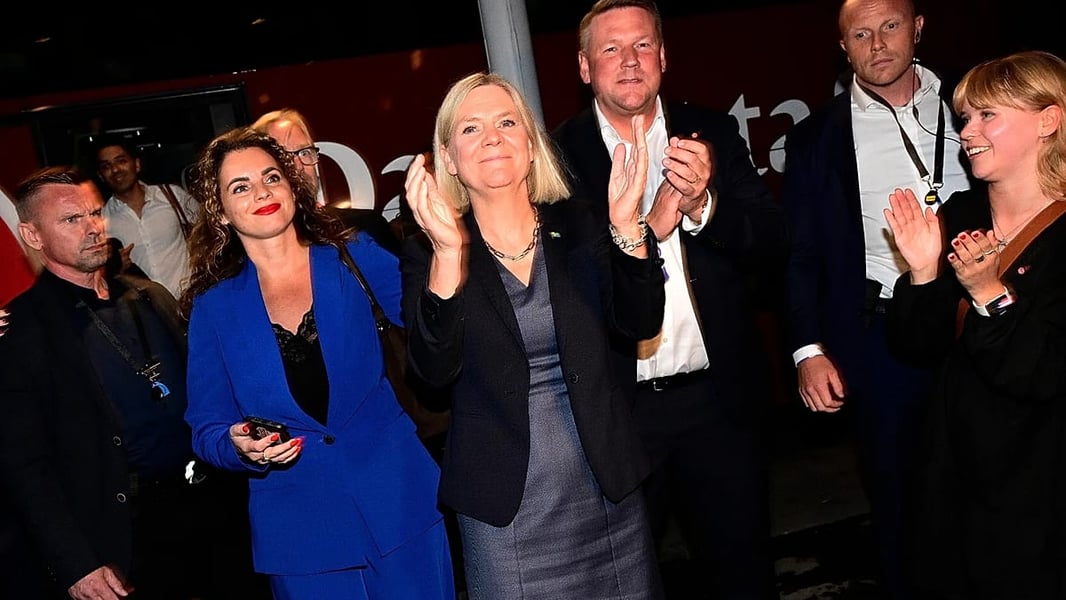

STOCKHOLM — Fifty thousand votes across a country of ten million is barely a mandate, but it is what Magdalena Andersson has to work with. Sweden’s parliament speaker, Andreas Norlen, handed her the formal task of forming the next government on Friday, setting a September 28 deadline, when the new Riksdag convenes for the first time, to report back with something workable.
The math is not comfortable. Four centre-left parties hold 176 seats to the right-wing bloc’s 173 in the 349-seat Riksdag. Andersson’s Social Democrats, the largest single party with roughly 99 seats, cannot govern alone. The coalition they need, and the disagreements buried inside it, will shape what Sweden looks like as a NATO member for the next four years.
Euronews reported that Andersson said she was “ready” to take on the task, hours after Norlen completed post-election consultations with all party leaders. Kristersson had resigned the day before, having conceded a race his alliance lost by the narrowest electoral margin in modern Swedish history.
The central complication is the Centre Party. The liberal wing of Andersson’s proposed coalition has made one condition unmistakable: the Left Party may not sit in cabinet. The Centre’s objection is structural: the Left’s economic program, including its spending ambitions and its hostility toward private healthcare providers, conflicts with the Centre’s market-oriented positions. Andersson must persuade the Left to support a government from the outside without holding ministerial posts. That arrangement has Swedish precedent, underpinning Andersson’s own first government in 2021-22, but it is inherently fragile. One defection, one bad vote, and a three-seat majority disappears.
What makes that fragility unusually consequential is what the coalition must agree on: a defense budget for a country that joined NATO eighteen months ago. NATO members this year formally committed to pushing national defense spending to 3.5% of gross domestic product by 2035, with an additional 1.5% directed toward broader security infrastructure. Sweden’s current spending, raised significantly under Kristersson, has passed 2% of GDP. Getting to 3.5% requires a sustained increase that cuts directly against the Social Democrats’ traditional priorities and against the Left Party’s deep resistance to funding a military alliance it never endorsed.
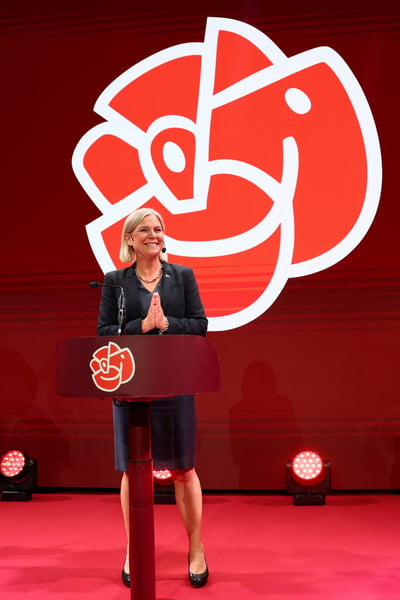
Sweden joined NATO as its 32nd member in March 2024, the culmination of an accession process Andersson herself launched in May 2022, in the weeks following Russia’s operation in Ukraine. For the Social Democrats, who had maintained Swedish non-alignment as near-constitutional policy since the Second World War, the decision represented a historical break. The Left Party never accepted it. The Greens remain uneasy. The Centre is enthusiastic. Holding four parties with different security commitments to the same defense budget, with a three-seat parliamentary margin, is the task that begins September 28.
The pressure from Washington adds an external dimension. Donald Trump’s administration has repeatedly used European NATO members’ defense spending as a lever, suggesting that countries failing to meet targets cannot count on unqualified American backing under Article 5. Poland, which already spends well beyond the old 2% benchmark, is the model the United States holds up as the European standard. Sweden, joining the alliance late and now governed from the left, is not that model. The expectation in Washington will be that Andersson answers that gap; the question is whether her coalition can.
The Sweden Democrats’ decline was the structural opening that gave the left bloc its majority. Jimmie Akesson’s party had been Kristersson’s parliamentary backbone, providing votes without cabinet seats in exchange for a hard line on immigration. That model now sits in opposition. Voters who moved away from the Sweden Democrats appear to have fractured between the left and the Centre, narrowing the right bloc just enough.
Al Jazeera reported Friday that Andersson took the mandate with “great humility.” She will need it. Ten days to assemble a government; years to answer the spending question the government must eventually face. Whether the coalition can hold together long enough to do both is, for now, the one thing no one in Stockholm can say for certain.