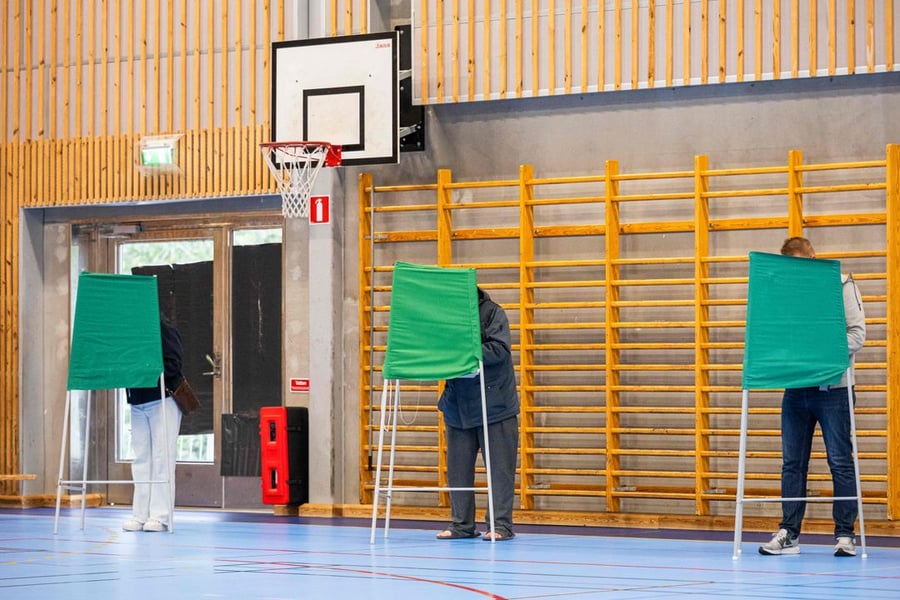

STOCKHOLM – Jimmie Åkesson spent much of the past four years telling Swedish voters that his party was ready to govern. The exit polls arriving Sunday evening gave the Sweden Democrats a different answer.
According to SVT exit polling released as polls closed on Sunday, the centre-left bloc led the right by 51.3 percent to 46.8 percent, and the Sweden Democrats, who had climbed to become Sweden’s second-largest party in 2022, fell to third place with 17.2 percent of the vote. The Social Democrats led at 28.4 percent, followed by Prime Minister Ulf Kristersson’s Moderate Party at 18.1 percent.
The result, if it holds through the official count expected across the coming days, would deny Åkesson the outcome his party has sought since its founding: a formal seat inside the cabinet room. Kristersson had promised, before election day, to bring the Sweden Democrats into a coalition government if the right bloc won a majority. Exit polls suggested that offer was not enough to produce one.
The Sweden Democrats’ retreat came sharpest on the issue that once propelled them. In 2022, immigration dominated the campaign, and the party climbed from 17.5 percent in 2018 to 20.5 percent, finishing second for the first time in its history, above the Moderates. Four years of supporting Kristersson’s minority government from outside the cabinet, close enough to governing to share accountability, far enough to deny responsibility, left the party without its cleanest argument.
What replaced immigration atop voters’ minds on Sunday was healthcare. TRT World reported that polling ahead of election day showed 64 percent of Swedes named healthcare as their primary concern, ahead of immigration and the cost of living. The Sweden Democrats, whose identity was built on migration policy, had less to offer on hospital waiting lists and eldercare staffing than the Social Democrats had spent decades promising.
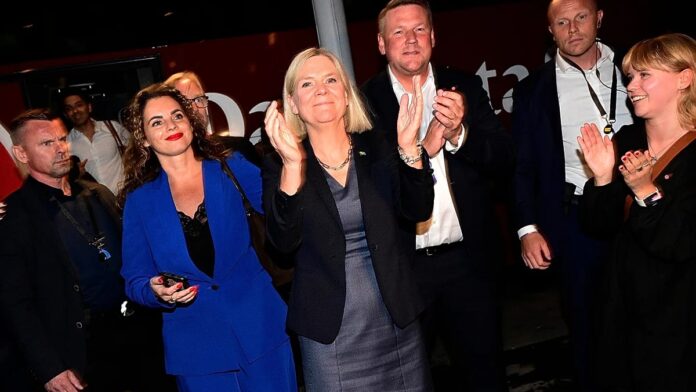
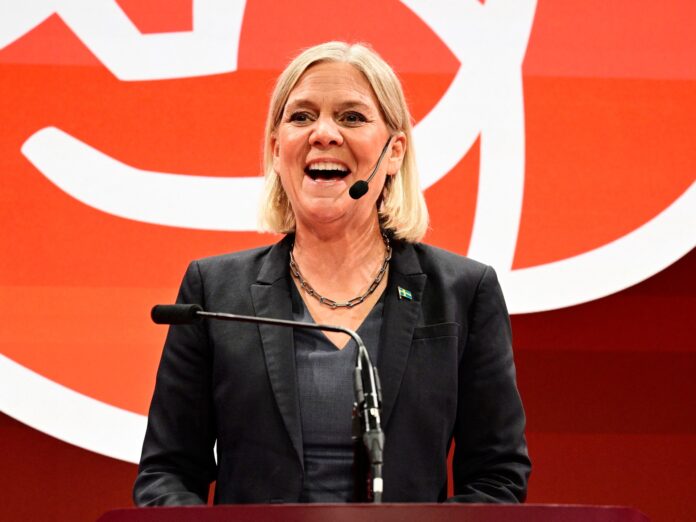
Magdalena Andersson, who returned as Social Democratic leader after stepping down as prime minister following the 2022 defeat, ran a campaign centred on welfare spending and the restoration of public services. Her party’s 28.4 percent exit poll figure places her as the dominant figure in any centre-left government, though the coalition arithmetic depends on a final count that may not arrive before the weekend.
A record 3.6 million Swedes cast early ballots, roughly 44.7 percent of the electorate, up 14 percent from 2022, an increase of approximately 446,000 voters. Swedish election officials attributed the surge to expanded early polling locations and longer voting windows. The volume of early and postal ballots means full certified results are unlikely before the weekend.
The centre-left bloc Andersson would lead is not internally uniform. The Social Democrats hold the plurality but require the Left Party, the Centre Party, and the Greens to form a working majority, a combination with limited ideological coherence beyond displacing the right. The Centre Party, which supported Kristersson’s bloc in 2022, returned to the centre-left fold in this cycle, a pivot that reflects how completely the expected Sweden Democrats ascent reshaped the calculations of every party between the two poles.
The Riksdag that emerges from Sunday’s vote will almost certainly look different from the one Kristersson managed with Sweden Democrat backing. If the centre-left holds its exit poll lead, Andersson faces the difficult task of coordinating four parties with competing domestic priorities: the Left Party’s push for public sector expansion, the Centre Party’s liberal economic preferences, and the Greens’ climate agenda. Sweden’s minority governments are not unusual by Nordic standards, but forming one stable enough for a full four-year term requires cross-party compromise on a scale the exit polls cannot yet measure.
The Sweden Democrats’ third-place showing is also the most visible test yet of whether Europe’s immigration-centred right can sustain momentum as domestic welfare concerns push back. The party that helped define the Scandinavian far-right wave, and whose trajectory influenced movements in Germany, Italy, and France, has run back-to-back elections in a continent where healthcare waitlists and cost-of-living pressures compete with border control as mobilising concerns. Åkesson’s party won seats; the coalition that was supposed to follow those seats did not materialise.
Sweden’s security posture also shifted between the two elections. Russia’s largest single-day drone assault on Ukraine struck within two kilometres of Poland’s border the day before Swedish voters went to the polls. Sweden’s NATO membership, formalised in March 2024, ended a 200-year neutrality and shaped the foreign and defence policy debate in this election without defining it. Every major party entered the campaign supporting the alliance; the argument was about defence spending levels and what the commitment costs.
Preliminary results are expected from around 9 p.m. local time Sunday. The official count, including overseas ballots and late postal returns, will continue through the week. Whether the Sweden Democrats interpret their third-place exit poll showing as a ceiling to be dismantled or a floor from which to rebuild is the question Åkesson now has a few days to prepare.