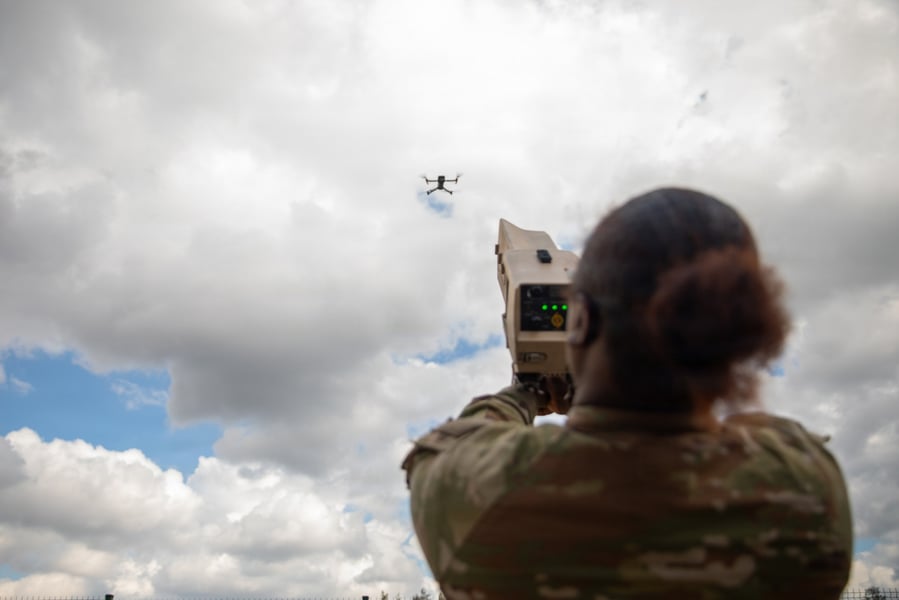

VILNIUS — A driver on the road from Birzai to Pasvalys in northern Lithuania heard an explosion on Sunday, and then debris from a drone struck the car and dented its door. Authorities confirmed that nobody was injured, and Prime Minister Mindaugas Sinkevicius described what the driver heard, according to Anadolu Agency.
That open question has since narrowed. TEH reported that NATO jets were tracking a suspected drone over Lithuania and that nobody could yet say what it was. Later in the day Vilmantas Vitkauskas, who heads the National Crisis Management Center, told LRT Radio that it was most likely a Ukrainian drone that may have strayed in during Kyiv’s strikes on Russia’s St Petersburg region.
Ukraine’s Foreign Ministry then apologised. Spokesman Heorhii Tykhyi said the incident may have resulted from Russian electronic warfare diverting a drone during an operation against “legitimate military targets in Russia,” and added: “We apologise for any disruption, risks, and concern this may have caused.” That explanation is Kyiv’s own, and TEH has found no independent confirmation of it.
The harder question for Vilnius is the warning. Defence Minister Robertas Kaunas called it “strange and unacceptable” that an air alert was issued only in northern Lithuania, Anadolu reported, and the military was told to deliver a detailed report. Poor weather kept the NATO pilots from visually identifying the object, Kaunas said. President Gitanas Nauseda wrote that the war was “spilling over onto the Eastern flank of NATO and EU,” even as Lithuania’s crisis centre chief and Kyiv’s own apology pointed to a Ukrainian drone.
The route is unsettled too. Kaunas said preliminary information indicated the object came in from Poland, and he asked his Polish counterpart to join the investigation. Vitkauskas pointed instead to Ukrainian strikes on the St Petersburg region, to the north-east. Xinhua reported that tracking began around 6:00 a.m. local time and that alerts followed shortly after 7:00 a.m., a gap that by TEH’s arithmetic runs to roughly an hour. The drone crashed, Xinhua said, “for unknown reasons.”
Sinkevicius has called the National Security Commission to meet on Monday and asked investigators to examine the possibility of sabotage and to establish the drone’s origin, flight path and how military radar detected it. Neither Anadolu nor Xinhua carried a response from Warsaw, and TEH has not found one in a source it can cite. The two accounts imply different entry points, and nobody has yet said which one the radar supports.