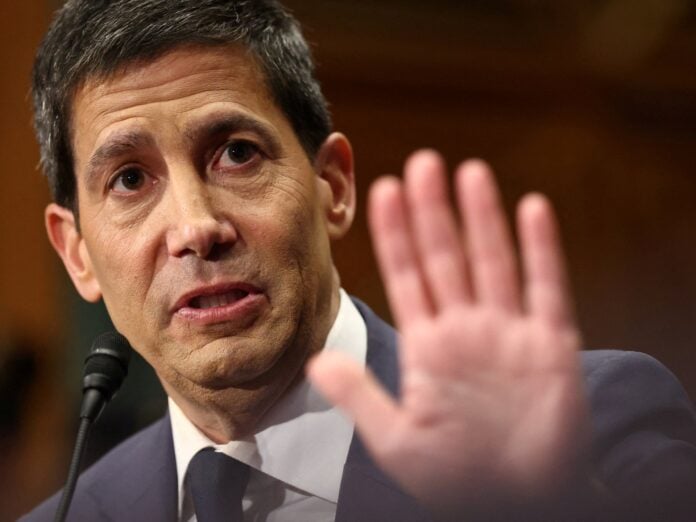

NEW YORK — Most of the money in American retirement accounts is invested according to a list that a committee decides. Not an algorithm, not a market-capitalisation cutoff applied automatically, but a group of people at S&P Dow Jones Indices who meet, apply written criteria, and exercise judgment about which 500 companies belong.
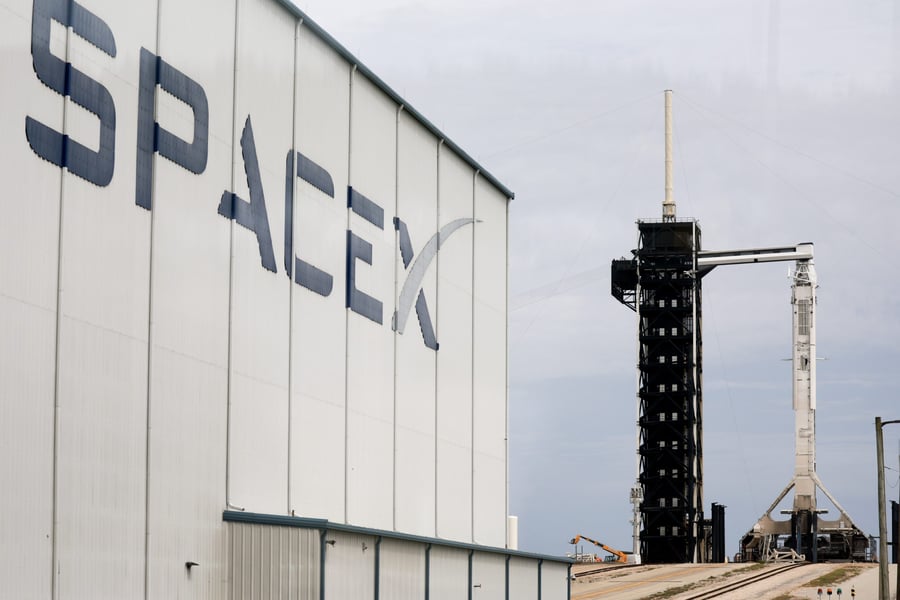
The clearest demonstration is sitting in plain view. SpaceX is one of the largest companies listed in the United States. It joined the Nasdaq 100 within a month of its debut. It is not in the S&P 500 and will not be for years, because the S&P 500 requires a company to have earned money, and SpaceX has not.
The index itself fell 0.28 per cent to 7,652.79 on Monday afternoon. Its own equal-weighted version, the same 500 companies with every member counting the same, rose 0.07. That divergence is small on the day and large over a quarter, and it is the second thing this column is about.
S&P 500 Index Today: The Average Member Is Closer to a Record
The S&P 500 is 2.1 per cent below its 52-week high. The equal-weighted version of the same index is 0.7 per cent below its own. Put plainly, the typical company in the index is nearer a record than the index that contains it, and the drag is coming from the largest members.
| Index | Level | Session | 1 month | 3 months | Below 52-week high |
|---|---|---|---|---|---|
| S&P 500 (cap-weighted) | 7,652.79 | -0.28% | +3.25% | +2.40% | -2.1% |
| S&P 500 Equal Weight | 8,976.10 | +0.07% | +3.75% | +7.41% | -0.7% |
| Dow Jones Industrial Average | 53,438.07 | +0.30% | +2.87% | +5.65% | -2.4% |
| Nasdaq Composite | 25,991.96 | -0.72% | +4.07% | -1.34% | -4.4% |
| Nasdaq 100 | 29,029.44 | -0.95% | +3.20% | -1.53% | -5.6% |
| Live intraday quotes, not settlements. The equal-weight figure is the published S&P 500 Equal Weight Index rather than a fund tracking it, so no management fee is embedded. Distance from the 52-week high is Eastern Herald’s calculation. | |||||
Over three months the gap is five percentage points: the equal-weighted index is up 7.41 per cent and the cap-weighted one up 2.40. A five-point spread over a quarter between two indexes holding identical companies is not a rounding difference. It is a statement that the largest members have been the problem.
A Committee, Not a Rulebook
Here is where the S&P 500 parts company with every other large American index. It is not purely mechanical. To be eligible a company must, among other conditions, have positive net income over the trailing year including the most recent quarter, and the index committee applies that test.
That requirement came under direct pressure this year, when a wave of very large loss-making companies came to market. According to Fortune’s account of the decision, S&P Dow Jones consulted market participants for a month on whether to relax the profitability rule for mega-listings and then declined to remove it. The other two index families moved the other way: the Nasdaq 100 cut its minimum waiting period to 15 trading days from three months, and FTSE Russell shortened its own wait to five.
| Index family | Profitability test | Minimum time listed | Selection |
|---|---|---|---|
| S&P 500 | Yes, positive net income over the trailing year and the latest quarter | Seasoning period applies | Index committee |
| Nasdaq 100 | No | 15 trading days, cut from three months | Rules-based |
| FTSE Russell | No | 5 trading days | Rules-based |
| Summarised from provider criteria as reported in 2026. Each family’s full methodology contains further conditions on liquidity, free float and domicile that are not captured here. | |||

What the Rule Costs and What It Buys
The profitability test is defensible and it is also expensive, and honest coverage has to say both.
What it buys is a quality filter. An index that holds only companies that have earned money is a different asset from one that holds whatever the market has recently decided is large. It kept the S&P 500 out of a good deal of trouble in earlier cycles, and it is the reason the index is treated as a proxy for corporate America rather than for market enthusiasm.
What it costs is growth. Evercore ISI does not expect SpaceX to post an annual profit before 2027, which on the committee’s timetable could delay entry into 2028. If the company compounds in the meantime, S&P 500 investors will buy it late and expensively, which is the recurring criticism of index inclusion. Every passive fund tracking the index will be obliged to buy at whatever price the shares command on the day they are added, and none of that gain will have accrued to them.
So the committee is not choosing between a right answer and a wrong one. It is choosing which mistake to make, and it has decided to keep making the old one.
Monday Underneath the Index
The quarter-point decline hid a rotation rather than a retreat. Our S&P 500 session column found six of eleven sectors higher in a falling market, and the equal-weight reading above says the same thing from a different angle. The damage was concentrated in the largest technology names: the Nasdaq 100 fell nearly a per cent while the Dow rose, and Tesla, Musk’s other listed company, was among the heavier fallers.
For the derivatives read on the same index, our S&P 500 futures column shows the September contract pricing an implied financing rate close to 4.7 per cent, roughly a point above Treasury bills.
What This Column Cannot Tell You Yet
We do not know what the committee actually discussed. S&P Dow Jones publishes its criteria and announces its decisions, but the deliberations that produce a specific addition or deletion are not public, and the discretion the committee holds is real rather than nominal. Anyone claiming to predict the next inclusion is reading tea leaves with a methodology document open beside them.
We also cannot say whether the equal-weight gap is the beginning of something or the end of it. Five points over a quarter is the sort of divergence that either compounds into a genuine rotation or closes in three violent sessions, and the honest position is that it has happened, that it is measurable, and that nothing in Monday’s tape settles which way it resolves.